Cthulhu Mythos
The Cats of Ulthar — Cthulhu Mythos
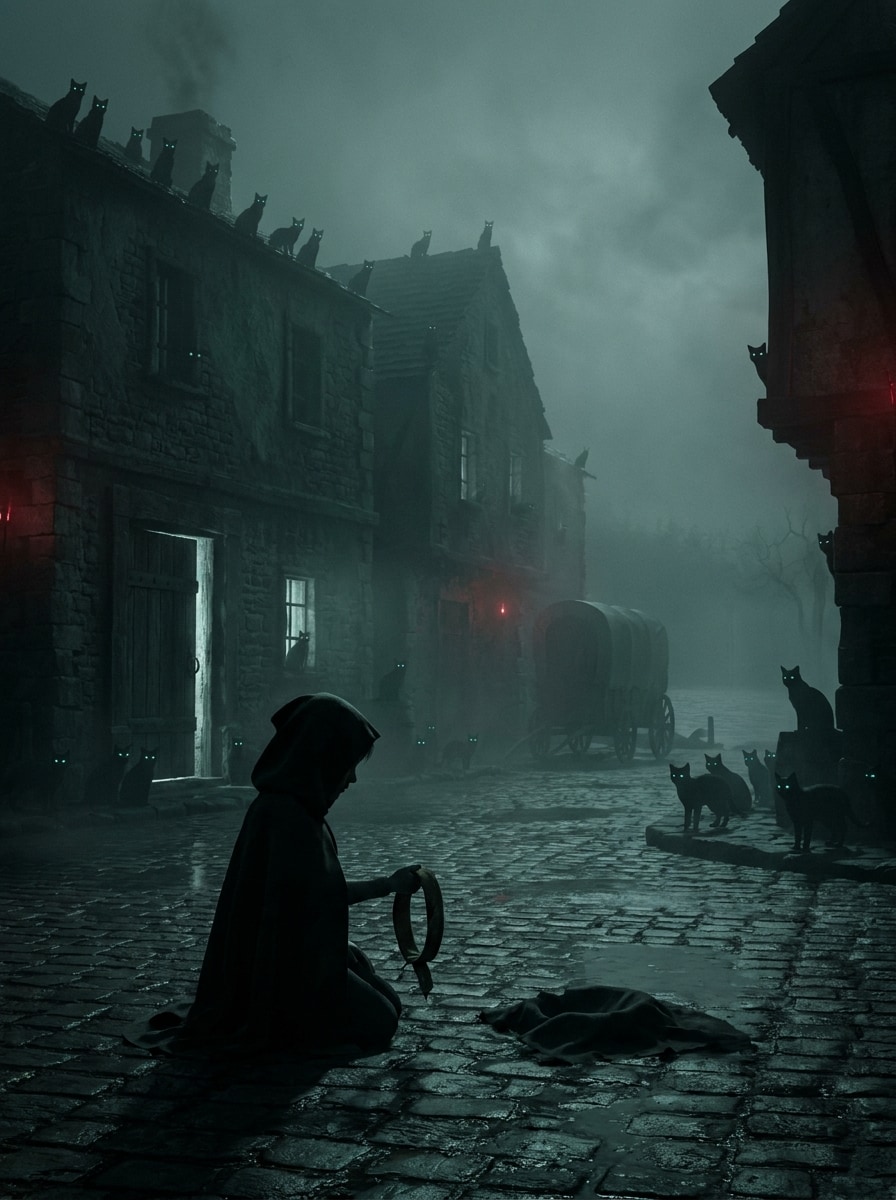
Beyond the River Skai in Ulthar, there once lived an old couple who made a habit of killing the town’s cats. Then an orphan traveling with a caravan lost his little black cat, and after he prayed beneath the night sky, every cat in Ulthar vanished for one night. By morning, the town had a law: no cat must ever be killed there.
Article
Summary
Beyond the River Skai, in the town of Ulthar, an old house stood at the edge of the streets. There lived there a couple who trapped and killed the town’s cats, while the townspeople, though angry and fearful, dared do nothing. One day a caravan came to Ulthar. Among its people was a little orphan boy who had only a small black cat for companionship. When the cat disappeared, the townspeople hinted that it had likely fallen into the hands of the old couple. Then the child lifted his grief to the night sky and made his silent appeal. That night every cat in Ulthar left its home and gathered near the old house at the town’s edge, and the streets remained strangely empty of them until dawn. By morning the cats had returned, calm and satisfied, while the old couple were gone, leaving only bones behind in the house. After that, Ulthar’s elders proclaimed a law: within Ulthar, no cat must ever be slain.
The House at the Town’s Edge
Beyond the River Skai there is an ancient little town called Ulthar. Its roofs are steep, its lanes are narrow, and cats are always moving beneath the eaves. Some lie on the doorsteps in the sun; some pad along the tops of walls; some sit before the hearth with half-closed eyes.
Today everyone in Ulthar knows one rule: no one may kill a cat. But that rule was not always there.
Long ago, at the edge of town, there stood a ruined little house. It was set near a dark wood, with tiny windows and weeds growing thick before the door. An old man and woman lived there: he was silent and cruel, and she was no friendlier. Children who passed the place quickened their steps, and when adults spoke of the house, they lowered their voices.
These two hated cats above all things. If one strayed into their yard, or leaped onto their roof by night, it often was never seen again. Some had heard screams; some had glimpsed shapes moving behind the window slits; but no one dared ask questions.
The people of Ulthar loved their cats, yet feared the old pair. They kept their doors and windows shut and brought their cats indoors at night, warning their children never to let a cat near that house on the outskirts. But cats are cats—light-footed, curious, and fond of wandering alone in the moonlight. So cats still vanished from time to time.
The Caravan from Far Away
One day a strange caravan came to Ulthar. The people had come from the south, or from even farther off, driving painted wagons whose wheels bore bells and whose tents were patterned with odd designs. Their earrings, bracelets, and belts flashed in the sun, and their speech sounded unlike that of the townsfolk.
The caravan camped in a meadow outside the town, lit fires, set up pots, and sang and drummed through the night. Ulthar’s children watched from a distance, half in fear and half in wonder.
Among them was a very small boy. Dust from the road still clung to his face, but his eyes were bright and black. People said his parents were dead and that only a little black cat remained with him. Its fur was as black as night, with a faint white patch beneath its throat. Wherever the boy went, the cat went too; when he ate beside a wagon wheel, it curled in his lap; when he slept beneath a blanket, it pressed against his chest and purred softly.
On the caravan’s first day, all was peaceful. But on the second evening the boy began searching everywhere. He lifted blankets, crawled beneath wagons, ran to and fro beside the fire, calling again and again, yet the little black cat did not return.
The townspeople saw him and understood at once what must have happened. One of them pointed toward the old house at the edge of town, then quickly dropped his hand. Another said in a low voice to those of the caravan, “There is an old couple there. If a cat goes to them, it seldom comes back.”
The boy understood enough of what they meant. He stood in the grass and stared toward the low, shadowed house. No light shone there; the windows looked like shut eyes. Wind came down from the woods and made the grass tremble.
The Child’s Prayer
The boy did not rush there, and he did not throw stones at the door. He merely lifted his face slowly to the darkening sky.
That night clouds drifted across the moon. The caravan fires burned low, and one by one the windows of Ulthar went black. In the middle of the meadow the little boy stood with his thin arms outstretched and spoke an ancient prayer taught by his people. His voice was not loud, but it was clear, as though he were addressing something far away and unseen.
The people of Ulthar could not understand the words. They only knew that it did not sound like the ordinary weeping of a child. It rose and fell strangely, full of sorrow and of a solemnity that seemed to forbid interruption. The caravan folk gathered behind him without a smile. Meanwhile, the town’s cats began to stir, as if they had heard some call. From doorways, from rooftops, from behind corners, heads appeared one by one.
Then the strange thing began.
The cats of Ulthar left their homes, one after another. A gray cat sprang down from the hearth; a brindled one slipped through a hedge; an old cat dropped from a windowsill into the street; kittens followed their mothers in silence through the cobbled lanes. They made no cry and no fuss. All moved in the same direction.
That night the streets of Ulthar were almost without cats. Some townsfolk heard tiles shifting; some saw, in the moonlight, small shadows crossing wall after wall toward the house at the town’s edge. But no one dared go outside. They locked their doors, held their children close, and listened to the faint sounds drifting from far away.
The Cats Return
Before dawn the caravan left Ulthar. Its wheels rolled over the grass, and its bells gave a soft jingle. The little boy sat among them with empty arms. He did not look back, and he did not speak again.
When the sun rose, the cats of Ulthar came home.
They walked slowly back through the lanes, calm and composed. Some leaped to their familiar windowsills; some returned to their masters’ doorways; some sat in the sun and washed their paws. The townspeople called their cats by name in delight, but soon noticed that the animals seemed in no hurry for food. Cats who usually begged for milk or fish bones merely sprawled sleepily that morning, licking their mouths and whiskers.
Before long, someone finally found the courage to go to the old house at the edge of town. A few others followed, carrying sticks, though none wished to go close.
They pushed open the door and found the house dead still. The old couple were gone, and on the floor lay only two clean white skeletons. There was no sign of a struggle, no blood, only a cold and dreadful silence. In the dust by the window, there seemed to be the marks of many tiny paws.
When the news reached town, everyone fell silent. Some were afraid; some whispered prayers; and some, looking at their own cats, suddenly felt that these small creatures by the hearth were not merely pets that purred and caught mice.
Ulthar’s New Law
The elders of Ulthar gathered to decide what must be done. They spoke of the cats that had vanished, of the orphaned boy, of the cats that had gone out into the night, and of the white bones left in the house at the town’s edge.
At last they made a law and fixed it in everyone’s memory: in Ulthar, no one may kill a cat.
From then on, the cats of Ulthar roamed the streets freely. They slept on steps, perched on rooftops, and when they passed through the narrow lanes, people gave them room. Children learned to stroke them gently, never pulling their tails or startling them.
Travelers from elsewhere still hear that rule when they come to Ulthar. Some find it amusing; others think it excessive. But the people of Ulthar do not argue. They only glance at the cat purring by the fire, then toward the place where the old house once stood, and lower their voices.
For they know that this law was not made to ornament an ancient town. It came from a child’s sorrow, from the silent procession of cats in that one night, and from the white bones left behind in an old house.