Cthulhu Mythos
The Doom That Came to Sarnath — Cthulhu Mythos
On the shore of the still waters of Mnar, the men of Sarnath destroyed the ancient city of Ib, stole its idol, and raised a city of extraordinary wealth in its place. But on the night of the great feast, a thousand years after that victory, the old wrong came back from the lake, and Sarnath was lost forever.
Article
Summary
Long before Sarnath rose beside the still lake of Mnar, the gray city of Ib stood there, home to a strange, ancient people who worshiped the water-lizard god Bokrug. The men of Sarnath despised them as alien and uncanny, and in time they marched against Ib, destroyed it, and carried off its green stone idol as a trophy. Sarnath then grew rich and powerful beyond most cities in the world. Its wealth, built on conquest, made it seem untouchable, and the ruin of Ib faded into legend—save for the missing idol and the old stories whispered beside the lake. A thousand years later, Sarnath held a grand feast to celebrate its ancient triumph. In the midst of that revelry, the forgotten vengeance of the lake drew near. By dawn, Sarnath was gone, and the city that had gloried in its victory was remembered only through the doom that destroyed it.
The Old City by the Still Lake
In the land of Mnar there lies a great lake. Its waters are so still that they seem like black stone polished smooth. No river flows into it, and no river flows out. By day it mirrors the sky and the reeds along its shore; by night, moonlight falls upon it, yet beneath the surface there seems to be a deeper darkness still.
Long, long ago, before Sarnath existed, there stood beside that lake a gray stone city called Ib.
Its walls were low and ancient, and damp moss clung to the blocks. Its people were unlike the men who came later. Their skin was greenish, their eyes bulged, their lips were thick and loose, and both their ears and their voices were strange. Other peoples said they had not come from the blood of mankind at all, but had descended from the sky when the moon was still young.
The people of Ib did not wander far, nor did they make war on neighboring cities. They lived by the lakeshore, kept their gray stone houses and old temple, and offered sacrifice to Bokrug, the water-lizard god. His image was carved in green stone, lizard-shaped, crowned, and cold-eyed as it gazed ahead. The people of Ib believed he dwelt deep beneath the lake and heard their prayers from its depths.
At night, a low drumming rose from the city. The priests would go down to the water, hold up torches, and cast spices, grain, and small beasts into the lake. Firelight shone on their protruding eyes and on the green idol. The water widened in ripples and soon became still again, as though it had taken nothing—or everything.
The Axes of Sarnath
Many years later, another people came to Mnar.
They were tall, skilled in metalwork, and strong in the building of walls. Not far from the lake they raised a new city and named it Sarnath. At first it was only a young settlement, with low gates and narrow streets. Yet its people were proud. When they saw the odd faces of the people of Ib and heard the drums that sounded by night along the shore, fear soon turned to disgust and ridicule.
“Such creatures should not live beside us,” said the warriors of Sarnath.
They heard, too, that Ib possessed a green stone idol of great age and value, and they saw that its people were poor warriors and its walls worn down by time. Greed and arrogance grew together in them.
One day the army of Sarnath marched out. Bronze spears, axes, and curved blades flashed in the sun; shields struck against shields; and the sound of marching shook the mud beside the lake. The people of Ib heard the uproar and came from their gray houses. The priests hastened toward the temple, seeking Bokrug’s protection.
But the men of Sarnath were already at the gates.
That day the streets of Ib rang with cries. The people of Ib had no great bows, no armor, no trained battle lines. They were driven to the lakeshore, slain before the altar, and dragged from their homes. Gray walls were broken down, the temple doors smashed open, torches were flung into the thatch, and thick smoke rolled away on the lake wind.
Sarnath left nothing of Ib behind.
Its walls were torn down, its houses toppled, its altars ruined, and its dead cast into the still water. The lake swallowed those greenish shapes without a sound. By dusk, Ib was only a scatter of shattered foundations and blackened posts.
At last the warriors carried off the green idol. It was oddly heavy, and many men were needed with ropes and beams to drag it back to Sarnath. As they went, its eyes seemed to face the lake, as though watching something that had not yet ended.
The Word on the Altar
The people of Sarnath rejoiced in their victory.
They placed the idol of Ib in their own temple, meaning to keep it as spoil and as proof of the city they had conquered. The high priest of Sarnath, Thalarion, was charged with its care. He was an old man who had seen many rites and heard many tales of the lake and of Ib. When others mocked such stories, he said little; only often did he stand in silence before the green god.
On the second day after the idol was brought into the temple, a strange thing occurred.
At dawn the attendants opened the temple doors and found the sanctuary cold. The ashes in the braziers remained, but no warmth was left in them. The green idol was gone.
In terror they searched the temple and found Thalarion beside the altar. The old man was dead, his fingers stiff upon the olive altar stone. His face was twisted, his eyes were wide open, as though in his final moment he had beheld something no man should ever see.
Upon the surface of the altar, he had traced a single word with desperate force:
“Doom.”
That word spread quickly through Sarnath. Some feared that the god of Ib had come; others said Thalarion, old and crazed, had seen the idol stolen by thieves and died of fright beside the altar. The younger warriors were least willing to admit that they had stirred up any vengeance at all. They spilled wine upon the ground and laughed. “Ib has no people left,” they said. “The dead do not return.”
They sent men to search the lakeshore, but the green idol was nowhere to be found. The still lake remained untroubled, and the ruins of old Ib still lay among grass and broken stone. In time the people of Sarnath spoke of the matter no more. Only the word carved by Thalarion remained deep within the temple, like a wound that would not heal.
A Thousand Years of Splendor
The years passed, and Sarnath grew ever mightier.
Its walls rose high enough to turn back distant armies, its gates were sheathed in bronze, and its towers flew with banners. The streets were paved with smooth stone. Merchants led camels and mules into the city, bringing spices, jewels, ivory, silk, and strange wines from foreign lands. In the palace there were golden columns and carved beams, and by the pools grew rare flowers. At night its lamps shone like another sky.
The king of Sarnath sat on an ivory throne while envoys from every land praised his city. Nobles wore dyed robes and rings upon their fingers; soldiers marched across the square, their spearheads flashing in order. Poets sang of Sarnath’s splendor, craftsmen carved its triumphs, and children were raised on stories of how their ancestors had destroyed the ugly city of Ib beside the lake.
Each year Sarnath held a great festival to honor that conquest.
On that day the gates stood open wide. Musicians played flutes and bronze horns, butchers slaughtered cattle and roasted sheep, and vats of wine were piled high like little hills. People danced in the streets and scattered petals over one another’s heads. At night the king and his nobles feasted in the palace and drank to the lasting glory of Sarnath.
They also told stories of the strange people of Ib, of the missing green idol, and of the word Thalarion had cut into the altar before he died. But by then these tales had become little more than banquet jokes. The younger the listener, the more he thought them only an old superstition left behind by his elders.
Yet the ruins by the lake remained.
Sometimes a shepherd driving sheep past the shore would glimpse pale stones rising through the grass. Sometimes a fisherman approaching the water at night would hear something like a drum in the distance, or only the wind moving through the reeds. Those who returned to the city spoke of it in low voices, and others told them to drink less and stare less at the lake after dark.
Sarnath was too rich, and had been too long unpunished. It had almost forgotten that its glory rested upon the ruins of a city it had destroyed.
The Feast of the Thousandth Year
When the thousandth anniversary of Ib’s destruction arrived, Sarnath prepared a feast such as it had never seen before.
Princes, merchants, priests, and envoys came from far-off cities. They entered Sarnath bearing gifts: perfumes in silver boxes, rare feathers, jewel-studded cups, and white elephants led by fine cords. Banners hung everywhere, flowers were heaped at the corners of the streets, and young trumpeters stood beside the fountains.
At evening, mist began to rise from the lake.
At first no one paid it much heed. The still lake was often shrouded in white vapor that clung to the water and slowly crept ashore. But this mist was different. It was thick and low, like cold smoke drawn up from the depths, and it carried the damp stink of something fishy and foul. The watchmen on the walls saw shapes moving within it, yet when they looked again there was only whiteness.
Inside the palace, the feast had already begun.
Golden platters held roast meat and sweet fruit. Musicians plucked their strings, and dancers moved barefoot across floors strewn with petals. The king raised his cup and boasted of Sarnath’s thousand years of victory. The guests raised theirs in turn, and the wine caught the lamplight like small rubies.
Then a dull sound rose outside the city.
It was not thunder, nor the beat of war-drums, but rather like something vast turning over in the deep waters of the lake. The music in the hall faltered for a moment, then was forced onward again. Some laughed and said it was only an echo from the hills; others lowered their heads over their cups and would not look toward the doors.
Then the mist poured through the gates.
It rushed along the streets, up the steps, and against the walls as though it had a will of its own. Lamps dimmed in the haze, horses screamed, and dogs slunk beneath the houses with their tails between their legs. The night watch rang the alarm bells, but after a few strokes the sound seemed smothered, as though wrapped in wet cloth.
Cries rose outside the palace.
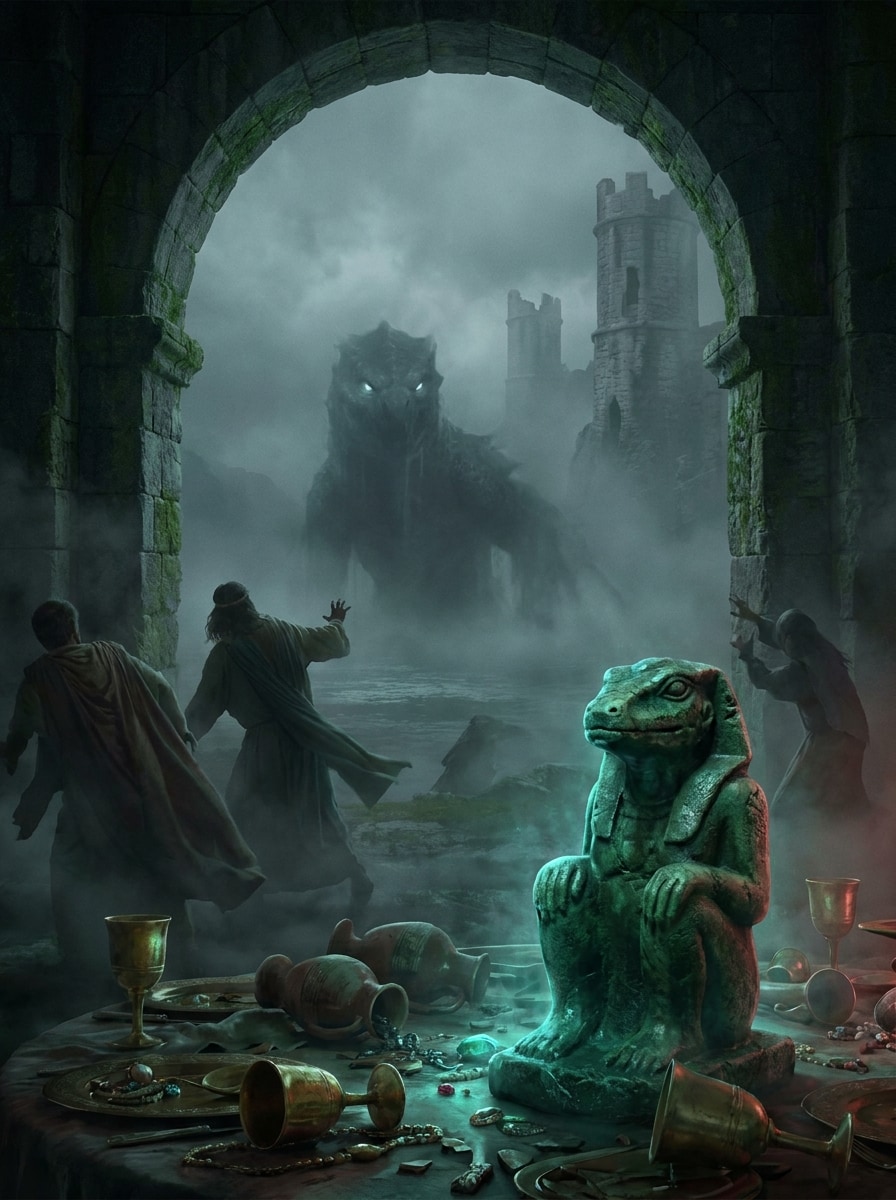
First one or two, then many feet running in terror. The nobles at the feast stood up, and cups crashed to the floor while red wine ran across the white stone. The king ordered the guards out to see what had happened. They drew their swords and plunged into the mist, and soon their voices were gone as well.
Some said they saw the people of Ib in the fog.
Not living men, but forms rising out of tide and darkness. Their eyes were bulging, their skin greenish, and water dripped from them as they moved with slow, unstoppable steps. Others said they beheld a green stone idol standing in the mist, crowned and cold-eyed, staring toward the palace of Sarnath.
Yet no man of Sarnath afterward could tell with certainty what truly occurred that night.
The outlanders who had come to the feast hid on high places and watched one palace window after another flare with light and then go dark. From the mist came screaming, pleas, the battering of doors, and the crash of stone breaking apart. Some saw the lake itself seem to rise over its banks and pour into the streets; others heard a deep drumming from beneath the ground, like the old rites of Ib or the pounding of a giant heart.
When dawn drew near, all sound ceased.
Sarnath Was Gone
The next morning the sun rose, and the mist slowly thinned.
The survivors from outside the city went down the slope to return to Sarnath. They had expected to find fallen walls, burned roofs, or streets strewn with bodies. But when they reached the lake, they stopped in their tracks.
Sarnath was gone.
The walls, the palace, the towers, the streets, the market, the temples, the gardens—everything had vanished. Where the city had once swarmed with voices and wheels, there remained only the damp shore and a wide field of mud. Here and there, broken stones protruded from it, yet no one could tell which building they had once belonged to. The lake lapped quietly at the bank as though nothing had happened in the night.
At the place where Sarnath’s center had stood, they found one thing.
It was a green idol shaped like a water-lizard, crowned, with cold eyes fixed upon the lake. It stood wet in the mud, as though newly returned from the depths, or as though it had never once left its temple.
No one dared approach it.
They fled from the lakeshore and carried the tale to their own cities. From that day forward there was no king of Sarnath upon an ivory throne, no line of soldiers marching across its squares. The trade roads shifted elsewhere, the songs fell silent, and the thousand years of wealth became only a name.
Later, the people of Mnar said that Ib’s old vengeance had waited in the lake for a thousand years. The men of Sarnath had believed that walls, gold, and feasting could bury the past, but the still water remembered, the ruins remembered, and the missing idol remembered too.
So, on the night of the thousandth anniversary, doom came at last to Sarnath.