Greek Mythology
The Trojan War — Greek Mythology
The Trojan War broke out in Greek mythology after Paris, Prince of Troy, abducted Helen, Queen of Sparta, which drove the Achaeans to march forth and lay siege to the city of Troy. A pivotal event in Greek mythology, it is recorded in the Homeric Epics.
Article
Summary
The Trojan War is one of the most famous and tragic war narratives in Greek mythology. It was fought between Troy, a powerful city in northwestern Asia Minor, and an Achaean coalition drawn from across the Greek world. In mythic tradition, its immediate cause was the departure—or abduction—of Helen, queen of Sparta, with the Trojan prince Paris. Yet beneath that story lies a deeper web of divine rivalry, heroic oaths, royal honor, fate, and human desire. For the ancient Greeks, the war was one of the defining events of the Heroic Age. Homer’s *Iliad* does not recount the entire conflict, but focuses on the wrath of Achilles in the tenth year of the siege and the consequences that follow. The *Odyssey* tells of Odysseus’s long wandering home after the war. Other episodes—the golden apple, the Judgment of Paris, Helen’s departure from Sparta, the sacrifice at Aulis, the death of Achilles, the wooden horse, the fall of Troy, and the troubled homecomings of the Greek heroes—were preserved by other epic traditions, tragedies, fragments, and later literature.
Background and Origins
The deepest cause of the war can be traced to the wedding of Peleus, the Thessalian hero, and Thetis, the sea-goddess. All the gods were invited to the feast except Eris, goddess of discord. Angry at being excluded, Eris cast into the banquet hall a golden apple inscribed “For the fairest.” Hera, Athena, and Aphrodite each claimed it, and Zeus, unwilling to judge among them, appointed Paris, prince of Troy, as arbiter.
Paris was the son of Priam, king of Troy, and Queen Hecuba. Before his birth, Hecuba was said to have dreamed that Troy was consumed by fire. Seers interpreted the dream to mean that the child would one day bring ruin upon the city. Paris was therefore abandoned on Mount Ida, but survived and was raised by shepherds. Later, after revealing himself in Trojan contests, he was accepted back into the royal house.
The three goddesses appeared before Paris and offered him gifts. Hera promised sovereignty, Athena promised wisdom and victory in war, and Aphrodite promised him the most beautiful woman in the world. Paris gave the apple to Aphrodite, gaining the favor of the goddess of love and the hatred of Hera and Athena toward Troy.
The woman promised by Aphrodite was Helen, queen of Sparta. Her beauty had once drawn many suitors, and her father Tyndareus, fearing conflict among them, had made them swear to defend whichever marriage Helen chose. Helen chose Menelaus, son of Atreus, who later became king of Sparta.
Paris came to Sparta under Aphrodite’s guidance. Menelaus received him as a guest, but soon left for Crete. In his absence, Paris took Helen and treasure back to Troy. Traditions differ: some say Helen was abducted, others that she went willingly. To the Greeks, however, the act violated both marriage and the sacred bond between host and guest.
Menelaus appealed to his brother Agamemnon, king of Mycenae. The old oath of Helen’s suitors was invoked, and Greek kings and heroes answered the call. What began as a private affront became a pan-Hellenic expedition across the Aegean.
The Gathering of the Greek Coalition
The Greek coalition was led by Agamemnon, king of Mycenae. Among its chiefs were Menelaus of Sparta, Nestor of Pylos, Diomedes of Argos, Ajax the Greater, Ajax the Lesser, Idomeneus of Crete, Odysseus of Ithaca, and eventually Achilles. Later tradition imagined their fleet as numbering more than a thousand ships, giving the campaign its grand, almost legendary scale.
Not every hero wished to go. Odysseus, newly married and father to the infant Telemachus, tried to feign madness by ploughing his fields with mismatched animals and sowing salt. Palamedes exposed him by placing the child before the plough; Odysseus stopped at once and had to join the expedition.
Achilles was even more crucial. Prophecy declared that Troy could not fall without him, but his mother Thetis knew that if he went, he would win immortal fame and die young. She hid him among the daughters of King Lycomedes on Scyros. Odysseus and Diomedes exposed him by laying out jewels and weapons; when alarm sounded, Achilles alone seized a weapon. He joined the war, bringing Patroclus with him.
The fleet gathered at Aulis. An omen—a snake devouring a mother bird and eight chicks before turning to stone—was interpreted by Calchas to mean nine years of struggle and victory in the tenth. Yet contrary winds held the fleet back. Calchas declared that Artemis demanded the sacrifice of Iphigenia, daughter of Agamemnon. In some versions she was sacrificed; in others Artemis replaced her with a deer and carried her away. Either way, the expedition began under the shadow of blood and family doom.
The Landing at Troy
The fleet finally reached the coast of Troy. A prophecy warned that the first Greek to set foot on Trojan soil would be the first to die. Odysseus cleverly leapt onto his shield rather than the ground; Protesilaus, eager for glory, landed after him and was killed by Hector. The war began with the fulfillment of an omen.
The Greeks drew their ships ashore and built a fortified camp. Achilles and Ajax guarded the flanks, while Agamemnon and Odysseus occupied the center. Attempts at negotiation failed: the Greeks demanded Helen and the treasure back, but Paris refused, and Troy chose resistance.
The war did not become a simple total siege. Troy’s walls were too strong, and neither side could force a quick decision. The Greeks raided neighboring towns and Trojan allies for supplies and pressure. Achilles distinguished himself in these campaigns, capturing towns and taking Briseis and Chryseis as prizes.
For nine long years, heroes died on both sides and hatred hardened into fate. Troy’s defence rested above all on Hector, Priam’s noblest son and the city’s true guardian. Paris had lit the war, but Hector bore its burden: he fought for father, mother, wife, child, and homeland.
The Wrath of Achilles
The Iliad begins in the tenth year, with a plague in the Greek camp. Chryses, priest of Apollo, had come to ransom his daughter Chryseis, but Agamemnon insulted him and refused. Apollo answered the priest’s prayer by sending disease among the Greeks.
Calchas revealed that Chryseis had to be returned. Agamemnon yielded, but seized Briseis from Achilles as compensation. To Achilles, this was not merely the loss of a captive; it was a public assault on his honor. He nearly killed Agamemnon, but Athena restrained him. Instead, he withdrew from battle.
Achilles asked Thetis to persuade Zeus to let the Greeks suffer until they understood his worth. Zeus agreed, and the tide turned toward Troy. Menelaus and Paris fought a duel that might have ended the war, but Aphrodite rescued Paris. The truce collapsed, and battle resumed.
Diomedes shone in battle, even wounding Aphrodite and Ares with Athena’s aid. Hector returned briefly to Troy and met Andromache and their young son Astyanax, one of the most human scenes in the epic. He knew Troy might fall, yet chose duty over safety. Later he challenged the Greeks, and Ajax met him in single combat; night ended the duel, and the two heroes exchanged gifts in mutual respect.
The Trojans Reach the Greek Ships
With Achilles absent, Hector pressed the Trojan advantage. Zeus weighed the fates and favored Troy. Greek heroes were wounded, morale collapsed, and the Trojans broke through the Greek defences toward the ships.
Agamemnon sent Odysseus, Phoenix, and Ajax to offer Achilles gifts and the return of Briseis. Achilles refused. The insult had gone too deep; without honor, glory itself seemed empty.
As the Trojans threatened to burn the ships, Patroclus begged Achilles to let him wear his armor and lead the Myrmidons. Achilles agreed, warning him only to save the ships and not pursue Troy. Patroclus drove the Trojans back and killed Sarpedon, but in the heat of victory he pressed too far. Apollo struck him, Euphorbus wounded him, and Hector delivered the fatal blow. With Patroclus’s death, Achilles’ anger became grief and vengeance.
The Death of Hector
Patroclus’s death transformed Achilles. He reconciled with Agamemnon and returned to battle in new armor forged by Hephaestus, including the famous shield that showed the whole world of human life—cities, fields, weddings, war, stars, and seasons.
Once back in battle, Achilles seemed almost more than human. He slaughtered Trojans in a fury so terrible that even the river Scamander rose against him. At last the Trojans fled inside the walls, and Hector alone remained outside. Priam and Hecuba begged him to enter, but shame and duty held him there.
When Achilles approached, Hector fled around the city three times. Athena deceived him into standing his ground. Hector asked that the victor return the loser’s body, but Achilles refused. He struck Hector through a gap in the armor and killed him.
Achilles dragged Hector’s body behind his chariot. Troy watched in horror. Yet the story closes not with hatred, but with mourning: Priam came by night to Achilles’ tent, kissed the hands that had killed his son, and begged for Hector’s body. Achilles remembered his own father and relented. The Iliad ends with Hector’s funeral, not Troy’s fall.
The Death of Achilles and the Later War
After the Iliad, the war continued. Penthesilea, queen of the Amazons, came to aid Troy and was killed by Achilles. Memnon of Ethiopia also came, killed Nestor’s son Antilochus, and was in turn slain by Achilles.
Achilles himself soon met his fate. In later tradition, Paris, aided by Apollo, shot the arrow that struck Achilles in his vulnerable heel. The greatest Greek warrior died before Troy.
His divine armor became the object of dispute between Ajax and Odysseus. It was awarded to Odysseus, and Ajax, humiliated and driven mad, took his own life. The Greeks were nearing victory, yet losing their greatest heroes.
Prophecy demanded further conditions: Philoctetes, with the bow of Heracles, had to return; Neoptolemus, son of Achilles, had to come; the Palladium had to be stolen; and Trojan secrets had to be learned. These conditions were fulfilled. Philoctetes killed Paris, but Troy still stood.
The Wooden Horse and the Fall of Troy
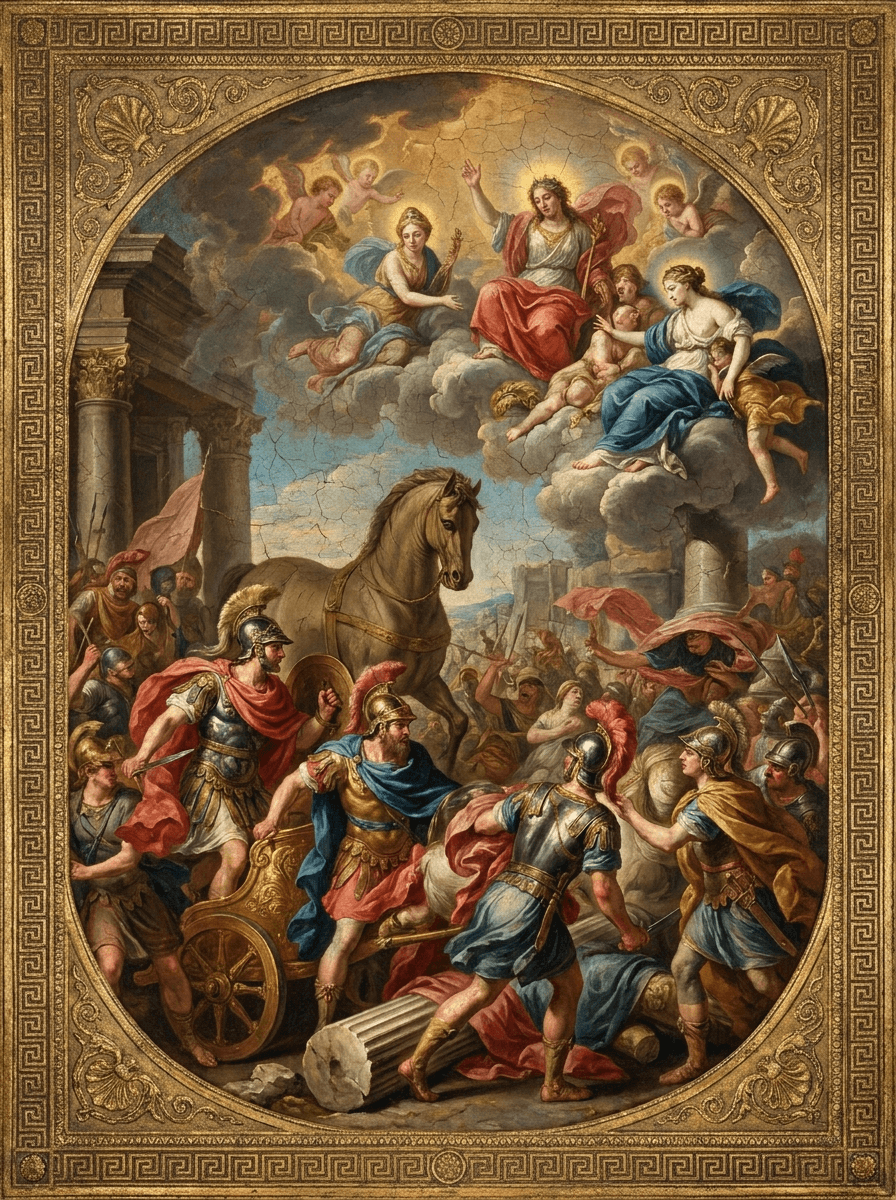
At last Odysseus devised the stratagem of the wooden horse. A huge horse was built, and chosen warriors hid inside. The rest of the Greek army pretended to sail away, but waited nearby.
The Trojans found the horse on the shore. Some wanted to burn it; others wished to bring it into the city. Laocoön warned them not to trust Greek gifts and struck the horse with a spear. But Sinon, a Greek left behind, lied that the horse was an offering to Athena and would bless Troy if brought within the walls. When sea serpents killed Laocoön and his sons, the Trojans took it as a divine sign.
Cassandra foresaw disaster, but no one believed her. The horse was dragged into the city. That night, as Troy slept in celebration, the hidden Greeks emerged, opened the gates, and let the army in. Fire, sword, and screaming filled the city.
Priam was killed at the altar; Astyanax was thrown from the walls; Cassandra was violated at Athena’s shrine; Andromache, Hecuba, and the royal women became captives. Troy, unconquered for ten years, fell not by open force but by deception disguised as victory.
Aftermath
Troy fell, but victory brought no peace. The Greeks had committed sacrilege in the sack, and the gods punished them on their homeward journeys.
Agamemnon returned to Mycenae with Cassandra and was murdered by Clytemnestra and Aegisthus. Her rage had roots in the sacrifice of Iphigenia and in Agamemnon’s return with a captive woman. His death led to Orestes’ revenge and the tragic cycle of the house of Atreus.
Ajax the Lesser died at sea. Menelaus and Helen wandered for years before reaching Sparta. Odysseus suffered the longest return: ten years of wandering through monsters, enchantresses, shipwreck, temptation, and loss before reaching Ithaca, where he killed the suitors and restored his household.
Aeneas carried his father Anchises from burning Troy and led the survivors westward. In Roman tradition, especially Virgil’s Aeneid, his journey became the seed of Rome’s origin myth.
Thus the Trojan War was not simply a Greek victory and Trojan defeat. It marked the end of the Heroic Age. Winners and losers alike were broken by the fire they had survived or kindled.
Historicity and Archaeology
The ancient Greeks believed the Trojan War had taken place in the distant past, often placing it in the thirteenth or twelfth century BCE. In modern times, the historicity of Troy and the war was long doubted, until excavations at Hisarlik in modern Turkey revealed the layered remains of an ancient city associated with Troy.
Whether the mythic war corresponds to one specific historical conflict remains uncertain. Many scholars see the tradition as a fusion of Bronze Age memories: Mycenaean expeditions, trade rivalries, warfare in western Anatolia, and the destruction of fortified cities. Troy VII, destroyed around the end of the Bronze Age, is often discussed in this context.
The Trojan War is therefore both myth and cultural memory. It may preserve echoes of real conflict, but it has also been reshaped by poets, tragedians, historians, and later civilizations into a story about desire, honor, wrath, ruin, and the long road home.
References
- [1]Proclus's summary of the Epic Cycle and later mythographic tradition as described in the source article.
- [2]Herodotus, Histories, as cited in the source article.
- [3]Homer, Iliad, especially the Catalogue of Ships and the books on the quarrel of Achilles and Agamemnon, Patroclus's death, and Hector's funeral.
- [4]Aethiopis, Little Iliad, Nostoi, Apollodorus, and related post-Homeric traditions summarized in the source article.
- [5]Little Iliad, Iliou Persis, Homer, Odyssey, Telegony, and Virgil's Aeneid as summarized in the source article.