Greek Mythology
Tantalus — Greek Mythology
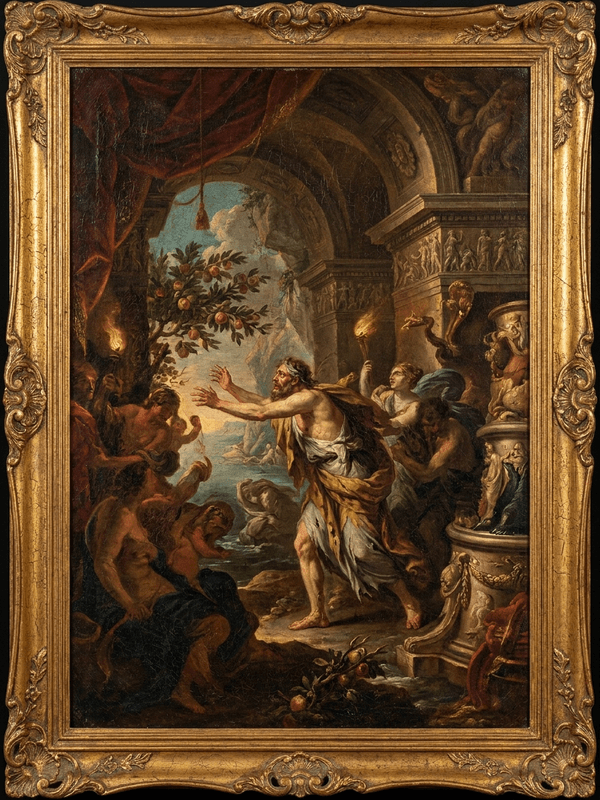
Tantalus was once a wealthy king beloved by the gods. But he stole divine food, betrayed the secrets of heaven, and even tried to test the gods with the flesh of his own son. At last he was cast down into the Underworld, where he stands thirsty beside water and hungry beneath fruit-laden branches—always within reach, and always denied.
Article
Summary
Tantalus, son of Zeus, ruled Sipylus and was honored beyond any ordinary mortal: the gods even let him sit at their table. But he abused that favor at once, boasting of heavenly secrets, stealing nectar and ambrosia, and hiding the golden dog that had been taken from Zeus's sanctuary in Crete. He then went further and invited the gods to his palace, where he killed his son Pelops, cooked the body, and served it at the feast to see whether the immortals could be fooled. The gods saw through the crime, restored Pelops to life, and replaced the missing shoulder with ivory. Tantalus was cast into the Underworld, condemned to stand beside water that always receded and fruit that always drew away.
The Wealthy King of Sipylus
In the mountains of Asia Minor there stood a prosperous city, a place of clear springs, grazing fields, and hillsides thick with sheep. Its king was named Tantalus. He came of noble blood; tradition called him a son of Zeus, and among mortals he shone with unusual splendor.
In Tantalus’ palace, vessels of gold and silver were heaped in abundance. At his feasts there was roasted meat, wine, and fruit fresh from the tree. Guests who came from distant lands entered his halls and saw tall pillars, polished bronze basins, and servants moving with wine-jars in their hands. People said that almost every form of wealth available to mortals was his—and that honors beyond mortal reach had also been granted to him.
Because of Zeus, the gods once allowed Tantalus to come among them at their own table. He could sit beside the immortals at their banquet, see them lift their cups and speak together, and hear many things no mortal ought to hear. On that table were nectar and the food that preserved the gods in deathless life. Such favor should have made him careful. Instead, Tantalus grew restless and bold.
When he returned to earth, he often boasted to those close to him of what he had seen in heaven. He treated divine secrets as ornaments for his own fame and repeated them among mortals. He also stole nectar and ambrosia from the gods’ table and gave them to his human friends to taste. They marveled, of course, at things no mortal had ever known. Their wonder delighted Tantalus. Each praise made him prouder, until he seemed to himself no longer merely a guest of the gods, but almost their equal.
The Golden Dog Hidden in the Palace
Then another offense was added to the first.
On the island of Crete there was a temple of Zeus, and in that temple a golden dog was kept. It was no trinket hammered out by an ordinary craftsman, but a sacred treasure bound up with the gods. Someone stole it, and after passing from hand to hand it came at last into Tantalus’ possession. Though he knew well that it had been taken unlawfully, he hid the golden dog inside his palace.
Those who were searching for the treasure came to him and demanded its return. Tantalus refused to admit anything. Standing in his own hall, he faced their questions calmly, as though he had never seen the thing. He covered his concealment with an oath and used the dignity of kingship to hold back further inquiry.
This deepened his guilt. To hide a divine object was already a daring crime; to deny it knowingly under oath showed how little reverence remained in him for the gods. Yet Tantalus did not stop. He had grown used to being admired, and he mistook the gods’ patience for proof of his own power.
A Terrible Feast
One day Tantalus resolved to entertain the gods in his own palace.
Servants swept the hall, spread the couches, and set bronze cauldrons bubbling over the fire. Wine-jars were brought out, and the fragrance of cooking drifted from the kitchens into the courtyard. For a mortal to receive the gods beneath his roof was glory enough. But Tantalus had hidden another thought in his heart: he wanted to test whether the gods truly knew all things.
He had a son named Pelops. The boy was still young and should have grown up safely in his father’s house, heir to the kingdom. But arrogance had blinded Tantalus. He ordered his own son to be killed, had the child’s body cut apart and cooked in a pot, then roasted as meat and served at the banquet.
The gods came to the feast, and the hall was bright and still. Golden cups were set out; platters of meat were carried in. Tantalus watched the immortals in secret, waiting to see whether they would be deceived.
But the gods knew at once what lay before them. Zeus did not reach out his hand. Hera did not lift her cup. The other gods also turned away from the dreadful food. Only Demeter was then overwhelmed by grief. Her daughter Persephone had been taken down into the Underworld, and the grieving mother thought of her day and night. Sitting at the feast in a daze, she failed to look closely and, out of courtesy, ate a small piece from the shoulder.
When she understood what had happened, all joy left the hall. The gods recoiled from Tantalus’ crime. They gathered together what remained of the child’s body, and Clotho, one of the Fates, joined the pieces again so that Pelops returned from death. Only the shoulder was missing, for Demeter had eaten that part. So the gods replaced it with a piece of shining white ivory.
Pelops lived again, and from then on he bore that strange white mark upon his shoulder. But for Tantalus there was no way back. He had stolen divine food, betrayed divine secrets, hidden a sacred treasure, and murdered his own son to test the gods. Such guilt could no longer be covered by mercy.
Water and Fruit in the Underworld
The gods punished Tantalus by casting him into the depths of the Underworld.
There he had no palace, no guests, and no one to praise his wealth. He stood in a pool of clear water, with the surface almost touching his chin. To a thirsty man, such water should have meant life. But whenever Tantalus bent down to drink, the water instantly withdrew, slipping away from his feet and leaving only cold, wet mud behind. When he straightened again, the water slowly rose back up, once more close to his mouth.
His throat burned as if with fire. Again and again he bent down; again and again he grasped at nothing. The sound of water was at his ears, its coolness before his eyes, yet not a single drop could enter his mouth.
Hunger tormented him no less.
Fruit trees grew beside the pool, their branches stretching out from the bank and hanging low over his head. Pears, apples, pomegranates, figs, and olives weighed down the boughs, so near that one might think a raised hand could pluck them easily. Tantalus lifted his eyes and saw the sheen on their skins; he smelled the fragrance of ripened fruit, and the emptiness in his belly sharpened.
He rose on his toes and reached. Just as his fingertips were about to touch the fruit, a sudden wind swept in and lifted the branches high above him. The fruit swung away, as though deliberately escaping him. When he lowered his hand, the wind fell still, and the branches drooped back down, hanging once more before his eyes.
So he stands there forever: water at his lips, yet he cannot drink; fruit above his head, yet he cannot take it. He had once stolen food from the table of the gods, food that did not belong to him. Now even the simplest mouthful of water, even a single fruit, is forever beyond his grasp.
The Stone Overhead
Some ancient traditions also say that a great stone hangs above Tantalus’ head. It seems always on the point of falling, heavy in the air. He dares not sleep, nor truly lift his eyes, but waits in hunger and thirst for the moment when it will crash down upon him.
Once he lived in a splendid palace, listening to praise and showing off the secrets of the gods. Now he stands in the cold waters of the Underworld, with no one to hear him speak and no one to trust his oaths. The water withdraws, the branches rise, the stone looms overhead, and the torment returns again and again.
In later memory, the name of Tantalus became bound to this kind of suffering: to see what one longs for close at hand, yet never be able to possess it. His son Pelops was restored by the gods and carried the ivory mark upon his shoulder; Tantalus himself remained in the darkness, paying forever for his crimes against both heaven and his own child.