Greek Mythology
Sisyphus and Bellerophon — Greek Mythology
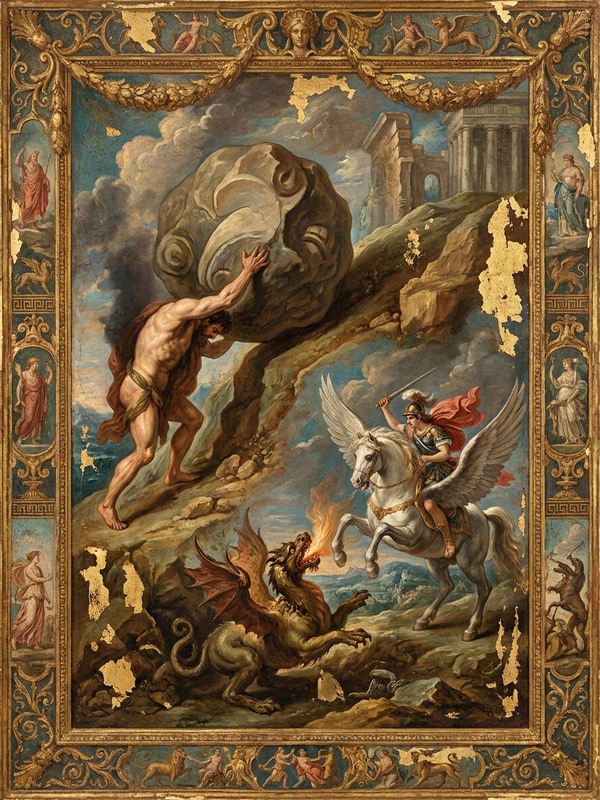
Sisyphus was an early king of Corinth, brilliant but eager to use trickery even against the gods; after death, he was condemned in the underworld to push his stone forever. Generations later, another man of the same royal line appeared: Bellerophon, a hero helped by the gods, who also fell from the heights after trying to pass beyond mortal limits.
Article
Summary
Corinth was once called Ephyra, and Sisyphus ruled there as king. He was quick-witted and calculating, bold enough to trade even divine secrets for advantage. When he told the river-god Asopus that Zeus had carried off Aegina, he gained a spring for his city, but angered the lord of heaven. Later, after his death, he was punished in the underworld: he had to push a huge stone up a slope, only for it to roll back down whenever it neared the top. After death, neither clever speech nor tricks could save Sisyphus. In the underworld he was led to the foot of a steep hill and forced to push a heavy boulder to the summit. Each time the stone was about to pass the highest point, it slipped from his hands and thundered back to the bottom. From then on, the name of Sisyphus was bound to labor that could never be finished. Many years later, Bellerophon was born into the Corinthian royal line. Some traditions call him the son of Glaucus; others say Poseidon was his father. Unlike Sisyphus, Bellerophon did not first become known through trickery. He left home because of a killing, sought purification, was slandered, and was sent to Lycia with a sealed letter that nearly made him another person's sacrifice. There he received help from the gods, mounted the winged horse Pegasus, killed the fire-breathing Chimera, and returned alive from several other tasks meant to destroy him. Iobates finally admitted that divine favor protected him, gave him his daughter in marriage, and shared half the kingdom with him. Yet victory can make a person forget where he stands. Later Bellerophon tried to ride Pegasus up to Olympus, and Zeus punished him. He fell from the heights back among mortals. So this Corinthian royal line left two answering images behind it: one man forever pushing his stone in the underworld, and one hero fallen from the back of a winged horse into the dust.
The Clever King in Corinth
In the days when Corinth was still called Ephyra, there was a king in the city named Sisyphus.
His city stood in a strong place. On one side the sea was visible; on the other, roads led inland. Merchants drove pack animals up from the mountain ways, and sailors brought bronze vessels, wine, and fine cloth from foreign harbors. Sisyphus sat in the city with eyes that seemed able to see into a person's thoughts. He questioned travelers, guessed the plans of neighboring kings, and sometimes named what someone wanted before that person had spoken.
Many admired his intelligence, and many feared it. His cleverness often refused to stay on the right path. If he could gain something, he was willing to deceive guests, offend the gods, and even tell heavenly secrets to those who should never have heard them.
Once, the river-god Asopus was searching everywhere for his daughter Aegina. The girl had vanished, and her father called her name along riverbanks, through valleys, and beside the sea, his waters running as if swollen with anger. Sisyphus knew what had happened: Zeus had desired Aegina and carried her away.
When Asopus came to Ephyra, Sisyphus did not reveal the truth at once. He pointed instead to the dry ground of his city and asked the river-god for a spring of fresh water. Asopus agreed, and clear water burst from the rock. It ran through stone channels, and at last the people of the city had living water.
Only then did Sisyphus tell the river-god that the one who had taken Aegina was Zeus.
Asopus rushed after him in fury, and the sound of his waters rolled through the valleys like thunder. But Zeus was not about to let a river-god overtake him. He drove Asopus back with thunderbolts, and the river-god had to return to his own stream. Yet Sisyphus had traded the secret of the lord of heaven for a spring, and that deed was not forgotten.
The Boulder on the Hill
Sisyphus lived for many years among mortals. In his palace there were feasts, schemes, and resentments slowly gathering around him. But when he died and his soul went down to the underworld, neither eloquence nor trickery could set him free.
There was no Corinthian sunlight in the realm below, no clear spring welling from the rock. There were only dim roads, cold winds, and silent shades. Sisyphus was led to the foot of a steep hillside. At the bottom lay a huge stone, rough and heavy, like a broken piece torn from the mountain itself.
He had to push that stone to the top.
Sisyphus bent down, set both hands against the surface, drove his shoulder into it, and dug his feet into the dust. Little by little he forced it upward. Sweat ran from his brow. The stone crept along the slope with a dull grinding sound. The summit did not seem far away. A few more steps, and perhaps he could set the boulder in place at the highest point.
But every time, just as the great stone was about to cross the ridge, it slipped from his hands. First it shifted slightly; then it broke away and plunged downward, striking the slope again and again until it thundered back to the foot of the hill.
Sisyphus had no choice but to turn, descend, and place his hands on the stone once more.
Again and again he pushed; again and again he lost it. The hillside had no end, and the boulder never came to rest. From that time on, when people spoke of Sisyphus, they remembered the king in the underworld pushing his stone: a man clever all his life, condemned after death to labor forever at a task that could never be finished.
Echoes in a Descendant
Sisyphus had sons, and his sons had descendants. In time another young man was born into the Corinthian royal line. His name was Bellerophon. Some traditions say he was the son of Glaucus; others say that Poseidon, lord of the sea, was his true father. In any case, people remembered him as noble-born, handsome, and skilled from youth at handling horses and using the spear.
Bellerophon's life did not begin with the same kind of calculation that marked Sisyphus. First, because of a killing, he left his homeland and came to Argos to ask King Proetus for purification. Then, because of the queen's false accusation, he was sent to Lycia with a sealed letter. The letter ordered the death of the man who carried it, though Bellerophon himself did not know that.
The Lycian king Iobates did not want to kill a guest whom he had already welcomed, so he sent Bellerophon on dangerous tasks instead. Bellerophon received help from the gods, mounted Pegasus, the winged horse, killed the fire-breathing Chimera, and returned alive from later battles and an ambush as well. The man who had arrived almost like a condemned prisoner became an honored hero, married the king's daughter, and received a share of the kingdom.
But the story did not remain within glory.
Two Kinds of Overreaching
Sisyphus crossed the boundary because he turned his cleverness against the gods. He thought secrets could be traded and even death could be negotiated. Only in the underworld did he discover that his tricks had no opening left. The stone rolled back to the bottom again and again, and he had to bend down each time and begin once more.
Bellerophon crossed the boundary after victory. He had been wronged, sent toward death, and saved by courage and divine help. But as people praised him again and again, human glory ceased to satisfy him. He tried to ride Pegasus up to Olympus and see the dwelling place of the gods with his own eyes.
Zeus did not allow a mortal to enter the realm of the gods in that way. Pegasus was startled, and Bellerophon fell from the heights. Afterward he kept away from crowds and wandered alone in desolate places. The winged horse returned to the heights, but the hero remained in the dust.
So this Corinthian royal line left two answering images: in the underworld, Sisyphus pushing the stone that always rolled back; among mortals, Bellerophon fallen from the back of Pegasus to the earth. One trusted his tricks too much, the other trusted his glory too much. In the end, both were forced to see that no mortal can use cleverness or achievement to push himself into the place of the gods.