Greek Mythology
The Sirens, Scylla, and the Cattle of Helios — Greek Mythology
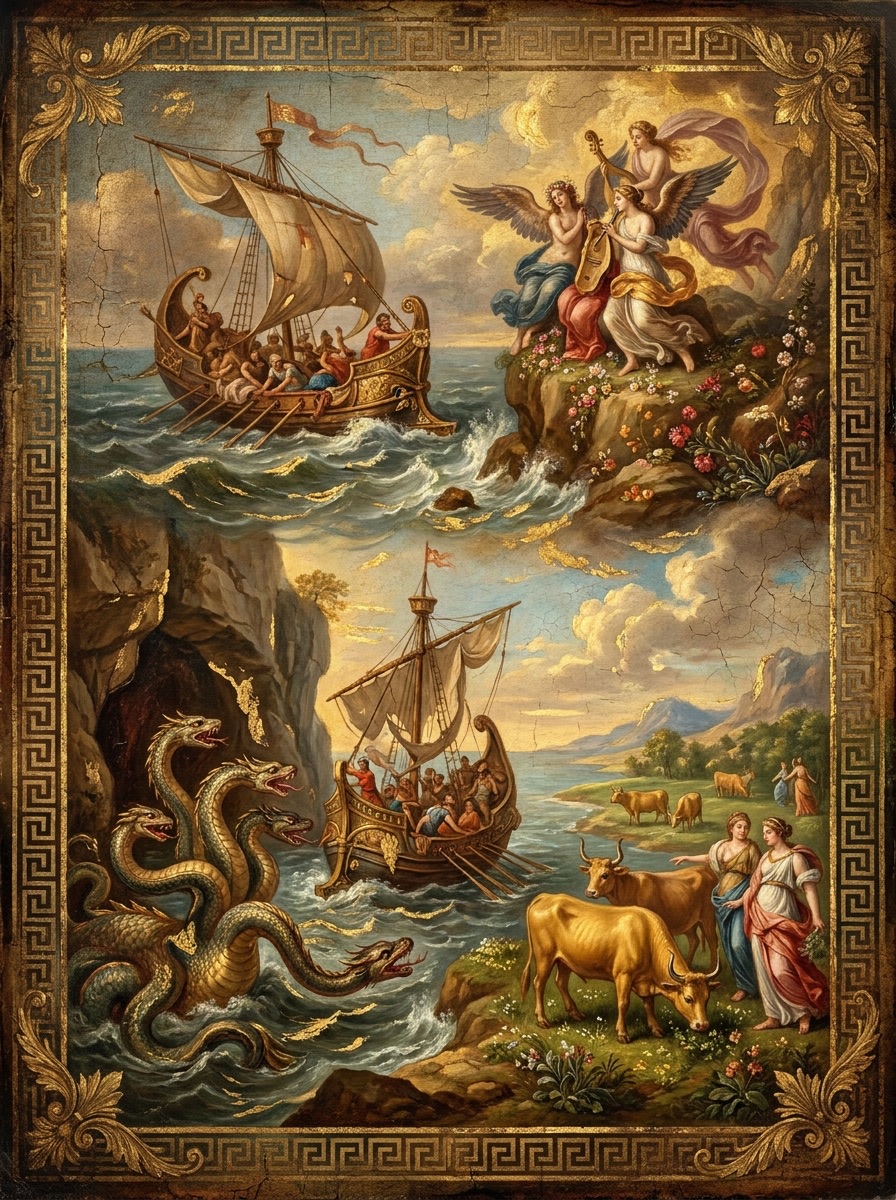
After Odysseus leaves Circe’s island, he passes through the song of the Sirens, the cave of Scylla, and the pastures of Helios’ cattle. His crew escapes the song and the monster, but hunger drives them to slaughter the sacred cattle. Thunder follows, and only Odysseus is left drifting alone upon the sea.
Article
Summary
Before Circe lets Odysseus leave, she names the dangers that still wait on the road home. First the ship will pass the Sirens, whose beautiful song draws sailors toward a shore strewn with bones; after that come the straits of Charybdis, who swallows and vomits the sea, and Scylla, who lurks in her high cave. Circe warns him that if he wants to save the ship, he must steer close to Scylla and accept a loss he cannot prevent. Odysseus follows her instructions. He softens beeswax and seals the ears of his crew, then orders them to lash him upright to the mast. As the ship nears the Sirens, he alone hears their song. They promise knowledge, glory, and the hidden story of Troy, calling to the deepest hunger in him. He struggles and commands the men to untie him, but they hear nothing and only bind him tighter, as he had ordered, until the ship has passed the deadly shore. Next they enter the channel between the two cliffs. Charybdis sucks down the water on one side until the dark depth shows beneath the foam, while on the other side Scylla thrusts out six long necks from the rock. Odysseus has not told the crew the full horror ahead; he only urges them to row hard. Scylla strikes suddenly and snatches six of the strongest men. They cry his name in the air, but the ship must keep moving, leaving their voices behind. The survivors reach Thrinacia, where the sacred cattle of Helios graze. Odysseus makes the men swear not to touch the herds, but contrary winds trap them on the island and their food runs out day by day. While Odysseus sleeps in exhaustion, Eurylochus persuades the others that it is better to risk divine anger than to starve. They slaughter the cattle, and dreadful signs follow: the hides crawl on the ground, and the meat lowes over the fire. Helios demands punishment from Zeus, and when the wind finally lets the ship leave, a thunderbolt shatters it at sea. The crew are swallowed by the waves, while Odysseus alone clings to the broken mast and keel. The current drives him back toward Charybdis, where he hangs from a fig tree until the wreckage is spat out again. After the Sirens, Scylla, and the cattle of the Sun, he is no longer a king bringing his fleet home, but a single man drifting on broken wood.
Circe’s Warning
Odysseus had lived for a long while on Circe’s island, but his heart never forgot the roof of Ithaca, his wife’s loom, or the face of his son. When the day came for him to leave, Circe did not try to hold him back as she once had. She called him aside and carefully told him what lay on the sea road ahead.
It would not be a safe homeward voyage.
First, Circe said, the ship would pass through the waters of the Sirens. Those two singers sat on a shore overgrown with flowers and grass, their voices softer than the lyre and more clinging than the sea wind. Whoever heard them forgot the oars, forgot his homeland, and longed only to steer the ship toward shore. But there was no feast there, no gentle bed—only whitening bones and rotting flesh. Those who had once landed there had never returned to their ships.
Odysseus listened without interrupting.
Circe went on. If he wished to hear the song and still pass by alive, he must seal his companions’ ears with beeswax and order them to bind him to the mast. No matter how he shouted, begged, or commanded, no one was to loosen the ropes. They were only to bind him tighter.
After the Sirens’ waters, there would be a still worse place. Ahead stood two great rocks, squeezing the sea passage between them. On one side was Charybdis, who several times a day swallowed the sea and violently spewed it out again, dragging ships, masts, and men into her whirlpool. On the other side lived Scylla, hidden in a high cave. She had six long necks and six mouths, and in each mouth were three rows of sharp teeth. Whenever a ship passed near her, she stretched down and snatched away a man in each mouth.
Odysseus asked whether he might put on his armor, take up a spear, and fight the monster.
Circe shook her head. That was no battle for mortals, she said. If he stopped the ship to resist, he would lose even more men. The best course was to row hard, keep close to Scylla’s side, endure the pain before his eyes, and save those who remained.
Last of all, she spoke gravely of an island. It was Thrinacia, where the cattle and flocks of Helios grazed. Those animals were no mortal’s property. They bore no young, yet their number never lessened. Each day they moved over bright pastures, watched by goddesses. Circe warned him that if Odysseus and his companions left the cattle and sheep untouched, there was still hope of reaching home. But if they slaughtered the sacred cattle, ship and crew alike would come to ruin. Odysseus himself might escape with his life, but only alone, and only after long delay.
Odysseus kept every word in his heart. The next day, the crew pushed the ship down to the sea and raised the sail. The wind filled the canvas, and the black ship left Circe’s island behind, sailing toward unknown waters.
Ears Sealed with Beeswax
The ship went on for a time, and then the wind gradually died. The sea lay flat as dark bronze, and the oar blades dipped and rose with a heavy sound.
Odysseus knew that the waters of the Sirens were near.
He did not tell his companions everything Circe had said. If they heard too soon of bones on the shore and monsters ahead, they might lose their grip on the oars. He told them only that a dangerous song lay before them, and that whoever heard it would forget the road home. Then he took a lump of beeswax and softened it in his hands. The sun beat down upon the deck, and the wax quickly grew pliant and shining.
He went from man to man, pressing the wax into their ears. Some laughed at his caution; others saw the seriousness in his face and fell silent. When every ear was stopped, Odysseus stood beside the mast and ordered his companions to bind him with ropes.
They wound the cords across his chest, shoulders, and arms, and tied him fast to the mast. Odysseus said to them, “Whatever I beg of you, however angry I become, do not set me free. If I order you to loosen the ropes, bind me tighter.”
The men could not hear his last words. They saw only his mouth moving, and nodded according to the instructions he had already given. Then they returned to the benches, took up the oars, and rowed hard ahead.
Before long, the sea wind carried a song to him.
It was unlike the cry of seabirds and unlike any human shouting. It was clear and gentle, as if flowing from a distant meadow of flowers. The Sirens sat on the shore; knowing a ship was passing, they began to sing Odysseus’ name, as though they had known him all his life.
They sang of his fame beneath the walls of Troy, of the bitter war between Greeks and Trojans, of all he had endured. They promised that if he stopped the ship and came ashore, he would learn still more of the hidden things of the world. The song entered Odysseus’ ears, and his whole heart was pulled toward the shore. He forgot the beeswax, forgot the ropes, forgot Circe’s warning. It seemed to him that someone waited there, ready to explain every hardship of his long years.
He strained against the bonds, his shoulders beating against the mast, the ropes biting into his flesh. He shouted to his companions, ordering them to release him, ordering them to steer the ship to shore.
The crew heard nothing.
Heads bent, they rowed in rhythm. Only two men sitting near him saw Odysseus struggling. Remembering his command, they rose and bound him with more ropes, tighter than before. Odysseus stamped and cried out in fury, but his voice scattered in the sea wind, and the ship continued past the Sirens’ shore.
Gradually the song fell behind them. First it was like strings sounding nearby, then like water murmuring far away, and at last it vanished altogether.
When the ship had passed out of those waters, Odysseus lowered his head and drew a long breath. His companions removed the wax from their ears and untied the ropes from his body. He looked back. The shore had grown dim, and the flowers, grass, and white bones were hidden by sea mist.
They had escaped the first disaster.
Six Mouths in the Cave
But ease did not last long aboard the ship.
Ahead, a heavy roar rose from the sea, like stones rolling beneath the water. The men looked up and saw cliffs closing in on both sides, with a channel between them so narrow it chilled the heart. Far off to the left, Charybdis was swallowing the sea. The water sank in circling rings; white foam curled into a deep pit, as if the whole sea were being dragged into a black mouth. After a while she spewed the water out again, and the spray leapt so high it drenched the cliffs.
The sailors froze in terror, their eyes fixed on the whirlpool.
Odysseus knew that if they saw Scylla on the other side, panic would break them completely. He did not speak the monster’s name. He only urged them to row, and ordered the helmsman to drive the ship forward close under the right-hand cliff. As for himself, he put on his armor, took two long spears, and stood between the prow and midship, peering upward in search of the cave.
The cliff was so high it seemed a black wall rising from the bottom of the sea. Waves struck its foot and flung up cold spray. Odysseus widened his eyes, but he could not see where the cave opened. Wind, wave, and the roar of Charybdis tangled together; the sailors’ faces went pale, yet their arms dared not stop.
Just as the ship swept beneath the cliff, Scylla thrust her heads out from the cave.
In that instant, before Odysseus could cast a spear, six long necks had already reached down like six gray-white serpents. Six mouths opened, their teeth flashing wet and cold. She snatched up one sailor in each mouth, as a fisherman lifts writhing little fish from the sea.
The men she seized waved their hands in the air and cried Odysseus’ name. Their feet still kicked, their hands still reached toward the planks, but their bodies had already been lifted from the deck. The others screamed; the oars faltered and splashed wildly, then fell back into the sea at Odysseus’ shout.
Odysseus saw his companions dangling beside the cliff. He saw them struggling, and he could save none of them. His spears found no place to strike, and if the ship stopped, more mouths would seize more men. So he forced the living to row on, out of that terrible passage.
When the strait lay behind them and the thunder of Charybdis faded into the distance, no one spoke. Six men were gone from the deck. Benches stood empty, and several oars were missing. The sea washed along the ship’s side as though nothing had happened.
Odysseus looked at the empty places, and the pain in his heart was sharper than the ropes had been around his body. But the ship was still at sea, and he could not stop.
The Island of Helios
After another stretch of sailing, an island appeared ahead. Its grass shone brightly, and the slopes gleamed gold in the sunlight. Before they even reached shore, the men heard the lowing of cattle and the bleating of sheep.
Odysseus recognized the place. He remembered Circe’s words, and he remembered too the warning that the seer Tiresias had given him in the underworld. Standing aboard the ship, he told his companions, “We must not land here. These are the cattle and sheep of Helios. If we leave them untouched, there is still a road for us. If anyone lays hands on them, our ship is doomed.”
But the sailors were exhausted beyond endurance. They had just escaped the Sirens and Scylla; their arms ached, and their spirits felt hollowed out. Eurylochus spoke up, saying that to sail at night was even more dangerous. If a sudden wind rose, the ship might be hurled back toward the rocks. He begged Odysseus to let them go ashore for one night, so long as they swore not to touch the sacred cattle and ate only the food they had brought.
The others pleaded with him too. Odysseus looked at their worn faces and knew that if he forced them to remain aboard, worse trouble might follow. So he made them swear that they would not slaughter any cattle or sheep on the island. The men raised their hands and swore by the gods; then they brought the ship to shore and dragged it up onto the sand.
At first they kept their oath. There was still a little food aboard, and they lit a fire on the shore and divided what remained. The cattle moved slowly not far away, their hides gleaming, the tips of their horns as though polished by the sun. They were not afraid of men, but lowered their heads and grazed in the meadow. The goddesses who guarded them moved in the distance, and the wind across the island was warm and still.
But the next day, a contrary wind rose over the sea. Wave after wave rolled in, and the ship could not depart. The third day was the same. Many more days followed. The food sacks grew empty, and the wine ran out. The sailors began to fish by the shore, catch birds, and dig for whatever edible things they could find. But none of it was enough to fill their bellies. At night many lay awake with hunger, hearing the cattle lowing on the hillside, and their stomachs tightened at the sound.
Odysseus still forbade them to touch the cattle. He prayed to the gods, begging for the wind to change. One day he went inland, seeking a quiet place to pray. After his prayer, weariness overcame him, and he fell asleep upon the ground.
Then Eurylochus gathered the men together.
He told his companions that it was better to choose the finest cattle and sacrifice them to the gods than to starve to death on the island. They could vow to Helios, he said, that if they returned to Ithaca, they would build him a splendid temple. The men were faint with hunger, and when they heard this, they no longer resisted. They drove the cattle together, broke oak leaves to serve as sacrificial grain, since no real barley was left, and used clear water in place of wine. Then they struck the cattle down.
Blood ran into the grass. The meat was cut and set over the fire. As smoke rose, dreadful signs appeared on the island. The flayed hides crawled upon the ground, and both the raw meat and the roasting meat gave out low, mournful cattle-cries. The sailors turned pale, but hunger overcame their fear, and they ate.
Odysseus woke and smelled roasted meat. His heart sank. He ran back to the shore and saw the fires, the hides, and the grease shining on his companions’ mouths. He knew the oath had been broken. He rebuked them, but nothing could now be undone.
From above, Helios saw that his cattle had been slaughtered, and his anger rose straight to Olympus. He complained to Zeus, declaring that if these men were not punished, he would no longer shine in the sky, but would go down into the underworld and give his light to the dead. Zeus promised that he would shatter the ship with thunder.
Thunder Falls upon the Sea
At last the wind died, and the sea lay calm, as though deliberately letting them depart.
Odysseus and his companions pushed the ship back into the water, raised the sail, and left the island of Helios. A few cattle were missing from the bright pasture, but the grass still shone. Odysseus felt no relief. He knew the anger of the gods would not simply pass away.
When the ship had reached the middle of the sea, the sky suddenly changed color. Black clouds pressed in from every side, and the wind broke the calm in an instant. Waves lifted the ship high and hurled it down again. The mast groaned in the gale, and the sailcloth strained as if it would tear apart.
Then the thunderbolt of Zeus fell.
A flash of white fire struck the ship. The planks burst apart, and the air filled with smoke and the smell of sulfur. The sailors were flung into the sea like seabirds scattered by a storm. Some clutched at broken wood; some rose above the water for a moment and were covered again by the waves. The black ship that had carried them over so many waters broke apart in thunder-fire and surf.
Odysseus too was thrown into the sea. He struggled up to the surface and saw his companions vanish one by one. No one answered his cries. Around him there were only the broken mast, planks, and rolling white foam.
He caught hold of a piece of wreckage, then lashed the broken mast and keel together with ropes, making a rough raft to keep himself afloat. Wind and waves drove him back toward the dreadful passage. In the distance he saw Charybdis swallowing the water again, and his heart went cold. The raft was drawn toward the whirlpool. As the water sank, he seized the branch of a fig tree growing from the rock and hung there in the air, while black water spun beneath his feet.
He clung there until Charybdis vomited up the wood she had swallowed. The time seemed stretched beyond measure, and his arms felt as though they would tear apart. At last the wreckage rose again from the water. He let go, dropped, and swam with all his strength until he reached it once more.
This time, Scylla did not thrust her heads out again. Odysseus lay upon the timber and drifted with the current. The cattle of Helios remained on their island, and his dead companions would never return home. Of all who had sailed on that ship, none escaped the punishment of the gods except Odysseus.
Later, the waves carried him, alone, toward a still farther place. Beside him there were no oarsmen, no helmsman, no bread to divide—only salt water, the sound of the wind, and one piece of broken wood that kept him alive.