Greek Mythology
The Sacrificial Portions at Mekone and the Theft of Fire — Greek Mythology
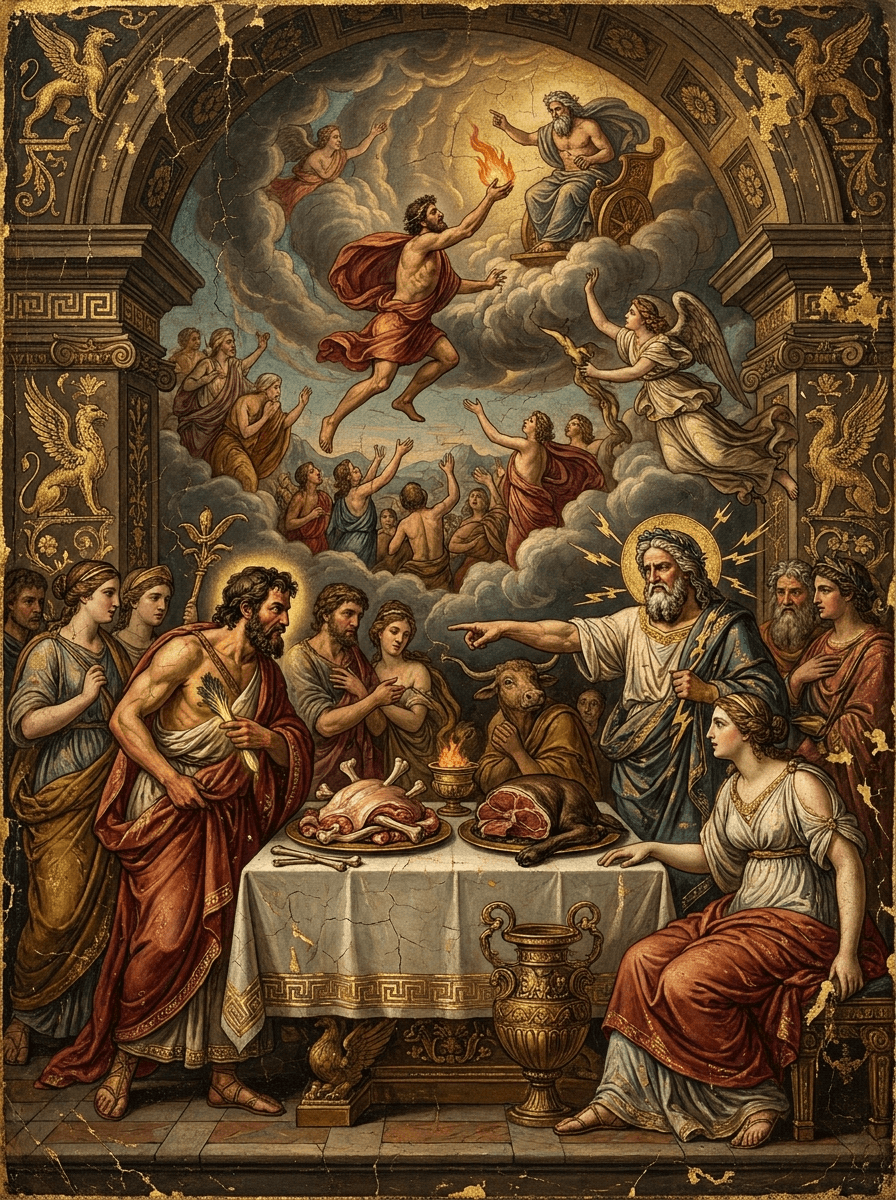
At Mekone, Prometheus divided the sacrificial ox on humanity’s behalf, setting before Zeus one heap of white bones and another of good meat. From that choice came the custom by which mortals offer sacrifice to the gods. Enraged, Zeus took fire away from humankind, but Prometheus stole it back—and in doing so brought a far heavier punishment upon himself.
Article
Summary
In those days, gods and mortals had not yet settled the boundaries between them. People slaughtered cattle for sacrifice, but no rule had been fixed: which parts belonged to the gods, and which might mortals keep? Prometheus stood with humanity. At Mekone he arranged two portions: one held the good meat hidden inside an ox’s stomach, plain and unappealing to the eye; the other was a pile of white bones covered with rich, gleaming fat. Zeus knew there was trickery in the arrangement, yet he chose the portion wrapped in fat. When the fat was lifted away, only bare bones lay beneath it. From then on, mortals burned bones and fat upon the altar for the gods, while the nourishing meat remained beside the fire for human hands and mouths. Zeus accepted the custom, but he did not forget the insult. To punish humankind, Zeus took fire from the earth. Hearths went cold, ashes held no spark, and night settled heavily over houses and caves. People shivered, ate their meat raw, and could no longer harden clay or work metal. Seeing their misery, Prometheus resolved to act again, though he knew Zeus’s anger would fall on him. He took a hollow fennel stalk, stole a hidden ember of heavenly fire, and carried it back down to the mortal world. Once more flames rose among human beings: red at first, then gold, then bright enough to push back the dark. Zeus saw the fires burning below and knew who had defied him. The fire would remain with humanity, but Prometheus would have to pay dearly for it.
The Division at Mekone
By then, heaven and earth had rulers. A new generation of gods sat upon Olympus, and Zeus, lord of thunder, held sway over clouds, rain, and storm. On the earth below, humankind was growing in number. People gathered together, cut timber, built fires, and lived among their fields and animals. Yet between mortals and gods many customs had not yet been fixed.
Humans knew that the gods were stronger than they were. They knew, too, that smoke from the altar rose toward heaven. Whenever they slaughtered a fat ox, they led it into an open place, gripped its horns, raised the knife, and let its blood fall into the dust. But of the animal’s meat, bones, and fat, which portion should go to the gods, and which might remain for men and women? No one had yet decided.
This was no small matter. If the finest meat belonged entirely to the gods, mortals would be left with bones and ash. If they kept the good meat for themselves, they might anger the masters of the sky. And so, at a place called Mekone, gods and human beings came together to settle the law of sacrifice.
Prometheus was there as well.
He was the son of Iapetus, born of the ancient race of Titans, subtle in counsel and cleverer than many gods. He saw humankind standing to one side, afraid yet hopeful, and he resolved to win them an advantage. Zeus sat among the gods, his gaze heavy and watchful, as Prometheus set to work.
A great ox was slaughtered and opened. Prometheus cut away the meat, gathered the rich entrails and the red flesh, and hid them inside the ox’s stomach. The stomach was wrinkled and dull-colored, not pleasing to look at. Then he took the clean white bones and piled them together, covering them carefully with shining fat. The layer of fat was white and thick, hiding what lay beneath; from a distance, it looked like the richest of offerings.
The two portions were ready.
One looked poor, but held the good meat. The other looked tempting, but held only bones.
Prometheus came before Zeus and said, “Noble Zeus, choose whichever portion you wish. What you choose shall be the share that belongs to the gods from this day onward.”
White Bones Beneath the Fat
Zeus was not blind to the trick. He was the son of Kronos; he had known the terror of a father who swallowed his own children, and he had fought the great war that overthrew the older gods. How could he fail to read Prometheus’ intention? Yet all the same, he stretched out his hand and took the heap covered in white fat.
When the fat was lifted away, bare bones lay beneath it.
The mortals who stood nearby felt a secret delight, though none dared laugh aloud. The gods saw it too, and the air seemed suddenly colder. Zeus’s face darkened. He understood what Prometheus had done for humanity: from then on, mortals would wrap bones in fat and let the smoke rise heavenward, while the meat that could truly feed them would remain beside the fire.
So the custom began. When flames climbed on the altar, people placed white bones and fat into the fire. The fat hissed and sputtered, and thick smoke rose into the sky as the gods’ portion. Around the altar, men and women cut the meat, boiled or roasted it, and shared it among family and companions.
Zeus accepted the rule, but he did not forget the humiliation. He watched mortals on the earth receive their meat, and he remembered Prometheus’ calculating face. His anger gathered slowly and deeply within him.
He did not at once hurl a thunderbolt at Mekone. He did not immediately tear Prometheus apart. Instead, he devised another punishment.
He would take away fire.
A World Without Fire
Fire mattered more to human beings than almost anything.
With fire, the cold night was no longer hard as stone. With fire, raw meat became fragrant and cooked. With fire, clay could be hardened, metal could be melted, and even in darkness a red glow could remain. Fire lived in the hearth, in the smith’s furnace, beneath the ashes where a traveler slept. It was like a little sun, guarded carefully by human hands.
But at Zeus’s command, fire vanished from the earth.
Hearths went cold. No spark could be stirred from the ashes. When night fell, only darkness filled caves and houses. Far off, the eyes of wild beasts shone. Cold wind crept beneath clothing. People piled up dry branches, rubbed wood against wood, struck stones together, but they could not summon back the red light they had known before.
Children trembled through the freezing nights. Old people crouched in corners. Hunters brought back meat that could only be swallowed raw, the taste of blood clinging to their hands. Clay vessels dried in the sun but stayed fragile. Metal lay trapped in stone, untamed by the furnace. Humanity seemed thrust backward into an older, harsher age, left to raise its eyes toward the sky and wonder whether any gleam of fire still remained near Olympus.
Prometheus saw all this, and his heart could not be still.
He knew that Zeus had taken fire because of him, and because of humankind. If he did nothing, mortals would suffer in cold and darkness. Yet if he acted again, the king of the gods would surely turn his wrath upon him.
Still, Prometheus decided to steal fire.
The Ember in the Fennel Stalk
Prometheus did not carry glittering weapons, nor did he drive a war chariot up to heaven. He knew that to meet Zeus by force would only summon the thunderbolt. Once again, he would rely on cunning.
He found a great stalk of fennel. The plant looked ordinary from the outside, but within it was a soft pith that could hold a spark and keep it from dying at once. Prometheus took it in his hand as if it were no more than a dry, common reed.
When the gods were not watching, he drew near the fire of heaven. This was no weak red coal from mortal ashes, but a bright, fierce, sacred flame, not to be taken lightly. Prometheus held out the fennel stalk and let a single spark slip into its hidden core. The fire did not flare openly. It glowed in secret within, like a heartbeat concealed.
Then he carried the fire down from heaven.
Below, the mortal world was still cold and dark. People sat around dead ashes, not knowing what they waited for. Prometheus came among them, split open the fennel stalk, and tipped the hidden spark into dry grass and twigs. He bent low and breathed gently upon it.
First there was a point of red.
Then the red caught the chaff, and a tongue of flame lifted its head. Dry branches cracked and snapped. Orange light shone over human faces. Some cried out in wonder; some reached toward the warmth and quickly drew back; some fell to their knees, staring at the fire that had been lost and restored. A small circle of night was pushed away, and before long the smell of roasting meat rose again beside the flames.
Fire had returned to humankind.
People carried it everywhere. Some took it into their houses. Some kept watch beside the hearth. Some covered embers carefully with ash, afraid the gift might vanish again. Night still existed, and winter would still come, but human beings now held in their hands something with which to resist them.
The Wrath of Zeus
On Olympus, Zeus soon learned what had happened.
He saw fires shining again on the earth—one here, another there, then more and more, like red pinpricks in a black cloth. Those flames had not been given by him. Prometheus had stolen them. The white bones of Mekone had not faded from Zeus’s memory, and now the theft of fire stood beside that earlier insult.
His anger could no longer be contained.
Zeus understood that Prometheus had not acted on a passing impulse. Once he had secured the sacrificial meat for mortals; now he had restored fire to them. Again and again he stood on humanity’s side, stealing some small advantage from the hand of the king of gods. If such a god went unpunished, the majesty of Olympus would be held cheap.
So Zeus began to prepare his revenge.
For humankind, he would devise another calamity. For Prometheus, a mere rebuke would not be enough. The stolen fire burned brightly on the earth, lighting human hearths and roads, but it also cast its glow upon the price Prometheus would have to pay.
Yet however fiercely Zeus raged, the fire had already come to the mortal world.
From that time onward, people still laid bones and fat upon the altar in sacrifice, sending smoke upward to the gods. Beside the altar, in houses and in hearths, the meat that truly nourished human life was cooked by flame. When evening came, people sat around the firelight, listening to wood split and crackle, watching red sparks fly into the dark.
They knew that this fire had not been won easily.
It had been hidden in a fennel stalk, carried down from the gods by Prometheus, and left as a gift to the cold, hungry, stubborn world of humankind.