Greek Mythology
Polyphemus the Cyclops — Greek Mythology
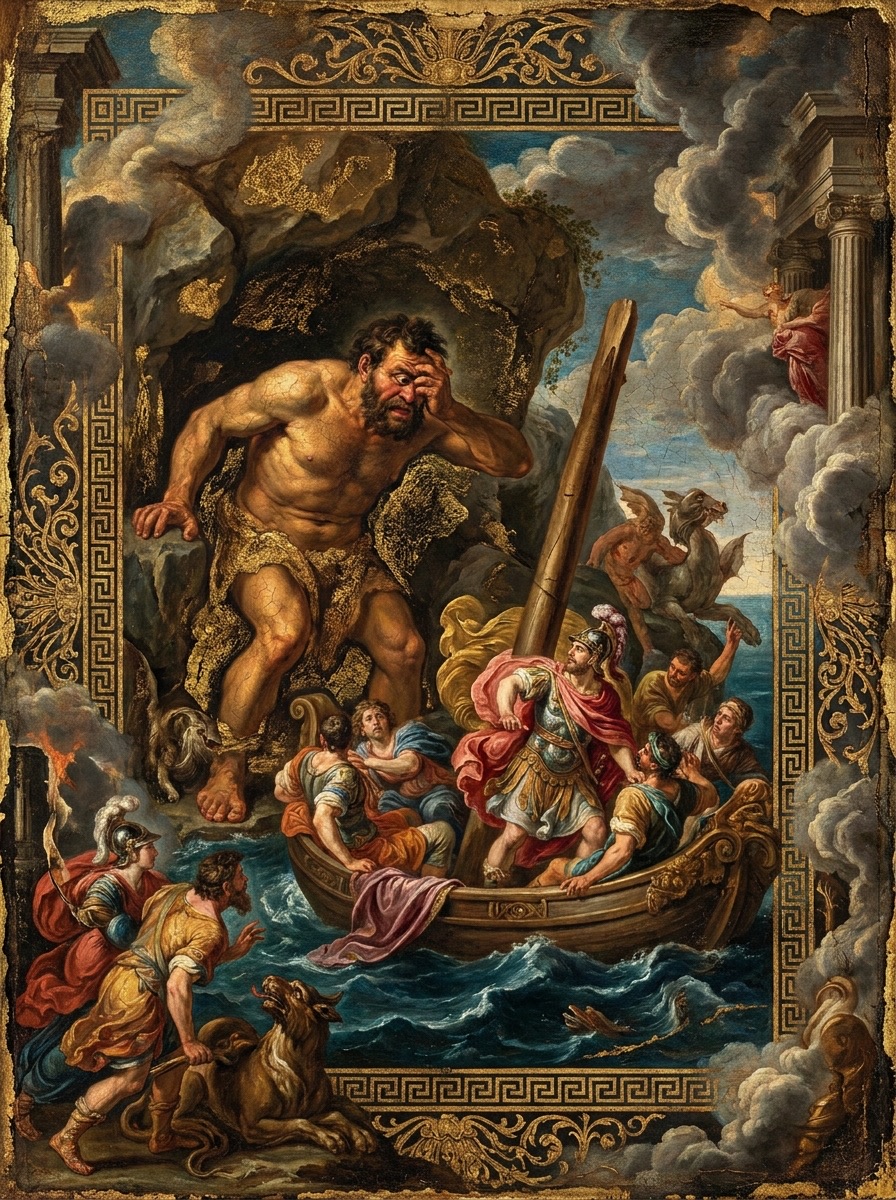
Odysseus and his companions land on the island of the Cyclopes and stray into the cave of Polyphemus, who traps them inside and devours them one by one. With wine, a false name, and a fire-hardened stake, Odysseus outwits the giant and escapes beneath the bellies of sheep—only to reveal his true name and draw down the wrath of Poseidon.
Article
Summary
Odysseus’ fleet reaches a fertile island rich in trees and grazing animals, and across the narrow water live the Cyclopes, who neither farm fields nor hold assemblies nor honor the laws of hospitality. His men would rather take water and leave, but Odysseus wants to know whether the people there are savage or god-fearing. He crosses with twelve companions and a skin of strong wine, then enters the cave of Polyphemus. The cave is full of cheeses, milk pails, and pens for sheep and goats. The companions urge Odysseus to take food and animals and return to the ship, but he insists on waiting for the owner. At dusk Polyphemus, son of Poseidon, drives in his flocks and seals the entrance with a huge stone. When Odysseus appeals to Zeus’ law of hospitality, the Cyclops mocks the gods, smashes two men to death, devours them, and later eats more before leaving the survivors trapped inside. Odysseus realizes that killing the giant outright would doom them, since no one else could move the stone. He has his men sharpen a massive olive-wood stake and hide it in the cave, then offers Polyphemus the dark wine until the Cyclops is drunk. Asked for his name, Odysseus answers that he is called “Nobody.” When Polyphemus collapses in sleep, Odysseus and the chosen men heat the stake and drive it into his single eye. Polyphemus screams that “Nobody” is killing him, so the other Cyclopes who gather outside think he suffers from some divine sickness and leave. At dawn, the blinded giant sits by the entrance and feels the backs of his sheep to keep the prisoners from escaping. Odysseus ties his men beneath the bellies of rams and clings under the largest ram himself, slipping out beneath Polyphemus’ hands and returning to the ship. Once the ship is offshore, Odysseus cannot resist shouting his true name and Ithacan identity back at Polyphemus. The Cyclops hurls rocks that nearly wreck the vessel, then prays to his father Poseidon to make Odysseus return late, alone, on another’s ship, and to find trouble at home. Odysseus escapes the cave by cunning, but his boast gives the sea god a name to punish and turns the journey home into a far longer ordeal.
The Island Beyond the Sea-Mist
Troy had already burned into memory, but Odysseus was still far from home.
For many days his ships wandered over the sea. The masts creaked under the wind, and white salt crusted the gunwales. One morning, as the mist lifted, the sailors saw a little island ahead. There were no fires on it, no ploughed fields, no sign of human labor; yet trees grew thickly there, wild grapevines climbed the stony slopes, and goats leapt through the grass. Beside the island lay a natural harbor, where ships could ride safely without casting their anchors far.
Odysseus ordered the men to go ashore, draw water, and light fires. By the beach they slaughtered several wild goats, and the smell of roasting meat drifted on the sea wind. The hungry sailors gathered around the flames and at last ate their fill. That night they slept beside the ships, listening to the tide strike the black rocks, and thought their hardships had eased for a little while.
The next day Odysseus climbed to a height and looked across the water. Beyond a narrow strait, smoke rose from the opposite shore, and he could hear the bleating of sheep. A race of towering beings lived there: the Cyclopes. They did not till the earth like men in Greek cities, nor meet in councils, nor make laws; they built no ships to visit other lands. Each lived apart in his own cave, ruling over his wife, his children, and his flock. The earth brought forth grain and grapes of itself, and on these they lived.
Odysseus’ companions wanted only to stay on the safe island, fill the waterskins, and sail away. But curiosity stirred in Odysseus. He wished to know whether the dwellers across the channel were cruel savages, or men who feared the gods and welcomed strangers. So he chose twelve companions and took with him a skin of wine—a rich, powerful wine once given to him as a gift. It was so fragrant and strong that in ordinary drinking it had to be mixed with much water. Odysseus said little. He ordered the rest to guard the ships, then led his small company across to the farther shore.
Cheese and Sheepfolds in the Cave
By the time they landed, the sun was high. There was no harbor wall on the beach, no road beaten down by footsteps. Odysseus and his companions followed a narrow track made by sheep up the hillside, until they came to the mouth of a vast cave.
Outside it, rough timber and stones enclosed a sheepfold, crowded with fat sheep and goats. Inside the cave it was cool. Milk-pails hung from the stone walls; rows of cheeses were stacked upon shelves; large bowls and small ones stood on the ground, some brimming with milk, others still dripping whey. The master was away—plainly he had driven his flock out to graze.
When the companions saw these stores, they at once urged Odysseus: “Let us take some cheeses, drive off a few lambs and kids, and get back to the ship. Who knows what sort of man the owner will be when he returns?”
It was wise advice, but Odysseus would not heed it. He wanted to see the master of the cave with his own eyes, and he hoped, according to the old custom, to ask for a guest-gift. So the men lit a fire in the cave, ate a little cheese, and waited for the giant to come home.
Toward evening, heavy footsteps sounded on the slope. The flock came first, crowding into the fold with restless bleating. Then the entrance darkened, and a giant, shaped like a cliff come alive, bent down and entered the cave. He had a single eye in the middle of his forehead, deep-set in its socket, its gaze like an ember not yet dead. This was Polyphemus, son of Poseidon, lord of the sea.
On his shoulder he carried a bundle of firewood. He flung it down inside, and the crash was like stones breaking from a mountain. Odysseus and his companions shrank back into a corner. Polyphemus, however, first attended to his own work. He drove the ewes and she-goats inside to be milked and left the rams outside; then he pushed a huge round stone across the entrance. It was terribly heavy—twenty four-wheeled wagons could scarcely have moved it. Once that stone sealed the doorway, the men inside were trapped as if in the belly of the rock.
The giant sat and milked his animals with practiced hands. He set the lambs and kids beside their mothers, divided the milk, made half into cheese, and kept half to drink at supper. Only when all this was done did he notice the strangers in the corner.
His voice rolled between the stone walls: “Who are you? Where do you come from? Are you traders, or sea-raiders?”
Odysseus mastered his fear and stepped forward to answer. He said they were Greeks returning from Troy, driven astray by winds, and now come here in need. He begged the master of the cave, in the name of Zeus, to receive them as guests, for travelers and suppliants are watched over by the gods.
Polyphemus listened and laughed coldly. “You must be a fool from far away,” he said, “to try frightening me with Zeus. We Cyclopes do not fear Zeus, nor any other god. We are stronger than they are. As for your ship—tell me where it lies, and then I shall consider how to treat you.”
Odysseus heard the trap at once. He said that Poseidon had smashed their ship against the rocks, and that only these few men had escaped.
The giant asked no more. Suddenly he stretched out both great hands, seized two of the companions as if they were puppies, and dashed them against the stone floor. The sound of breaking bones chilled every man in the cave. Polyphemus tore them apart and devoured them for supper, leaving neither bones nor entrails. When he had eaten his fill, he drank his milk, stretched himself among the sheep, and fell asleep.
Odysseus gripped the hilt of his sword and almost rushed forward to drive the blade into the giant’s breast. But then he looked at the enormous stone across the doorway, and his hand loosened. Even if they killed the giant, the survivors could never move that rock; they would only starve in the cave. So he bit back his fury and waited for morning.
“My Name Is Nobody”
At the first gray light of dawn, Polyphemus woke and seized two more companions for his breakfast. Then, as before, he milked the flock and tended the young animals. When he had finished, he pushed aside the stone, drove the sheep out to graze, and then rolled the rock back again, shutting Odysseus and the others inside.
Only the smell of blood, milk, and low weeping remained in the cave. Odysseus knew that strength alone would not save them. Searching through the cave, he found a great stake of olive wood, one that Polyphemus had cut to make himself a staff. It was as thick as a ship’s mast. Odysseus told his companions to cut off a length of it and sharpen one end. They took turns scraping it with their swords, then hardened the point in the fire. When the work was done, they hid the stake beneath dung and fodder.
Next Odysseus cast lots to choose the bravest men, who would help him act when night came. Those upon whom the lot fell turned pale, but none drew back; they had already seen what it meant to wait helplessly for death.
At evening Polyphemus returned. Once again he sealed the cave with the stone; once again he sat down to milk his animals. Then he seized two more companions and ate them. Odysseus watched the firelight shine upon the single eye, and hatred cut through him like a knife. Still, he took up the wineskin and went toward the giant.
“Cyclops,” he said, “since you have eaten human flesh, drink some wine. This is fine wine from our ship. If you choose to pity us, perhaps you may yet send us home.”
Polyphemus took the wine and drank it in one draught. The strong liquor rolled down his throat, and a delight he had never known spread across his face. He demanded another bowl. Odysseus poured again. The giant drank bowl after bowl, until his tongue grew thick and his eyelids heavy.
“Tell me your name,” he said. “I like this wine, and I will give you a guest-gift.”
This was the moment Odysseus had been waiting for. With careful courtesy he answered, “My name is Nobody. My father and mother call me Nobody, and so do all my companions.”
Polyphemus laughed, and the sound shook dust from the roof of the cave. “Very well, Nobody. This shall be my guest-gift: I will eat you last. I will eat your companions first, and you after them.”
With that, drunk and heavy, he fell backward. His huge body sprawled upon the ground, and his breath stank of wine and human flesh. Soon he was snoring.
The Burning Stake
Odysseus at once called to his companions. They dragged out the hidden stake and thrust its sharpened end into the fire. The flames licked the olive wood until the point glowed red, like iron heated in a smith’s forge. When the moment came, Odysseus and the chosen men lifted the stake together and drove it into the single eye in the middle of Polyphemus’ forehead.
The instant the wood sank into the eyeball, the giant gave a terrible scream. Odysseus leaned on the stake and twisted it, as a carpenter twists a drill into timber. A scorched stench rose from the wound; blood and burned fluid spattered everywhere. Polyphemus thrashed in agony, clawed at the air with both hands, and at last tore the stake out and flung it aside.
His roar burst from the cave and woke the Cyclopes in the neighboring hills. They came and stood outside the entrance, calling through the stone: “Polyphemus, what has happened? Is someone stealing your sheep? Is someone trying to kill you?”
Inside, the blinded Polyphemus rolled on the ground and shouted hoarsely, “Nobody is hurting me! Nobody is trying to kill me!”
When the others heard this, they answered, “If nobody is hurting you, then it must be a sickness sent by Zeus. We cannot help you. Pray to your father Poseidon.”
One by one, they went away.
In the darkness Odysseus heard their footsteps recede, and his heart eased a little. Yet the stone still blocked the mouth of the cave. The giant was blind, but his strength remained. They had not escaped yet.
Escape Beneath the Sheep
Polyphemus did not sleep all night. He sat beside the entrance with his hands spread wide, waiting to seize anyone who tried to slip past him. At dawn the flock began bleating restlessly, eager to go out to graze. The giant, groaning with pain, pushed the stone aside, but then sat down in the doorway and felt along the backs of the sheep with both hands. He thought Odysseus and his companions would try to hide among the flock, riding out on the animals’ backs.
Odysseus had already foreseen this.
There were many rams in the cave, thick with long wool. He bound them together in threes with willow withes and twisted grass. Beneath the belly of the middle ram in each group of three he fastened one companion, while the rams on either side walked close enough to conceal him. For himself, he chose the largest and strongest ram of all—the one that usually led the flock, with dense fleece and powerful curving horns. Odysseus slipped beneath its belly, gripped the heavy wool with both hands, and clung tight against the animal’s underside.
One by one the sheep passed through the entrance. Polyphemus felt their backs, found no man there, and let them go. When the greatest ram came, the giant laid his hand on its back and paused. He spoke to it, and there was something like grief in his voice: “My good ram, why are you last today? You were always the first to go out to the tender grass, the first to reach the stream for water. Are you grieving too for your master’s eye? If only you could speak and tell me where that Nobody is hiding, I would smash him against the stones.”
Odysseus hung beneath the ram, scarcely daring to breathe. The giant’s hand was just above him; the thick fingers passed over the ram’s back. At last Polyphemus released the animal and let it go out.
When they had reached a place far from the cave mouth, Odysseus dropped from beneath the ram and quickly untied his companions. They drove several fat sheep with them and ran down the slope toward the sea. The men on the ship were astonished and overjoyed to see them return—but when they realized how many were missing, joy turned quickly into grief.
Odysseus would not let them weep long. They drove the sheep aboard, cut the mooring ropes, and bent hard to the oars. White foam curled beneath the blades, and the ship slowly drew away from shore.
The Shout Across the Sea
When the ship had gained some distance from land, Polyphemus stood on the hillside and heard the splash of oars and the voices of men. He could see nothing, and so he groped his way toward the shore, following the sound.
Then anger and the fierce pleasure of victory rose together in Odysseus’ heart. He could not hold back. He shouted toward the land: “Cyclops! If anyone asks who blinded you, say it was Odysseus, sacker of Troy, king of Ithaca!”
His companions were terrified and begged him to be silent. But the words had already crossed the water and reached the shore.
When Polyphemus heard the name “Odysseus,” he cried out in pain. He remembered an old prophecy that said a man named Odysseus would one day rob him of his eye. He had thought such a man would come tall and mighty, bearing shining weapons before him. Instead, the one who came had defeated him with wine and craft.
The giant felt for a huge rock, lifted it, and hurled it with all his strength toward the voice. The stone crashed into the sea in front of the ship, and the wave it raised rolled back like a mountain, nearly driving the vessel onto the shore again. The sailors rowed with desperate force and barely kept the ship clear.
Odysseus wanted to shout once more. His companions pleaded with him, saying that if the giant threw another rock, ship and men alike would be shattered in the sea. But Odysseus was fierce in spirit. When the ship had drawn farther off, he again cried out his name and homeland. He wanted Polyphemus to know that the one who had beaten him was not “Nobody,” but Odysseus.
Polyphemus lifted a still larger stone and hurled it far out across the water. This time it fell behind the ship, and the wave it raised drove the vessel outward toward the open sea. Odysseus and his companions seized the chance, rowed hard, and at last escaped the coast of the giant.
On the shore, Polyphemus raised both hands and prayed to his father Poseidon. He begged the sea-god to remember this name: Odysseus of Ithaca. If the man was fated to reach home at all, let him come late, having lost all his companions, in misery, aboard another’s ship; and when he reached his house, let him find no peace waiting there.
The sea wind carried the prayer away. Odysseus’ ship returned to the small island, where the companions who had remained behind gathered around and listened to the tale of the horrors in the cave. They made offerings for the dead and divided the stolen sheep among the fleet. That night they ate meat and drank wine beside the shore, but no one was truly glad. Every man knew that the sea still stretched long before them—and that the enemy they had made was not only a blinded giant, but Poseidon himself, ruler of the deep.