Greek Mythology
Phineus and the Harpies — Greek Mythology
When the Argo reached the coast of Thrace, the heroes met Phineus, a blind seer tormented by the Harpies. The sons of Boreas drove the monsters off, saved the old man, and Phineus in return told Jason how to pass the Clashing Rocks.
Article
Summary
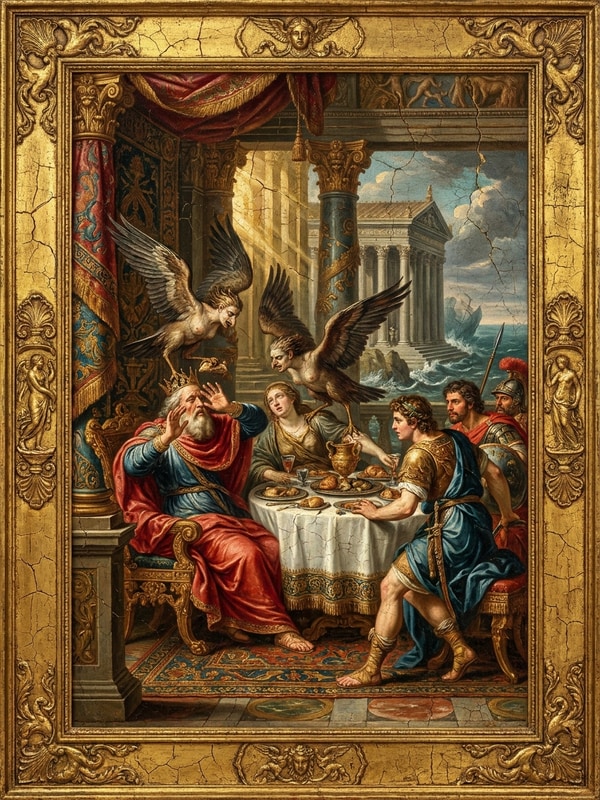
When the Argo came to the Thracian coast, Jason and his companions found a blind old man worn down by hunger. He was Phineus, a seer punished for revealing too much of what the gods wished to keep hidden. The gods had taken his sight and sent the Harpies to torment him: whenever food was set before him, they swept down, snatched away what they could eat, and fouled whatever remained. Phineus knew that the men before him were the Argonauts, and he also knew that they needed guidance for the sea road ahead. Jason resolved to help him, and Zetes and Calais, the winged sons of Boreas, promised to drive the Harpies off. The heroes set a meal before Phineus and waited with weapons ready. As soon as the scent of food rose, the Harpies screamed out of the cloud-shadow, overturned the table, and carried off the meat and bread. This time the monsters did not escape as they had before. Zetes and Calais spread their wings and pursued them with drawn swords, driving them beyond the shore and out over the open water. When the sons of Boreas were about to overtake and kill them, Iris came down in rainbow light, stopped the chase, and swore by the Styx that the Harpies would never again return to steal Phineus's food. After the brothers came back to shore, Phineus was at last able to eat in quiet. Once he had recovered a little strength, he kept his promise and warned the Argonauts about the greatest danger ahead: the Clashing Rocks. They were to release a dove first; if the bird passed through, the crew must seize the instant when the rocks opened and row with all their strength. The next day the Argo left Phineus's shore. The heroes carried away his warning and a new hope for the voyage, while behind them the old seer, after years of hunger and terror, finally lived to see a day without the Harpies.
The Blind Old Man by the Sea
After the Argo had left many unfamiliar shores behind, she continued onward with the winds that blew near the entrance to the Black Sea. In those waters mist often hung low, the cliffs were dark, and the waves broke against the rocks like someone speaking in a distant murmur. Jason and his companions brought the ship in near the Thracian coast, hoping for fresh water and news of the road ahead.
Soon they heard a faint voice from the shore. It was not the cry of a young man, nor the hail of a fisherman, but the sound of someone who had gone hungry so long that he could only call out with his last strength.
When the heroes landed, they found a poor dwelling. Outside it sat an old man in a filthy, worn cloak, his cheeks hollow and his white hair falling over his shoulders. His eyes could no longer see; he only turned his head toward the sound of their steps.
“Are you men from a long voyage?” he asked. “Have you come in the Argo with Jason in search of the Golden Fleece?”
Jason was startled. He had not even spoken his own name, and the old man already knew who they were. So he went forward, helped him to his feet, and asked who he was and how he had come to such a state.
The old man said that his name was Phineus, and that once he had known many things the gods do not wish mortals to know. He had spoken too freely of prophecies to the world, and so he had angered Zeus and the other gods. They did not take his life at once, but they robbed him of his sight and sent a dreadful monster to torment him day after day.
“I am not without food,” Phineus said softly, “yet whenever a meal is set before me, the Harpies come down from the sky.”
The Food Taken Away
The Harpies were like storm-winds made into birds. They had wings and talons, and faces like women’s, and when they came screaming out of the air they were as swift as a black cloud sweeping over the sea. They were no common beasts; no mortal hand could easily wound them.
Phineus said that whenever anyone pitied him and brought him bread, meat, and wine, the monsters would smell the food at once. They would plunge down, spread their wings over the table, snatch away everything fit to eat, and leave behind whatever they did not take as something so foul and tainted that no one could swallow it.
As he spoke, the old man’s thin fingers found Jason’s cloak and clutched it.
“You have the sons of Boreas with you,” he said. “Zetes and Calais. They have wings on their shoulders and can overtake those creatures. A divine warning had already told me that only when they came here would my suffering come to an end.”
Jason looked back at his companions. Zetes and Calais were the sons of Boreas, swift in body, with marvelous wings at their shoulders. When they heard Phineus’s plea, they did not refuse. They stepped before the old man and promised to drive the Harpies away.
Yet Phineus still feared something else. As a seer, he knew that the anger of the gods had not fully left him, and he was afraid that if the heroes helped him, some fresh disaster would follow. So Jason gathered everyone together, set food out before the house, and had the old man sit down at the table first. The heroes gripped sword hilts and spears, while Zetes and Calais took their places nearest the table, wings half-spread, waiting for the monsters to appear.
Phineus smelled the bread and roasted meat. His throat worked, and just as he reached out, the sky suddenly darkened.
A shrill cry came from afar. The sea wind seemed torn open, and dust fell in little streams from the roof. Then the Harpies plunged down out of the cloud-shadow.
The Sons of Boreas in Pursuit
Their wings swept across the table, overturning bowls and carrying off meat and bread in their claws. They came so quickly that even the heroes standing by could scarcely follow them with their eyes. A stench of filth spread at once, and Phineus’s table was left in ruin.
But this time the monsters did not escape in safety.
Zetes and Calais flung out their wings and rose sword in hand after them. The sons of Boreas were no slower than the Harpies. They flew over the roof, skimmed along the coast, and chased the black shapes out over the open water. Jason and the others stood on the shore and could only watch them grow smaller and smaller, like hawks carried off by the wind.
The Harpies fled desperately. They swept over the sea, their wing-tips nearly touching the spray; then they rose high into the air, trying to hide themselves in the clouds. But Zetes and Calais stayed after them, pressing close with their blades again and again.
At last, far out over the water, the sons of Boreas were almost upon them. The Harpies gave out a terrible cry, like women weeping in the middle of a storm. Zetes raised his sword and was about to strike when a rainbow light suddenly fell from the sky.
Iris, the messenger goddess, stood before them. Her robes shone with the colors of the rainbow, but her voice was stern.
“Stop,” said Iris. “The Harpies are also of the divine race, and they must not die by your swords. You came to save Phineus, not to destroy them all. I swear by the Styx that from this day on they will not return to snatch his food.”
Even the gods do not take lightly an oath sworn by the Styx. When Zetes and Calais heard Iris’s promise, they lowered their swords and did not continue the chase. The Harpies took the chance to fly far away, and from then on they dared not trouble Phineus again.
The two brothers turned back toward the shore. When the Argonauts saw them return from the horizon, they hurried to meet them. Phineus could not see their landing, but he could hear the sound of their wings and feet. His hands trembled, for he knew that the misery clinging to him for so many years had at last been broken.
The Meal at Last
The heroes cleared the table before the house once more, threw away the soiled food, and set out fresh bread, meat, and wine. Phineus sat down at the table, but at first he still did not dare reach for it. He waited a while; there was no dark shadow above him now, and the air no longer carried that foul stench.
He found a piece of bread and slowly put it in his mouth. Such a simple bite of food, yet to him it was like being drawn back from the edge of death. The old man ate slowly, and Jason and his companions did not hurry him. They only waited in silence beside him.
When Phineus had recovered a little strength, he washed his hands in clean water and turned toward the sound of Jason’s voice.
“You have saved me,” he said. “I cannot let you go toward the danger ahead without warning. But the gods do not allow me to say everything. I can only tell you what you must know.”
The heroes drew near. The road before the Argo was still long, and ahead lay waters through which many ships had never safely passed.
Phineus told them that if they continued onward, they would come upon two rocks that rushed together and struck one another. They were no quiet reef standing in the sea, but seemed alive, now parting, now crashing together with violence. Between them the waves were crushed into spray, and if a ship entered at the wrong moment, it would be smashed to splinters, mast and hull alike.
“When you reach them,” Phineus said, “do not hurry to drive the ship through. First release a dove and let it fly between the rocks. If the bird is crushed, do not go on. If it passes through and only loses the feathers from its tail, then seize that moment. The instant the rocks draw apart, all of you must row with all your strength, and if the goddess is willing to help, the ship will get through.”
Jason fixed those words firmly in his mind. The others understood that Phineus had not given them an easy promise, but a narrow road to survival.
He also pointed out what seas they should follow afterward, what places they must avoid, and where they might seek aid. Yet even as he spoke, he remained careful not to go beyond what the gods allowed. A man who has suffered under divine wrath knows that once it falls, it does not leave easily.
Leaving Phineus’s Shore
That night the Argonauts rested by the coast. No Harpies circled Phineus’s house anymore; only the waves kept pushing up over the stones. When the old man lay down, the strain that had tightened his face through the day was gone. He was still blind, still weak, but at least he no longer had to sit beside a table from which his food was endlessly stolen, listening every day for wings overhead.
The next morning Jason and his companions took their leave of Phineus. The old man stood at the doorway with his staff, listening as they pushed the ship back into the water. The hull scraped over the wet sand, the rowers climbed aboard one after another, and the sail filled with the morning breeze.
Before they departed, Phineus warned them once more: “Remember the dove, and remember to be swift. The rocks will not wait for you.”
Jason promised that he would. Zetes and Calais also bade the old man farewell. They made no boast of their chase, but returned to the ship as if they had only done what had to be done.
The Argo pulled away from the shore, and Phineus grew small in the distance. For the heroes, the Clashing Rocks and the Golden Fleece still lay ahead; but on that stretch of coast, one old man who had known hunger and fear to the bone at last lived to see a day without the Harpies.