Greek Mythology
Phaethon — Greek Mythology
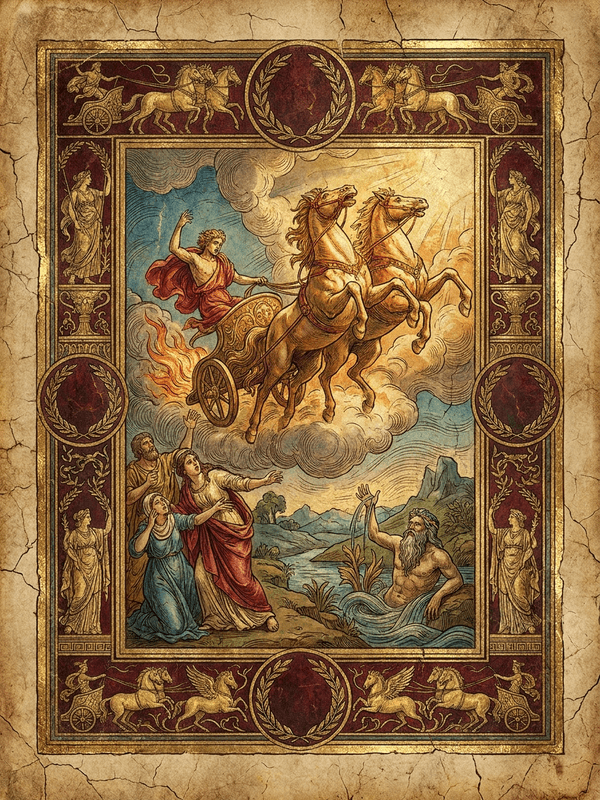
To prove that he is the son of Helios, Phaethon begs his father to let him drive the chariot of the sun for a single day. But he cannot master the fiery horses of heaven. The chariot tears wildly through sky and earth, until Zeus strikes the boy down with a thunderbolt.
Article
Summary
From childhood Phaethon had heard his mother, Clymene, say that his father was Helios. Others did not believe it. Epaphus mocked him to his face, saying he was only boasting. Stung by shame and anger, Phaethon ran to his mother and demanded proof. Clymene pointed toward the place where the sun rose and told him to go to his father and ask him himself. Phaethon came to the palace of Helios and saw his father seated in radiance. Helios acknowledged him as his son and, swearing by the river Styx, promised to grant him one wish. Phaethon at once asked to drive the sun chariot for a day. Helios was horrified and begged him again and again to choose another gift, but the oath could not be taken back, and the boy would not change his mind. At dawn Phaethon climbed into the golden chariot and took the reins of the four fierce horses. When the gates opened, the team rushed into the sky and soon sensed that the hands behind them were not their master’s. Phaethon could not restrain them. The chariot left its ancient track, now climbing too high, now plunging too close to earth. Its fire scorched forests and mountains, dried rivers, and drove even the sea into turmoil. The Earth, suffering under the heat, cried out to Zeus for help. Seeing that both heaven and the mortal world were near ruin, Zeus raised his thunderbolt and struck the runaway chariot. Phaethon fell from the sky and landed beside the river Eridanus. His sisters wept by his grave until they were changed into poplar trees, their tears becoming amber; Cycnus, who mourned him too, was changed into a swan.
The Boy Who Was Mocked
Phaethon grew up beside his mother, Clymene. She told him that his father was no mortal man, but Helios, the god who drove the chariot of the sun across the sky each day. When the boy heard this, pride and uneasiness rose together in his heart. Whenever the sun climbed over the world and gold light touched the rooftops and the river, he could not help looking upward, as if somewhere in that height a pair of eyes were watching him.
But not everyone believed him.
One day Phaethon was arguing with other boys, and Epaphus was among them. Epaphus was a son of Zeus, proud of his noble birth and not one to yield in speech. When he heard Phaethon speak of Helios, he laughed coldly and said, “You heard a few words from your mother, and now you call yourself a child of heaven. Who knows who your father really is?”
The words struck Phaethon like a stone against the chest. He wanted to answer, but for a moment no words came. Some of the boys around him lowered their heads and smirked; others pretended not to have heard. Phaethon’s face burned. He turned and ran back to his mother.
When he entered the house, Clymene saw that his eyes were red and hurried to ask what had happened. Phaethon repeated every word Epaphus had spoken, growing more wounded as he spoke. “Mother,” he said, “if what you told me is true, give me proof. I want them to know that I am not lying.”
Clymene listened, then lifted both hands toward the bright sun in the sky. “My child,” she said, “I have not deceived you. The god who lights the earth each day is your father. If doubt still troubles you, go and find him. His palace stands where the sun rises. You may ask him with your own mouth.”
At once an urgent fire caught in Phaethon’s heart. He did not want to wait. He did not want to endure another laugh. So he left his mother and set out toward the east, where the sun came up.
The Palace of Helios
Phaethon traveled far. The roads of the mortal world fell away behind him, mist and cloud spread beneath his feet, and the light of the east grew brighter and brighter. At last he reached the palace of Helios.
No mortal hands could have built such a place. Tall columns shone with gold; ivory gleamed along the roof; on the silver doors were carved the sea, the earth, the stars, and many ancient scenes. Light poured through the cracks of the doors, so brilliant that Phaethon could scarcely keep his eyes open.
He gathered his courage and went inside, though he dared not draw too near. Deep within the palace Helios sat upon his throne, clothed in blinding radiance, his hair like threads of burning gold. Around him stood the four seasons: Spring crowned with flowers, Summer robed in ripened grain, Autumn bearing grapes, and Winter with frost in his hair. Day, Month, Year, and the Hours were there as well, each in its appointed place.
Helios saw the boy standing at a distance. He softened his light and asked gently, “Child, why have you come here? What do you seek from your father?”
At the word “father,” all Phaethon’s hurt rose up again. He stepped nearer and said, “On earth they mock me. They say I am not your son. They say my mother lied to me. I have come to ask you for a sign, so that everyone may know I truly am your child.”
Helios looked at him, stretched out his arms, and embraced him. “Clymene did not lie to you. You are my son; I have never denied it. To set your heart at rest, ask one gift of me. Whatever it is, I will grant it.”
Then he swore by the river Styx. Once a god had sworn by the Styx, there could be no turning back.
Phaethon hardly paused to think. He had waited too long to hear such a promise. He lifted his head and said eagerly, “Then let me drive your sun chariot for one day. Only one day. I want to drive it across the sky myself, where all may see.”
At once the face of Helios changed.
The Oath That Could Not Be Recalled
Helios regretted his promise so deeply that for a moment he could barely speak. Then he shook his head and pleaded, “Child, you have asked for the wrong thing. What you seek is not glory but danger. The sun chariot is no ordinary chariot, and the horses that draw it are not horses of the earth. They breathe fire. As soon as the gates open at dawn, they surge upward into the sky. Only I can hold the reins.”
Phaethon stood before him, still filled with longing.
Helios spoke again. “The road is hard. At first it climbs steeply, and the horses strain upward with all their force. At the height of heaven, earth and sea lie far below, and even I do not look down carelessly. Toward evening the wheels rush downward into the west. And in the sky there are terrible constellations: the Bull lifting his horns, the Lion opening his jaws, the Scorpion curling his venomous tail. You are young. Your arms do not have the strength. How will you make them obey?”
He paused, and his voice grew lower. “Ask for something else. Gold, jewels, cities, long life—anything difficult for mortals to obtain, I will give you. Only do not touch that chariot.”
But Phaethon had only one thought left in him: he would make everyone who had mocked him see that he could drive the chariot of the sun. He clutched his father’s robe and begged again and again. Helios looked at him and knew that the oath had already been spoken. It could not be recalled. At last he fell silent.
Before dawn, the gates outside the palace opened.
The sun chariot stood ready. Its axle and wheel-spokes glowed with gold, and flame-like patterns ran along its pole. The goddesses of the Hours led in the four fierce horses. They stamped the ground, white-hot breath streaming from their nostrils, their manes reddened by firelight. They were used to the hands of Helios and would not stand quietly for even a moment.
Helios rubbed a divine ointment over Phaethon’s face to protect him from fire, then set the radiant crown upon his head. One last time he warned him: “Hold the reins tight, but do not urge the horses on. They run too swiftly by themselves. Keep to the middle path. Do not go too high, or you will scorch the halls of heaven; do not go too low, or you will burn the earth. Follow the old wheel tracks. Do not leave them.”
Phaethon nodded. His heart beat fast, and sweat dampened his palms, but he still climbed into the chariot and took the reins.
The Chariot Runs Wild
The eastern gates opened, and the four horses sprang forward. The wheels rolled over the clouds, and fire scattered from the ruts behind them. At first Phaethon felt almost like a god of the sky. He stood in the chariot and watched the earth slowly unfold beneath him, its rivers like silver threads, its mountains like folds in a rumpled cloak.
But the horses soon knew something was wrong.
On other days the hands of Helios were steady and strong. A tightening of the reins, a loosening, and the horses knew where to go. Now a boy held them, his arms trembling, unable to check their force. The fiery team ran faster and faster, and the sun chariot began to stray from its ancient track.
Phaethon tried to pull them back, but the reins leapt and writhed in his hands. He heard the axle shriek beneath him, felt the chariot box shudder under his feet. The constellations loomed near one after another: the Crab sprawled at one side, the Lion opened its mouth, the Scorpion raised its curved tail. When Phaethon saw that sting like a poisoned spear, terror drained the strength from his hands.
The reins slackened, and the horses broke wholly free.
Now they rushed too high, and clouds burned away; even the stars seemed licked by tongues of flame. Now they plunged too low, and the blazing wheels almost grazed the earth. Forests were the first to catch, pines and oaks bursting into sparks. Pastures withered; crops curled in the heat. Rivers bubbled and hissed, streams exposed cracked beds, the surface of the sea turned pale under the glare, fish fled into the depths, and even the gods of the deep drew back in fear beneath the water.
Mortals on earth did not know what had happened. They looked up and saw that the sun was no longer moving calmly along its daily path, but dragging terrible fire as it lurched from side to side across the sky. Some ran to wells and found the water hot. Some knelt before altars and begged the gods for mercy. Some clasped their children and hid in caves, but even the caves were stifling as ovens.
Phaethon stood in the chariot, and all the pride with which he had set out was gone. Hot wind whipped his hair across his face. Fire filled his eyes; the neighing of horses and the thunder of wheels filled his ears. He tried to call out to his father, but the wind tore his voice apart. He tried to seize the reins again, but they slipped and twisted like living snakes, and he could not hold them.
The Earth Cries Out
The fire spread wider and wider. Snow melted from the high mountains, forests fell in burning ranks, and deep cracks opened in fertile fields. River gods lifted their heads from dry channels, their faces smeared with mud; spring nymphs, bereft of their clear waters, wept along blackened banks.
At last the Earth could bear no more. From the split ground she raised her heavy face, smoke caught in her hair, dry roots clinging to her brow. She cried to the high heavens, her voice hoarse with pain: “Zeus, if I deserve such punishment, then let your thunderbolt strike me directly. But look at the sea, look at the sky, look at the dwelling places of the gods. If this chariot is not stopped, everything will be burned away.”
Zeus heard her. From his height he saw that the sun chariot had left its proper course, that fires raged everywhere on earth, and that heaven itself trembled in the heat. He knew there could be no more delay.
Yet there was only one way to stop the chariot.
Zeus lifted his thunderbolt. Clouds gathered around his hand, and thunder drowned the horses’ cries. Then a bolt split the sky and struck the boy standing in the chariot.
Fire and lightning swallowed Phaethon together. The reins fell from his hands, and his body was hurled from the car, falling like a burning star toward a distant land. Fragments of the chariot scattered through the air; the maddened horses flew apart, until at last they were brought under control again.
The boy fell beside the river Eridanus. The water received his charred body, and steam rose from the stream. Silence lay along the bank. Those who had mocked him, those who had doubted him, would never see him return in triumph with the chariot of the sun.
The Poplars by the River
The nymphs of the river pitied Phaethon and buried his body on the bank. His grave bore none of the glory the boy had longed for. Only an inscription remained, saying that here lay one who had driven the chariot of the sun. He had not guided it well, but he had died daring the attempt.
When the Heliades heard the terrible news, they came to the banks of the Eridanus. Around the tomb they wept for a long time, day after day, unwilling to leave. Their tears fell into the soil, but their feet slowly ceased to move. Skin became bark, arms became branches, and hair turned into leaves that whispered in the river wind.
They became poplar trees along the bank. Yet their mourning did not end. From their trunks seeped clear bright drops, like tears, falling into the water; in time those drops hardened into golden amber.
Another mourner, a kinsman or friend named Cycnus, grieved for Phaethon as well. All day he wandered by the river, unwilling to leave the fire-scorched sky and the waterbank where the boy was buried. In time his voice grew low and rough, white feathers covered his body, his neck lengthened, and he became a swan drifting over the river’s surface.
The sun still rose every day, but the chariot was never again entrusted to a boy. Phaethon had wanted one day of light to prove his birth; instead, heaven and earth remembered his fall.