Greek Mythology
Pandora — Greek Mythology
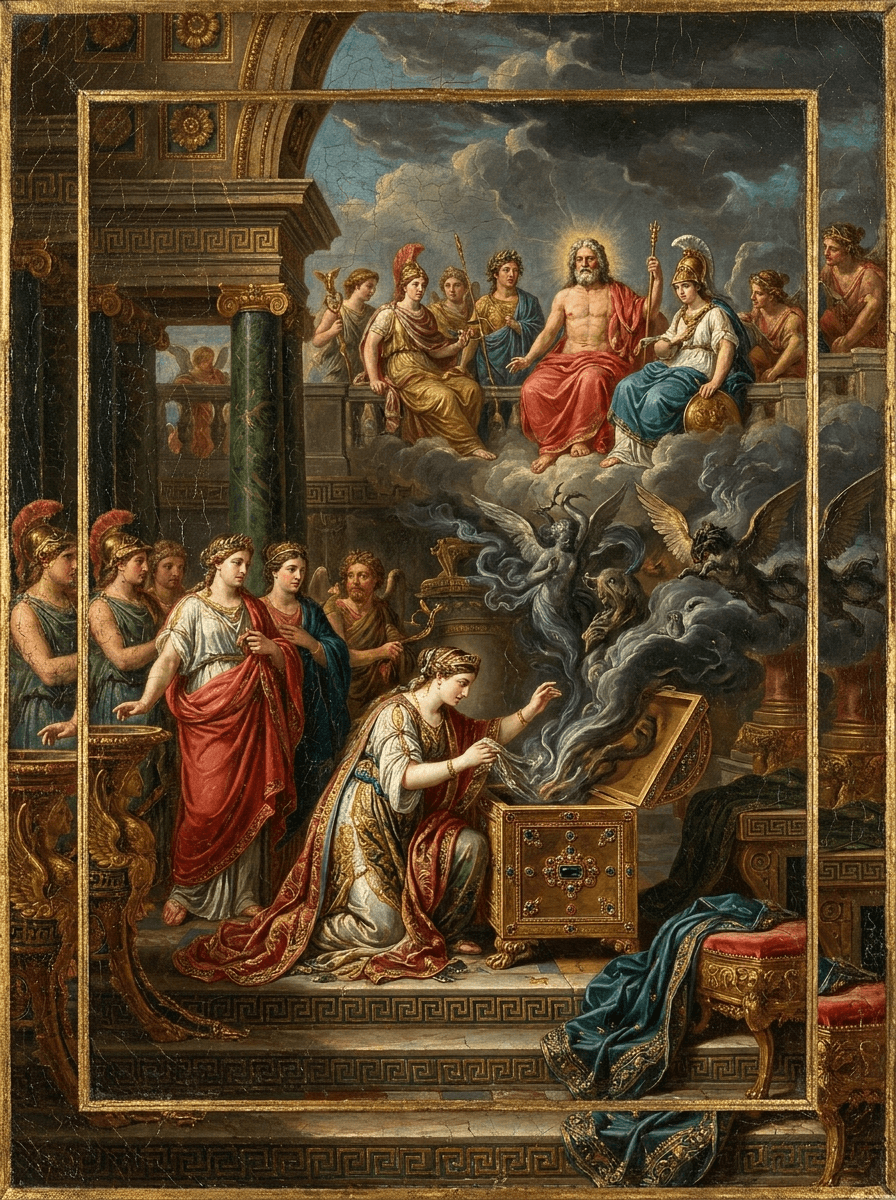
After Prometheus brought fire to humankind, Zeus refused to let the deed go unanswered. He ordered the gods to fashion Pandora, the first woman, and sent her to the house of Epimetheus. When the jar she brought with her was opened, suffering scattered through the human world, and only Hope remained inside.
Article
Summary
To help humankind, Prometheus had once deceived Zeus and stolen fire from heaven. With fire, people could warm themselves, roast meat, bake clay, and forge iron, and life on earth grew better day by day. When Zeus saw smoke rising from below, he knew that mortals had gained something never meant for them. Anger settled in his heart, and he resolved to answer Prometheus with a different kind of gift. He commanded Hephaestus to shape a maiden out of earth and water. Athena clothed her and taught her women’s work; Aphrodite gave her a radiance that could charm the heart; Hermes placed cunning speech within her. Each of the gods bestowed a gift, and so she was called Pandora. Zeus sent Pandora to Epimetheus, the brother of Prometheus. Prometheus had already warned him never to accept anything sent by Zeus. But when Epimetheus saw Pandora standing at his door, beautiful in face and gentle in speech, he forgot his brother’s warning and let her stay. Later, Pandora opened the jar that had come with her. Disease, toil, hunger, grief, old age, and many unseen pains flew out and spread over land and sea and into human homes. When she hurried to close the lid, only Hope was left at the bottom. From then on, human beings could no longer live without suffering; yet amid labor and sickness, they still held fast to a small hope that would not die.
Firelight on the Earth
After Prometheus brought the seed of fire down to humankind, night on earth was never the same.
Before that, when darkness fell, people could only hide in caves and listen to wild beasts moving outside. Cold winds crept in, and old people and children clung together, shivering. Raw meat was hard to swallow; wood and stone, however useful they might become, lay stubborn and unchanged. Then people learned to shelter embers in a hearth, to feed them with dry grass and twigs until they grew. Flames licked the wood and crackled. Red light leapt across cave walls. People gathered around the fire to roast meat, boil water, and drive away beasts. They began to harden clay in flame and melt metal in the heat.
Zeus saw all of it.
On Mount Olympus, clouds wound around the palace of the king of the gods. Zeus looked down upon the earth and saw columns of smoke rising one after another. He saw humans grow bolder because of fire, saw their lives become steadier. He remembered how Prometheus had tricked him over the sacrificial meat, and he remembered the fire that should never have fallen into mortal hands. His face darkened.
Prometheus was clever, and merely punishing him would not be enough. Zeus decided to let his anger fall upon humankind. Yet he would not hurl down thunderbolts, nor would he send a flood. He would give them a gift—beautiful on the outside, but carrying ruin within.
The Maiden Shaped from Clay
Zeus summoned Hephaestus.
Hephaestus was the craftsman among the gods, forever at work beside the furnace. In his forge the coals burned red, and tongs, hammers, and anvils lay close at hand. Zeus ordered him to take earth and clear water and shape from them a maiden in the likeness of the goddesses.
Hephaestus did not dare refuse. He lifted the damp clay, kneaded it, and slowly pressed out a forehead, eyes, lips, arms, and ankles. Under the hands of the divine smith, the clay ceased to look like clay. Little by little it took on a soft living form. When he withdrew his hands, a maiden unlike any ever seen among mortals stood before him, as though she had just stepped out of the deep earth.
Then Zeus called the gods and commanded each of them to give her a gift.
Athena came forward and wrapped the maiden in a white robe. She taught her weaving, sewing, and the delicate arts of the household. The goddess’s fingers passed over the cloth, and the folds fell neatly; the girdle sat just as it should. She placed a veil upon the maiden as well, so that she stood there at once modest and solemn.
Aphrodite gave her a captivating radiance. It was not only beauty of the face, but something hidden in the way she lowered her head and smiled, and in the way she lifted her eyes to look at someone. Whoever saw her would find it easy to let down their guard.
Hermes came too. He was the messenger of the gods, often wearing the swift sandals that carried him through the air. He put the power of speech into the maiden’s heart, and with it craftiness, curiosity, and words that could move the mind. From then on she was not merely beautiful; she knew how to speak, and how to make others want to listen.
Hephaestus also made for her a finely wrought golden ornament, covered with tiny patterns of birds, beasts, and flowers, so lifelike they seemed ready to stir. The gods looked upon the newly made maiden in wonder. She was not a goddess, yet she carried many things bestowed by gods. She was no ordinary gift, yet she had been adorned like a bride at a wedding.
Zeus named her Pandora, “the woman gifted by all,” because every god of Olympus had placed something of their own upon her.
But Zeus did not tell her what she would bring when she came to earth.
The Warning of Prometheus
On earth, Prometheus had already guessed that Zeus would not let matters rest.
He had a brother named Epimetheus. Prometheus had a deep, foreseeing mind and always considered the consequences before a thing was done. Epimetheus was often the opposite: he rejoiced at whatever good stood before his eyes, and only after he had suffered for it did he understand his mistake.
Prometheus had warned his brother solemnly: “If anything comes from Olympus, do not accept it. No gift from Zeus comes to humankind for nothing. Send it back. Do not let it cross your threshold.”
Epimetheus nodded and promised. He knew his brother was wise, and he knew Zeus was still angry over the matter of the fire. But the human heart can sometimes hold fast to a warning and still fail before a sudden temptation standing at the door.
Not long afterward, Hermes led Pandora down to the world of mortals.
That day, Epimetheus saw a strange maiden approaching his house. Her garments shone; a finely made ornament rested upon her head; her veil fell softly. Her steps were neither hurried nor slow, like morning light flowing down a hillside. She stood before the door and said that she was a gift sent by Zeus.
Epimetheus should have remembered his brother’s words at once.
But he looked at Pandora, heard her gentle voice, and saw the objects and gifts she had brought with her, and his caution slowly loosened. The name of Zeus made him uneasy, but the maiden before him had no thunderbolt and no chains. She seemed only like a bride with nowhere else to go.
He hesitated for a while. At last he welcomed her inside.
And so the warning of Prometheus was left forgotten beyond the door.
The Jar with the Sealed Lid
When Pandora came into the house of Epimetheus, she brought with her a great jar.
In later tellings, some would call it a box; in the older telling, it was more like a storage jar of clay. It was heavy, round-bellied, and tightly sealed, as though something precious were hidden inside. It sat silently in the house. It neither spoke nor shone, yet again and again the eye was drawn toward it.
Epimetheus asked little about it. Perhaps he thought it was part of the dowry Zeus had sent with her; perhaps he simply did not wish to think too carefully. Pandora, however, often looked toward the jar.
She did not know what was inside. The gods had given her beauty, skill, and speech, but they had also given her a heart easily stirred. The sealed lid seemed to call to her: What is inside? Why must it not be opened? Why has it been placed where I can see it?
Day followed day. Outside, the wind moved over the fields; inside, the hearth burned as before. Humankind still believed life might continue in this way: with labor, but without the full weight of disease; with the cold and heat of the seasons, but without endless calamities; with the shadow of death, but not yet with so many pains pressing close by night and day.
At last, one day, Pandora could bear it no longer.
She went to the jar and set her hands against the rim of the lid. It was tight. She pulled hard, and in the instant the clay cover lifted from the mouth of the jar, a cold breath surged out from within.
It was not fragrance. It was not light.
A dark mass burst from the jar, like smoke, or like a swarm of insects whose shapes could not be seen. They crowded through the opening, brushed past Pandora’s arms, and flew toward the cracks beneath the door, the window holes, and the gaps in the roof. Pandora stumbled back in terror, yet there was almost no sound in her ears. Zeus had made these afflictions travel quietly, so that people would often discover them only when they were already at their side.
Disease flew out and entered human bodies. Fever flew out and made foreheads burn and throats crack with thirst. Toil flew out, and the earth no longer gave food easily; people had to bend over the fields, and sweat fell into the soil. Hunger, grief, quarrels, old age, and pain followed one after another and spread across the earth. They crossed hills, rivers, and the surface of the sea. They entered villages, fields, and the houses where people slept.
Pandora rushed back and pressed the lid down with all her strength.
The jar was shut again.
But it was too late. Nearly all the evils had escaped. Only one thing remained at the bottom, unable to fly out in time. That thing was Hope.
Hope at the Bottom of the Jar
From then on, the world of mortals was no longer as it had been.
At dawn people still lit their fires, still took up their hoes and went out to the fields, but the soil had grown stubborn, and grain had to be won with sweat. Children fell ill; the old grew weak; even those in the strength of life could be struck down by pain. Many afflictions made no footsteps and gave no cry. They came quietly to the bedside at night and hid by day along the roads where people walked.
Only then did Epimetheus remember the warning of Prometheus. He understood that what he had accepted was no ordinary gift, but a revenge carefully prepared by Zeus. Yet the deed was done. However tightly the lid was shut, it could not gather back the sorrows already scattered through the world.
Pandora stood beside the jar in fear. She was not a god who wielded thunder, nor a hero who had stolen fire, yet she had become the doorway through which suffering entered human life. The beauty the gods had given her remained; the garments remained; the golden ornament remained. But none of these could call back what had flown from the jar.
Only Hope was still inside.
Some say this gave humankind one comfort to cling to in suffering. Others say that because Hope was shut at the bottom of the jar, people go on hoping without ever truly escaping pain. However it is told, from the day Pandora opened the jar, sickness, labor, and grief made their home among mortals. Humanity kept its fire, but kept its hard days too; frightened in the dark, groaning in sickness, working the barren ground, and still, even so, lifting its eyes toward tomorrow.
Once that jar was closed, the old world never returned.