Greek Mythology
Orestes and the Furies — Greek Mythology
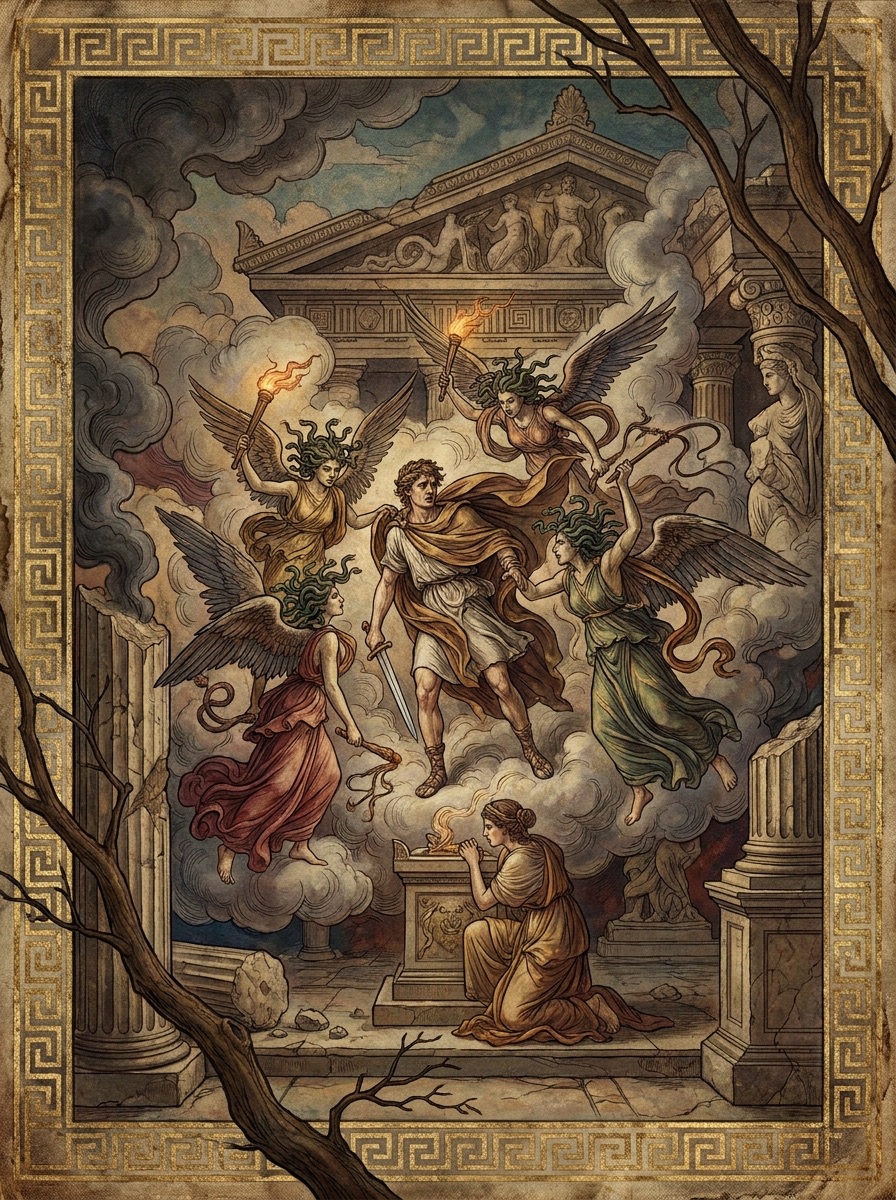
Orestes avenges his father by killing his mother, Clytemnestra, but at once the Furies begin to hunt him. Apollo sends him to stand trial in Athens, where Athena establishes a court and brings the hatred of bloodshed under the judgment of the city.
Article
Summary
After Agamemnon returned from Troy to Mycenae, he was murdered by his wife Clytemnestra and Aegisthus. Years later, Agamemnon’s son Orestes obeyed Apollo’s oracle and came home. There he recognized his sister Electra, and beside their father’s tomb he swore revenge. Orestes killed Aegisthus, then went into the palace and killed his mother, Clytemnestra. The revenge was done, but the moment his mother’s blood touched the earth, the ancient Furies awoke. They pursued the man who had killed his mother; Orestes alone could see them, robed in black, their hair entwined with serpents, driving him onward without rest. Orestes fled to Delphi and clasped Apollo’s altar for protection. Apollo declared that he himself had commanded the deed, and sent Hermes to guide Orestes to Athens, where he would be judged before Athena. The Furies followed him there as well, demanding that a mother’s blood be paid for with the blood of her son. Athena did not simply favor one side. She summoned the Athenians and established a trial on the Hill of Ares. After both sides had spoken, the votes were equal; Athena cast her vote for Orestes, and he was acquitted. At first the Furies were furious beyond measure, but Athena persuaded them to remain in Athens and receive honor as the “Kindly Ones.” Orestes was freed at last from pursuit, and the generations of blood-feud in the house of Atreus came to rest in that judgment.
The Oath at His Father’s Tomb
After Agamemnon’s death, the palace of Mycenae seemed crushed beneath a shadow.
He had led the Greeks against Troy and, after ten years, had come home at last on the sea wind. Yet soon after he entered his own halls, he fell in the bath. Clytemnestra entangled him in a robe like a net, and Aegisthus helped strike him down. The king’s blood ran over the stone floor, and everyone in the palace fell silent, afraid even to speak aloud.
Agamemnon’s daughter Electra remained in the house like an overlooked shadow. She kept her father’s memory alive, and with it her own bitterness. Her younger brother Orestes had been only a child and had long ago been sent away, fostered in a distant land. Clytemnestra and Aegisthus believed that if the boy never returned, Agamemnon’s blood would slowly grow cold.
But Orestes grew to manhood.
He went to ask Apollo’s oracle what he must do. The god’s voice came from Delphi, stern and clear: he must go home and avenge his father. If he failed, the guilt would fall upon him. Orestes heard the command, but it brought him no ease. His father’s enemies were two: Aegisthus, who had usurped the throne, and the woman who had given him birth.
He returned to Mycenae with his friend Pylades. The two did not knock first at the palace gates. Instead they went to Agamemnon’s tomb. Beside the mound were traces of libations and locks of shorn hair. Electra had come there with slave women to make offerings. She had been sent by her mother, but not from any true wish to soothe the dead. Clytemnestra had dreamed a terrible dream: she had given birth to a serpent, and the serpent bit her breast and drew blood. Fearing the anger of the dead, she had ordered offerings to be carried to the tomb.
Electra saw a lock of hair upon the grave, then footprints on the ground, and her heart leapt. The hair looked like her own; the footprints seemed to belong to her family. While she stood in wonder, Orestes came forward and made himself known.
Brother and sister had been separated for many years. When they met beside their father’s grave, there was little laughter, only muffled weeping. Electra clung to her brother as if she had seized the last hope left to her. Orestes pointed to the mound and swore that those who had killed their father would pay blood for blood. Pylades stood beside him, silent and steadfast.
Together they made their plan. Orestes would pretend to be a stranger and enter the palace with a message: Orestes was dead.
The Knife Behind the Palace Doors
Orestes and Pylades came to the palace gates. When the doors opened, Orestes looked like a traveler from abroad, dusty from the road, his voice steady. He said he had come from a foreign land bearing news of Orestes’ death.
When Clytemnestra heard that her son was dead, a troubled expression crossed her face. She seemed at once startled like a mother and relieved, as if a heavy stone had been lifted from her. She welcomed the visitors into the palace and sent for Aegisthus. Aegisthus came without guards. He thought danger had passed and hurried only to hear the details of the boy’s death.
As soon as he entered the room, Orestes struck.
There was a brief cry within, and then silence. After Aegisthus fell, Clytemnestra understood who the stranger was. She rushed out from the inner chamber and saw her son standing beside the blood, a blade in his hand.
She did not first beg for the throne, nor did she begin by arguing guilt. She tore open her robe, pointed to her breast, and said, “Child, look here. This is where you fed when you were small.”
Orestes’ hand faltered.
He could kill Aegisthus, for that man was a usurper and his father’s enemy. But the woman before him was his mother. She had held him in her arms, and she had led his father to death. He turned to Pylades, as if asking whether he could still draw back.
Pylades had remained silent until then. Now he spoke. He reminded Orestes not to forget Apollo’s command, and not to make the oracle vain.
Those words drove Orestes back onto the path before him. He turned again to Clytemnestra. She was still pleading, speaking of fate, speaking of how she had killed Agamemnon because of the death of their daughter Iphigenia. Orestes listened, his face growing paler. He knew there was old grief in his mother’s words, but his father’s blood could not be wiped away.
At last he led her inside.
Behind the door came a cry. Clytemnestra fell beside Aegisthus. When Orestes came out again, his hands were stained with his mother’s blood. He showed the people the garment that had once trapped Agamemnon and said his father had been murdered with that thing. He seemed to be proving that he was no murderer, but the agent of justice.
Yet before he had finished speaking, his eyes suddenly changed.
The Dark Shapes Only He Could See
Others saw only the bodies in the palace, the bloodied knife, and terrified servants. Orestes saw something else.
Out of the darkness a company of ancient goddesses pressed toward him. They were not like the bright gods of Olympus. They wore black robes; serpents twisted in their hair; in their eyes burned a rage that would not go out. They followed kindred blood, and above all they would not spare a man who had killed his mother. The moment Clytemnestra’s blood struck the ground, they awoke as if they had scented it.
Orestes cried out, saying they were before him. The others saw nothing and thought his crime had driven him mad. But he saw them clearly: the Furies reached out their hands and forced him from the palace, forced him to acknowledge the debt of his mother’s blood.
He could not remain. He could not sit upon his father’s throne. The knife had avenged him, but it had brought him no peace. Orestes fled from Mycenae as if lashed by whips, making for Delphi.
On the road he scarcely dared to sleep. Whenever his eyes closed, the dark figures gathered around him. They did not fear night or wilderness. Their steps made no sound, yet they always came up behind him. He crossed mountain paths and rivers, covered in dust, until he reached Apollo’s holy place.
In the temple at Delphi, the altar fires shone brightly and laurel branches hung upon the walls. Orestes threw himself before the altar and clasped the god’s stone seat with both hands. The blood on his hands had dried, but in the eyes of the Furies it was forever fresh.
Apollo appeared. He did not deny that the killing had been bound to him. He said Orestes had killed his mother to avenge his murdered father, and in obedience to his own oracle. Since that was so, the god could not abandon him to his pursuers.
The Furies, too, came to Delphi. They sank into heavy sleep inside the temple, like a pack of exhausted hounds. But Clytemnestra’s ghost rose from beneath the earth and urged them awake. She reproached them for sleeping, for letting the son who killed her escape. The Furies started up with angry cries and resumed their search for Orestes.
Apollo ordered Hermes to escort Orestes to Athens. There Athena would be found, and there a new judgment would be given. Orestes set out once more, with the Furies still pursuing him from behind.
Athena’s City
By the time Orestes reached Athens, he was like a man dried out by the wind. He went to Athena’s image and clasped it, asking for refuge. He no longer claimed to be wholly without guilt. He said only that he had already suffered long torment, and that the blood on his hands had been cleansed by rites. He begged the goddess not to surrender him.
The Furies soon arrived. They surrounded the image and sang a grim song, as if casting an invisible net. A mother’s blood, they said, could not be lightly dismissed. A person might have many bonds, but a mother’s body had carried her son, and the blood between mother and child was closest of all. Orestes had killed the one who bore him; therefore he belonged to them.
Apollo also came to Athens. He bore witness for Orestes, saying that the oracle had come from him and that Orestes had not committed a private crime on his own. Agamemnon was a king, a husband, and a hero returned from war, yet his wife had murdered him by deceit. If a son did not seek justice for his father, then oaths and marriage would be trampled underfoot.
Each side had its anger, and neither would yield. The Furies were ancient and terrible. They cared nothing for palace arguments; they knew only the debt of kindred blood. Apollo was young and radiant. He protected his suppliant and defended vengeance for a murdered father. If the gods alone kept quarreling, the quarrel would never end.
Athena listened and decided not to judge by herself. She summoned citizens of Athens and established a trial on the Hill of Ares. That place had long been linked with war and killing; now it would hear a case of family bloodshed. She allowed both sides to speak and ordered the people to vote. This was not an ambush in the night, nor a knife behind palace doors, but a matter brought into the open and argued before all.
The trial began.
The Furies accused Orestes first. They asked whether he had killed his mother with his own hand. Orestes could not deny it. He admitted that the knife had been in his hand, and that Clytemnestra was his mother. Yet he said also that his mother had killed his father, had killed her husband, and had destroyed his house. If there was guilt, he had not come to this place alone; Apollo’s oracle stood behind him.
Apollo came forward and said that he had commanded Orestes. He said too that Clytemnestra’s crime in killing her husband could not be hidden behind the name of mother. The Furies grew still more furious, believing that Apollo made light of the mother’s blood. Their voices rang over the hill, while those who listened held their breath.
At last the stones were cast into the voting urns. Each vote fell like a drop of water, slowly deciding Orestes’ life or death.
The votes were equal.
Then Athena cast her own vote. She stood with Orestes. And so Orestes was declared acquitted.
Fury Housed Beneath the Earth
When Orestes heard the verdict, it was as if he had awakened from a long nightmare. He thanked Athena and Apollo. The dark shapes that had hunted him could no longer seize him. He could leave Athens and return to his own fate, no longer driven onward by the cry of his mother’s blood.
But the Furies were not calm.
They believed they had been dishonored. They were ancient goddesses who had guarded the punishment of blood-kin long before many of the newer gods held power. Now a man who had killed his mother had been set free. Their rage rose high, and they threatened to pour poison over the land of Athens, to make the fields barren, to make women childless, and to fill the city with ruin.
Athena did not drive them away with thunderbolts, nor did she mock them as outdated. Patiently she persuaded them. Athens, she said, did not wish to cast them out, but to give them an honored place. They could remain in the city, dwelling deep beneath the earth, receiving offerings and reverence. They need not be only goddesses who hunted blood; they could also protect the harvest, the safety of families, and the city from being torn apart by civil strife.
At first the Furies would not listen. Their angry voices sounded again and again, like black cloud pressing down upon the city. Still Athena spoke to them, promising that the Athenians would honor them with solemn rites. In this city, she said, they would not be forgotten. People would know that without them, crimes would seem too light and oaths too thin.
Slowly, the anger of the Furies subsided.
They accepted Athena’s arrangement and ceased to pursue Orestes. They received a new title and were honored as the “Kindly Ones.” The name did not mean they had become weak or harmless. Rather, people addressed them with reverence, hoping that their fearful power would turn toward protection.
The Athenians led them on their way. Torches lit the road; women and elders followed with sacrificial robes and solemn song. The dark goddesses went down to their dwelling beneath the earth. No longer did they pursue a single exile like hunters; they became deities whom the city itself must honor.
So the case of Orestes came to an end.
For many years the house of Atreus had seen one generation kill another: the crime of Tantalus, the hatred of Pelops, the feud of Atreus and Thyestes, the death of Agamemnon, the blood of Clytemnestra—all of it ran like a river thick with silt until it reached Orestes’ feet. In Athens, the knife was not raised again. The quarrel was brought before a court; the votes were counted; a goddess gave judgment.
From then on, the Furies still heard human oaths beneath the earth, and the court of Athens remembered that day. Orestes escaped pursuit, and when he left he no longer looked back for the black-robed figures. His mother’s blood was not forgotten, but his father’s vengeance no longer bred new killing. The long night of that family had at last shown a little daylight in the sound of judgment.