Greek Mythology
Oedipus's Marriage to His Mother and the Plague — Greek Mythology
After Oedipus saves Thebes, he becomes king and marries Jocasta. Years later, plague strikes the city, and the oracle forces him to reopen the old murder of Laius.
Article
Summary
After saving Thebes from the Sphinx, Oedipus receives the throne and marries Jocasta, never knowing that the marriage fulfills the oracle he tried to escape. For years the city trusts him as its savior. Then plague falls on Thebes, and Apollo’s answer points back to the unavenged murder of Laius, forcing Oedipus to begin the investigation that will undo his house.
Throne and Wedding
Inside the palace, Queen Jocasta still lived in widowhood.
She had once been the wife of Laius. Many years before, she had given birth to a baby boy. Because an oracle had said that the child would one day kill his father and marry his mother, Laius had ordered the infant’s ankles pierced and handed him to a shepherd to be left out in the hills. Jocasta believed the child had long since died, and that the dreadful prophecy had ended in the past.
Now Thebes needed a king. Oedipus had saved the city, the people acclaimed him, and Creon yielded the throne. So, according to the earlier agreement, Oedipus married Jocasta.
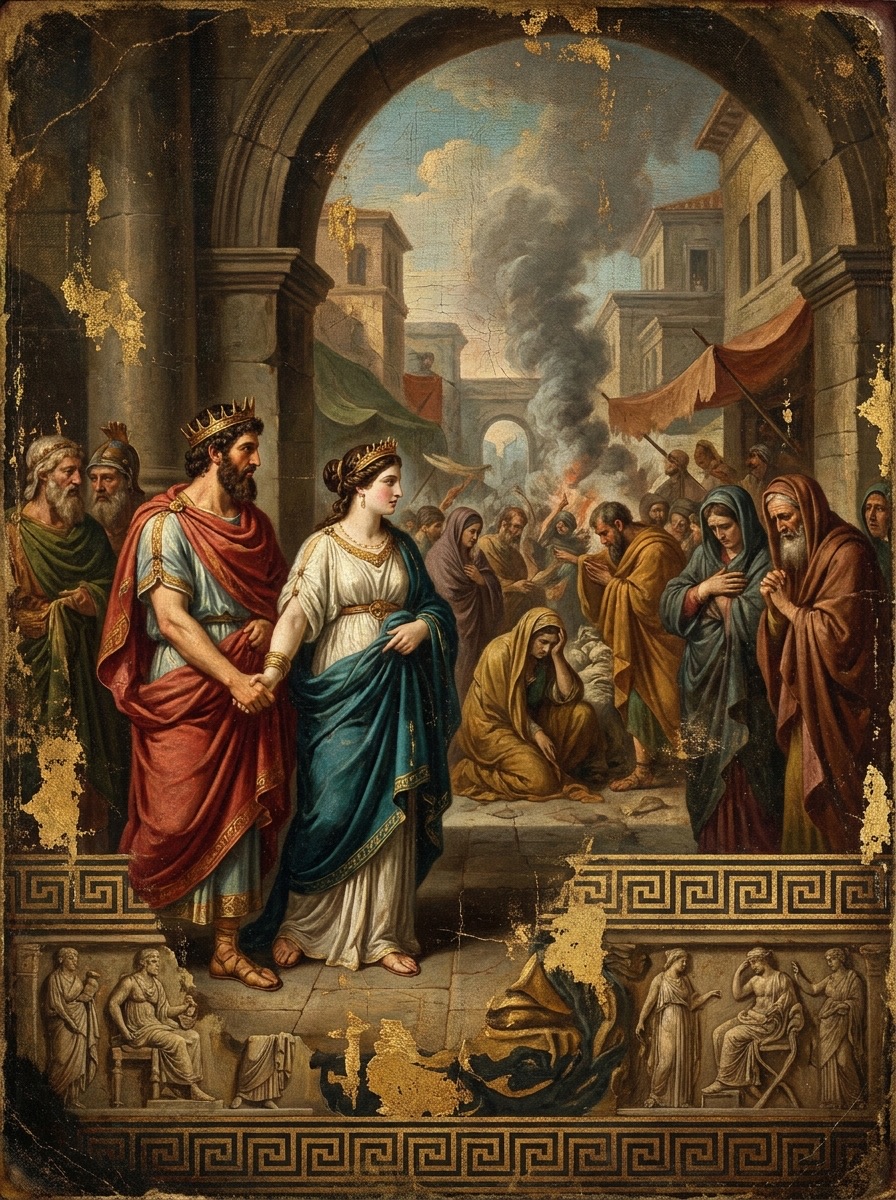
At the wedding, joy returned to the city after a long absence. Animals were brought to the altars, smoke rose toward the sky, and music drifted through the columns of the palace. The people rejoiced that the Sphinx was dead and that the new king was young, bold, and able to restore peace to Thebes.
Oedipus believed his fate had changed at last.
He had not returned to Corinth. He had not killed Polybus. He had not married Merope. In his heart, he told himself that he had escaped Apollo’s terrible prophecy.
But he did not know that the more he fled, the more closely he stepped into it.
The old man he had killed was Laius, and the queen he had married was Jocasta. The infant with the pierced ankles, abandoned in the mountains, had not died. It was he himself.
Years Later in Thebes
Many years passed, and Oedipus sat firmly on the throne.
He and Jocasta had children: two sons, Eteocles and Polyneices, and two daughters, Antigone and Ismene. The children grew up within the palace walls, while the people beyond them gradually grew used to their foreign-born king.
Oedipus was decisive and did not hide from trouble. When men quarreled, he heard both sides. When the city was in danger, he came forward himself. The Thebans remembered that he had solved the Sphinx’s riddle and saved the whole city, and so they respected him and trusted him.
But peace did not remain in the city forever.
First the fields failed to bear fruit. Farmers stood beside cracked earth and watched the grain wither. Then cattle fell sick, and beasts could not bring forth their young. Women in labor cried out in agony, and many children died before they had even seen the light. House after house had its dead, and the streets filled with those carrying corpses away.
The temples were crowded with suppliants. Old men came with olive branches, children knelt by the altars, and ash settled into their hair. The air was thick with the smell of herbs, blood, and burnt offerings, yet none of it could silence the city’s grief.
This time, once again, the people of Thebes came to the palace.
But they were not there to celebrate. They had come to beg for help.
The Petition at the Altar
By dawn, the palace entrance was already filled with kneeling people.
A priest stood with boys and old men, all carrying branches bound for supplication. When they looked up and saw Oedipus emerge, they told him of the ruin overtaking the city: the land was dead, the cattle were dying, women and infants alike were perishing. Thebes was like a ship broken by storms, and everyone aboard was drowning.
Oedipus looked at them and did not pretend ignorance.
He said that he had not been idle in the palace. He too was troubled by every cry in the city, and he had already sent Jocasta’s brother Creon to Delphi to ask Apollo why Thebes suffered and how the plague might end.
The people heard this and found a little hope.
Soon Creon returned. A wreath was on his head, and his face was grave. Before anyone else could speak, silence had already settled around the gate. Oedipus asked him publicly what the oracle had said.
Creon answered that Apollo’s words were plain: Thebes was hiding bloodguilt. The murderer of Laius had not yet been punished. So long as that man remained within the city, the plague would not depart. He must be found and driven out, or made to repay blood with blood.
At that, the crowd seemed to shiver.
Laius had been dead for many years. Back then, Thebes was trapped by the Sphinx and everyone was occupied with surviving. The old case had never been properly investigated. The attendants who had returned said only that the king had been killed on the road by a band of robbers. Then Oedipus saved the city, and people turned their thoughts to the new king and the new life he had brought.
Now Apollo had brought that old matter back into the open.
The Oath to Pursue the Old Crime
Oedipus did not shrink back.
Before the priest, the elders, and the people, he declared that Laius might not have been his kin, but he had been the former king of the city; now Oedipus sat on Laius’s throne, had taken his widow as wife, and had inherited all that belonged to Thebes. To avenge the old king was to cleanse the city of its suffering.
He ordered that anyone who knew the murderer’s name must speak. If someone feared to come forward, confession would allow him to leave with mercy; if anyone sheltered the killer, he would be cursed. Whoever the man might be, no one was to house him, pray with him, or let him near holy water and the altars. The blood on that man’s hands was killing Thebes itself.
As he spoke, Oedipus’s voice was firm. The people looked at him and saw again the fearless young man who had once faced the Sphinx.
But this time, the enemy he sought was not a monster on a cliff or a stranger on the road.
He was searching for the truth of the quarrel at the crossroads years before, for Laius lying in the dust, for the path that had always led back to himself.
The plague still spread through the city, and smoke still rose from the altars. The people of Thebes placed their hope in their king, and Oedipus swore that he would drag the murderer out of darkness.
He did not yet know that the fire he had kindled would first shine upon his own face.