Greek Mythology
Niobe — Greek Mythology
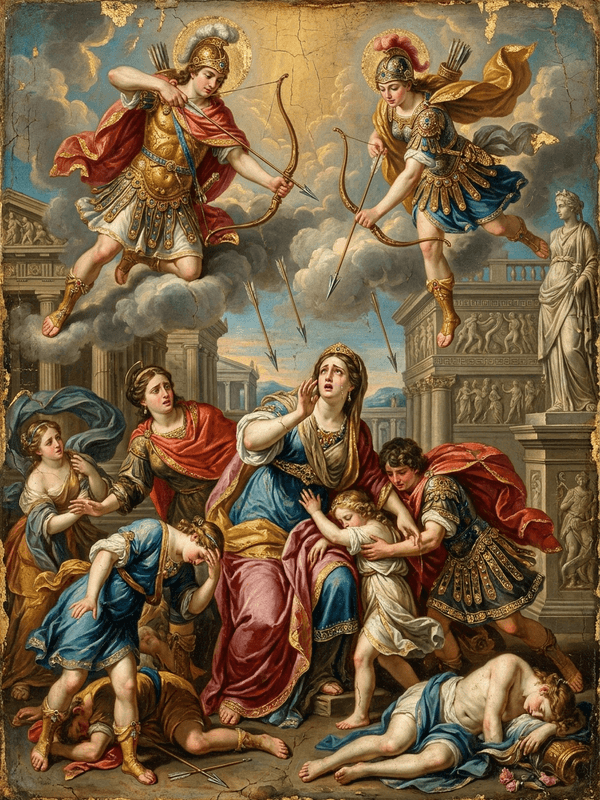
Niobe, queen of Thebes, boasted of her many children and insulted Leto and Leto’s twin children, Apollo and Artemis. The two gods answered with arrows, killing Niobe’s sons and daughters. In her grief, Niobe left Thebes and at last became a stone that never ceased to weep.
Article
Summary
Niobe was queen of Thebes, wife of Amphion, the musician-king said to have built the city walls with his lyre. Her lineage, beauty, wealth, and rule all fed her pride, but her deepest pride was in her children: seven sons and seven daughters. When the women of Thebes were called to honor Leto, Apollo, and Artemis, Niobe came before the altar and mocked Leto for having only two children, urging the city to honor her instead. Leto heard the insult and did not argue with a mortal woman. She called Apollo and Artemis to her side. Apollo went first to the fields outside Thebes, where Niobe’s sons were racing horses and practicing with spears. His silver arrows struck them down one after another, and the young princes who had been the pillars of Niobe’s pride were carried back to the palace in blood and dust. Even then, Niobe did not wholly surrender her arrogance. Kneeling beside her dead sons, she cried that she still had daughters and still surpassed Leto. Artemis answered next. Her arrows entered the palace itself, and Niobe’s daughters fell in terror, until the last child died in her mother’s arms while Niobe begged too late for one life to be spared. After the ruin, the dead lay unburied for nine days before the city found strength to bury them. Niobe lost her husband, her children, and the glory she had counted as protection. She left Thebes for the region of Mount Sipylus, where her body slowly hardened into stone. Yet water kept seeping from the rock like endless tears, and later travelers would point to that mountain stone as Niobe, still weeping for her children.
The Queen of Thebes
In the city of Thebes there lived a queen named Niobe.
Her husband was Amphion. It was said that in his youth Amphion had been beloved by the Muses, and that he possessed a lyre whose music rang clear as a mountain spring falling over stone. When he built the walls of Thebes, he had only to touch the strings, and the great rocks would begin to move, as if they understood the music. One by one they drew together and rose into high ramparts. Gates were set in place, towers followed towers, and Thebes became a strong and splendid city.
Niobe lived within that city, dressed in robes woven with gold thread, surrounded by many handmaids. Her father was Tantalus, who had once sat at table with the gods, and her lineage was crowded with famous names. She herself was beautiful and rich, and when she stood upon the palace steps, the people of Thebes often had to lift their eyes to look at her.
Yet neither palace nor gold was the thing that made her proudest. Her greatest pride was her children.
She had seven sons, all young and strong, skilled with chariots and horses, able to cast the spear in the training ground. She had seven daughters too, just coming into the flower of their youth, who spun and sang in the palace and followed their mother to the sacred rites. People called Niobe a fortunate mother. She heard it so often that in time she began to think of it as no more than her due.
The Women Crowned with Laurel
One day a divine command spread through Thebes.
Manto, daughter of the blind seer Tiresias, went through the streets and called to the women of the city. They were to leave their work and come to the altar to honor Leto and her two children, Apollo and Artemis. She told them to weave laurel branches into garlands and place them on their heads, to bring incense, wine, and offerings, and not to neglect the gods.
So the women came out from their houses. Some carried children in their arms; some brought baskets filled with grain and flowers. They passed through the streets to the open altar, set the laurel on their heads, and bowed in prayer. The smoke of incense rose slowly, curling beneath the bright sky.
Niobe came too.
But she had not come to pray. She rode in her chariot, wearing magnificent robes, with her attendants walking on either side. When she saw the women of Thebes bowing before Leto, surprise crossed her face, and then it hardened into scorn. She approached the altar, looked around at them all, and spoke in a clear, ringing voice.
“What are you doing? Why offer incense to a goddess far away in heaven, and forget the woman standing before your eyes?”
The women were startled and raised their heads. The fire still burned upon the altar, and the wind bent the incense smoke aside.
Niobe went on. “What has Leto done to deserve such honor from you? She has only two children: one son and one daughter. But I have seven sons and seven daughters. My father dined with the gods; my ancestors shine with glory. I rule this city, and my husband built its walls with the music of his lyre. If you must worship a fortunate mother, why not worship me?”
The more she spoke, the more pleased she became with her own words, and her voice grew louder.
“Count my children. Even if fate were to take a few from me, I would still have more than Leto. What has she that can compare with me?”
Her words fell before the altar like ashes thrown into flame. The women dared not answer. Some lowered their eyes; some tightened their fingers around the garlands in their hands. They knew that the gods heard human prayers—and that they heard human arrogance as well.
Leto’s Silence
Leto heard.
She was not the stone image before the women of Thebes, nor a wisp of smoke rising from an altar. She was the mother of Apollo and Artemis. Long ago, when she was heavy with the twins, she had been hunted by jealousy and driven over the earth in search of a place to give birth. Many lands had not dared to receive her, and she had wandered in pain. At last, upon a floating island, she bore her two children: one became the god of the bow, of light, and of music; the other became the goddess who roamed the mountains and guarded young maidens.
She had suffered, and for that reason she remembered insult all the more keenly.
When Niobe’s words reached her, Leto did not argue with a mortal woman. She only called Apollo and Artemis to her side. Their mother did not need to speak at length; when the twins saw her face, they understood.
Apollo took up his silver bow. Artemis slung her quiver across her shoulder. The feathers of the arrows trembled faintly in divine hands, as if they had already heard the wind before they were loosed.
The Sons Outside the City
At that hour, Niobe’s sons were outside the city.
The young princes were racing horses and practicing with spears. Sunlight flashed on the horses’ backs, on bronze fastenings, and on reins drawn tight in eager hands. They knew nothing of what their mother had said before the altar; from the city they heard only a faint murmur of voices.
Then the sky seemed to fall still.
When the first arrow came, no one saw the bow that had sent it. One prince had just drawn in his reins when his chest jerked violently; his hand opened, and he fell from the chariot. The horses, frightened, bolted with the empty car behind them, its wheels grinding through the dust.
His brothers cried out and rushed toward him. Before they could lift the fallen boy, a second arrow struck. A young man still gripping his spear sank to his knees and collapsed upon the grass. Someone looked up into the sky and saw only blinding light.
They tried to flee back to the city, but the arrows were swifter than horses.
Some fell beside their chariots. Some arched backward from horseback. Some reached out to pull a brother away and were themselves struck down. Blood ran into the dust, and the training ground that had been bright with youth only moments before was filled with confusion. Charioteers ran, horses screamed, and servants fled weeping toward the gates.
Apollo stood in a height no mortal eye could see and drew his silver bow. His arrows did not miss. Niobe had counted her sons as the firmest pillars of her pride; now one after another they fell outside the city, like branches snapped by a storm.
When the news reached the palace, Niobe could not at first understand it.
She thought it must be an accident, an enemy attack, some cruel rumor. She rushed out through the palace doors and saw the young bodies being carried home one by one. Her sons were still covered with dust. Sweat and blood had matted their hair, and some of their fingers still clutched broken pieces of reins.
When Amphion saw the bodies of his sons, grief overcame him so completely that he could hardly stand. The lyre that had once moved stones made no sound. In some tellings, he drew his sword and killed himself; in others, he too fell beneath a divine arrow. In either version, Thebes lost its king, and Niobe lost her husband.
But the calamity was not yet finished.
The Daughters in the Palace
Niobe’s daughters heard the cries and ran out from the inner rooms.
They were still wearing soft light dresses; some had not finished arranging their hair, and some wore bracelets their mother had given them. When they saw their brothers laid upon the ground, they clung to one another in terror. The women of the palace began to weep as well, and their voices echoed through the colonnades.
Niobe knelt beside her sons, her hands stained with blood. She lifted her head, and even then she would not wholly bow her pride. Through her tears she cried, “Leto, even if you have taken my sons, I still have daughters! I still have more than you!”
The words had barely left her mouth when the sound of a bowstring stirred the air again.
Artemis had come.
Her arrows did not fly like mortal arrows through a doorway, nor were they stopped by walls. One daughter suddenly pressed her hands to her breast and fell beside her mother. Another turned to flee back into the inner rooms, but before her foot crossed the threshold she sank limply to the floor.
The palace broke into chaos.
The girls ran in terror. One hid behind a column; one clung to an altar; one flung herself toward her mother and begged for protection. Niobe opened her arms, trying to hide the youngest daughter against her own body. Her voice no longer rang with pride. There was only pleading in it now.
“Leave this one! Leave me at least this one!”
But the divine arrow had already left the string.
The last daughter fell in her mother’s arms. Her head rested on Niobe’s knees as if she had only gone to sleep, but the color soon drained from her face. Niobe bent over her, passing her fingers through the child’s hair, and could not wake her.
Some old traditions say that not all of Niobe’s children died, and that one or two were spared by the gods. But in the best-known telling, all fourteen children in whom Niobe had gloried fell on that day. She had used their number to shame Leto, and the gods made her taste loss in that same number.
Nine Days Without Burial
Thebes fell into a silence like death.
No music sounded before the palace gates. In the training ground, only overturned chariots and scattered reins remained. Niobe sat among her children as though she no longer recognized the palace around her. She did not eat, did not drink, and did not answer when her handmaids called to her. Her eyes moved from a son’s hand to a daughter’s face and back again, as if, by looking long enough, she might make them rise.
The disaster was so terrible that even the people of the city were afraid to come near. The tale says that the bodies lay unburied for nine days, because the anger of the gods pressed upon the people and they did not dare touch them. On the tenth day, the gods at last gave them strength to bury the dead. Layer by layer, earth covered the young bodies, and with them it covered all Niobe’s former glory.
By then she had cried until no sound was left in her.
The Stone on Mount Sipylus
Afterward, Niobe left Thebes.
She no longer rode in a splendid chariot, and no handmaids lifted a canopy over her head. She returned to the region of her birth and came to Mount Sipylus. The mountain wind passed over the rocks, and high above, the pines murmured in a low voice. She walked into the hills and stopped beside a cold, hard cliff, as if there were nowhere else in the world for her to go.
Her grief had not ended, but she no longer had the strength to cry out. She stood there, and little by little her body grew rigid. Her feet seemed rooted in the earth; her arms lay fixed against her sides; the color drained from her face. The wind could no longer move her garments, but her tears still flowed.
Her hair became lines in the stone. Her cheeks became a gray-white face of rock. Her shoulders and breast turned into the mountain itself. Yet from the cracks in that stone, water still seeped drop by drop, like tears that could never dry.
In later days, travelers passing Mount Sipylus would look up and say that the rock resembled a weeping woman. Then they would remember Niobe of Thebes: she who had once gloried in the number of her children and mocked Leto before the altar; she who afterward lost them all, and whose own body became stone, leaving only tears that flowed without end.