Greek Mythology
Narcissus and Echo — Greek Mythology
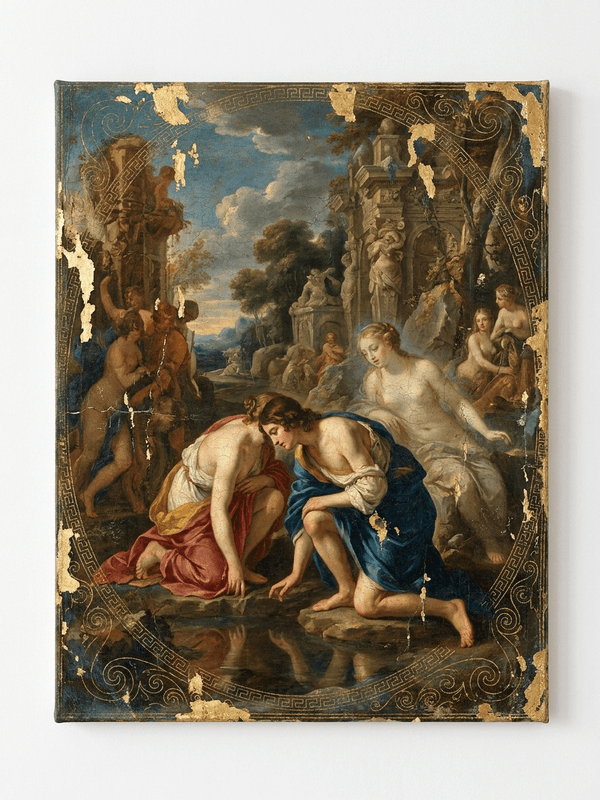
The mountain nymph Echo, punished by Hera, could only repeat the last words spoken by others. The beautiful youth Narcissus rejected her, as he rejected many who loved him. In time he fell in love with his own reflection beside a clear spring, wasted away while gazing into the water, and left behind only a flower at the water’s edge.
Article
Summary
The river-god Cephisus once had a child with the water nymph Liriope, a boy named Narcissus. He was beautiful beyond belief, and his mother, fearing what such beauty might bring, went to ask the seer Tiresias about his fate. The old man gave only a strange answer: he would live long, so long as he never came to know himself. Narcissus grew into a youth whose beauty drew every eye, but he kept every longing heart at a distance. In the same woods lived Echo, a nymph who once had been skilled at speech. After she delayed Hera with talk while Zeus' affairs were hidden from sight, Hera punished her: Echo could no longer begin words of her own, but only repeat the last sounds spoken by others. One day Narcissus became separated from his companions while hunting, and Echo saw him from behind the trees. She fell in love at once, yet Hera's punishment would not let her speak first. When Narcissus called into the woods, she could only return the ends of his phrases. At last she rushed out to embrace him, but he rejected her coldly, saying he would rather die than belong to her. Ashamed and grieving, Echo hid among caves and rocks until her body faded away and only her answering voice remained. Narcissus still refused everyone who loved him. At last one wounded heart prayed that he too might love someone he could never possess, and the goddess of vengeance heard the prayer. Soon afterward, Narcissus came thirsty to a clear spring in the forest. Bending to drink, he saw a beautiful youth in the water and forgot thirst, hunting, and the world around him. He gazed, called, smiled, and stretched out his arms, but every touch shattered the image. When the water calmed, the face returned, and Narcissus finally understood that the beloved in the spring was himself. The knowledge came too late: he could neither leave the image nor embrace it. He wasted away beside the water while Echo, hidden far off, repeated his sighs and farewell. After his death, the nymphs found no body, only a white flower with a golden center bending over the spring. From then on, Echo's voice remained in the valleys, and the flower of Narcissus remained beside the water.
The Child of the Marsh Nymph
In the land of Boeotia there was a river called Cephisus. Its waters ran between stony crevices and grassy banks, and when the spring floods came, the reeds along the shore were bent and scattered by the current. In that country lived the water nymph Liriope.
In time she bore a son. Even while he was still wrapped in swaddling clothes, his face was so lovely that it startled those who saw him. His mother named him Narcissus. She held the child in her arms with both joy and unease, for beauty so rare is seldom a safe gift among mortals.
Liriope had heard that Tiresias could perceive what ordinary people could not, and so she brought the child to him and asked, “Will my son live to old age?”
Tiresias was a blind prophet. He could not see the child’s face, yet it was as if he heard fate speaking from the dark. After a silence, the old man answered only this: “If he never knows himself, he will live a long life.”
The words sounded strange. How could a person fail to know himself? Liriope did not understand, but she kept the saying in her heart. Narcissus grew, and the prophecy, like a stone sunk beneath clear water, did not show itself for a time.
The Voice in the Woods
When Narcissus was sixteen, he had become the kind of youth who made everyone turn to look again. He often hunted in the hills and forests, wearing a light hunting cloak, a javelin in his hand and hounds at his heels. He passed along paths broken by leaf-shadow; deer vanished into thickets at the sound of his steps, and birds startled up from the branches.
Many girls and many boys loved him. They saw him bend his bow, cross streams, and pursue the fleeing game, and their hearts were caught. But Narcissus paid no heed to such gazes. If someone came near him, he turned away. If someone begged for kindness, he answered with cold words. Beauty sat upon him like hard armor, shutting out the hearts of others.
At that time there was a nymph of the woods named Echo. Once she had been quick and graceful in speech, and no one was better at holding another person with talk. When Hera was searching for Zeus, Echo had entangled the goddess in one idle story after another, giving other nymphs time to slip away. When Hera realized she had been deceived, her anger did not quickly fade. She punished Echo, saying, “Since you loved to use your tongue to delay others, from now on you shall not speak first in words of your own. Whatever another person says, you may only catch the final sound and give it back.”
From then on, Echo lost the long sentences that had once been hers. Her heart was full of things she wished to say, but she could not utter them. If someone called, “Who is there?” she could only answer, “There.” If someone said, “Come,” she could only say, “Come.” Among valleys, stone walls, and groves, her brief replies were often heard.
“Come Here”
One day Narcissus was hunting alone and became separated from his companions. He passed through thick woodland, treading on fallen leaves, while the barking of the hounds grew farther and farther away. Echo saw him from behind the trees.
At once she was drawn to the beautiful youth. She longed to step forward, to tell him her name, to speak of how she wandered through the woods, to say that she would gladly go with him through valleys and shaded streams. But Hera’s punishment lay heavy on her tongue. She could not be the first to speak a single word.
Narcissus heard a faint movement in the trees. He stopped, looked around, and called, “Is anyone here?”
Hidden behind the trunk, her heart beating wildly, Echo could only answer, “Here?”
Thinking someone had replied, Narcissus called again, “Come to me!”
Joy rose in Echo, and like a returning sound she answered at once, “Come!”
Narcissus looked about but still saw no one. “Why are you hiding from me?” he said. “Let us meet here.”
Echo could bear it no longer. She ran out from behind the trees with her arms open, as if she meant to give him all the words she had been carrying in her heart. But the only words she could truly speak were the last ones he had left her: “Meet here.”
When Narcissus saw her coming close, his face grew cold. He stepped back as if avoiding something he could not bear to touch. “Do not touch me! I would rather die than belong to you.”
Echo’s hands stopped in midair. She could only repeat his final words, but her voice was already broken: “Belong to you.”
The youth turned and went away. Branches brushed his shoulders, and soon he was lost among the trees. Echo stood where she was, with the wind passing through the woods around her, unable to speak even one sentence of her own.
Nothing Left but a Voice
After that, Echo was ashamed and full of grief, and she no longer appeared in open glades. She hid in caves, behind rocks, and in the loneliest parts of the mountains. She neither ate nor slept, and day by day her body wasted away.
Her skin seemed dried by the wind, and the color drained from her face. At last her bones seemed to pass into stone, and her body gradually vanished. But her voice did not disappear. If someone cried out in a valley, she still answered with the final words; if someone called to a companion beside a spring, her voice came back from the rocks.
People could no longer see Echo, but they could still hear her. She could not tell her own story. She could only repeat the ending of another’s speech. Her love had received no answer, and in the end only an echo remained in the woods.
Narcissus did not change. He went on rejecting those who came near him. Some were humiliated by him; others left in tears. At last, one person whose heart he had wounded past bearing lifted a prayer to heaven: “May he too love one he cannot have. May he too taste such pain.”
The goddess of vengeance heard those words. She did not appear at once, nor did thunder shake the forest. Punishment often comes quietly, like a single drop falling into a clear spring, unnoticed at first.
The Youth in the Spring
Not long afterward, Narcissus was hunting once more in the mountains. The sun was high, the leaves shone in the heat, and the quarry had fled into distant brush. He had walked a long way, and his throat ached with thirst, so he began to look for water.
In the forest there was a clear spring. No shepherd had muddied it, and no mountain goat had come down to trample its edge. The surface lay still as transparent stone. Soft grass grew around it, and the shadows of trees covered it from the fierce sunlight. Narcissus bent down to drink from his cupped hands.
At that moment, he saw a face in the water.
The face was young and bright. Its eyes seemed to gaze into his, its hair fell over its forehead, and its lips were slightly parted. Narcissus froze. Never before had he looked at anyone like this. The youth in the spring stared back at him, as if caught by the same wonder.
Narcissus reached out to touch him, and the surface broke beneath his fingers. The face shattered into fragments of light and motion, then disappeared. When he drew his hand back and the water grew calm again, the youth returned.
He spoke softly, and the lips in the water moved too, but without sound. He smiled, and the youth in the spring smiled. He stretched out his arms, and the other stretched out his arms in return. Narcissus thought he had found someone beautiful and shy, close enough to see, yet forever separated from him by a thin layer of clear water.
He forgot to drink. He forgot the hunt. His javelin lay in the grass, and the hounds had vanished somewhere among the trees. He lay beside the spring and reached again and again, and each time his hand met only cold water.
Love That Could Not Be Reached
The sunlight moved slowly from the treetops onto the grass, and still Narcissus kept watch over the spring. He pleaded softly with the image in the water: “Why do you draw away? I love you, and you look at me. You reach out, and I reach out. But when I touch you, you vanish.”
As he spoke, tears fell into the spring. The surface trembled, and the face seemed to weep with him. Narcissus suffered all the more, and waited anxiously for the water to become still again.
After a long while, he understood. There was no other youth in the water. It was himself.
The knowledge came too late, and it was cruel. He who had refused to pity the love of anyone else was now trapped by his own image. He could not leave, for if he left he would no longer see that face. He could not possess it, for the image in the water had no body to embrace, no life that could be carried away.
Narcissus leaned beside the spring, growing paler little by little. His fingers clutched at the grass, and his chest rose and fell with sighs. He spoke to the reflection as if speaking to a real person; the image in the water opened its mouth as he did, but never answered.
Far off, hidden from sight, Echo heard his voice. She still loved him, and she still could not speak her own words. When Narcissus sighed, she repeated his sigh among the rocks. When he cried, “Ah, poor me,” she could only cry after him, “Poor me.” She could not save him, just as she had once been unable to speak her whole heart.
Narcissus slowly lost his strength. He no longer reached out. He no longer wept. He only gazed into the water. At last he whispered farewell to the reflection. Echo, far away, repeated his farewell, her voice so faint it seemed to seep from cracks in the stone.
The Flower by the Water
Narcissus died beside the clear spring. The woods grew quiet; the water remained pure, and the shadows of the trees still lay across its surface. Later, the nymphs of the forest came looking for his body, hoping to give him funeral rites. They brought torches and a bier, and they had prepared songs of mourning for the dead.
But they did not find the beautiful youth.
In the place where he had fallen, a flower had grown among the grass. Its petals were white, and at its center was a faint touch of gold. It bent low toward the water, as if still gazing into the spring. People came to call it the flower of Narcissus.
From then on, Echo’s voice remained in the valleys. When someone called out, she repeated the final words. And when someone came to a clear spring and saw the flower bowed above the water, they remembered the youth who had loved only his own reflection.