Greek Mythology
King Midas — Greek Mythology
Midas, king of Phrygia, treated Dionysos’ old companion Silenos with kindness and was granted a wish. Greedy for gold, he asked that everything he touched be turned into the precious metal. The glittering gift soon became a calamity, and he washed it away in a river. Later, after slighting Apollo, he was punished with a pair of donkey’s ears.
Article
Summary
Midas, king of Phrygia, loved gold, and he also loved the merry company that followed Dionysos. One day, Dionysos’ old companion Silenos lost his way and was brought to the palace. Midas recognized him, entertained him for ten days and nights, and then returned him safely to Dionysos. Dionysos was pleased and promised Midas one wish. Midas, without thinking carefully, asked that everything he touched become gold. At first he was delighted, as if he had stepped into a dream: branches, stones, doorposts, and ears of grain all shone beneath his hand. But when food and clear water also hardened into cold gold, he understood that what he had asked for was no blessing. Midas begged Dionysos for mercy. Dionysos told him to wash his hands and body in the river Paktolos. The water carried away the terrible power, and from then on the river sand was said to gleam with gold. Midas escaped disaster, but he had not truly learned caution. Later, the rustic god Pan played his reed pipes and boasted that he could surpass Apollo’s lyre. The mountain god Tmolos judged Apollo the victor, but Midas insisted that Pan’s music was better. Apollo, offended by ears so poor at hearing, changed Midas’ ears into those of a donkey. Midas hid the secret beneath a turban, and only his barber knew. Unable to bear the burden, the barber whispered the secret into a hole in the ground. Reeds grew there, and whenever the wind blew through them, they spoke for him: “King Midas has donkey’s ears.”
The Old Man Who Lost His Way
In Phrygia there lived a king named Midas. He dwelt in a broad palace filled with golden cups, golden dishes, patterned robes, and servants enough to pour his wine, spread his couches, and lead his horses. Yet none of this was enough to satisfy him. Whenever he saw gold, his eyes lingered over it. Whenever he heard the dull clink of bullion in his storerooms, his heart seemed to fill with sweetness.
In those days Dionysos wandered through the hills and forests with his followers. They drank wine, sang songs, shook ivy-wreathed staffs in their hands, and wild beasts padded at their heels. Among them was old Silenos, Dionysos’ companion and foster-father. Silenos was aged, unsteady on his feet, and often so full of wine that he fell behind the rest.
One day he lost his way among the vines and tree-shadows and stumbled into the land of Midas. The country folk saw an old man reeking of wine, crowned with leaves and flowers, with no attendants beside him. Not knowing who he was, they brought him before the king.
Midas recognized Silenos at once. He did not mock the old man, nor did he order him driven away. Instead he had soft couches spread for him, brought clear water to wash his feet, and set wine and food before him. The palace grew noisy with celebration. Music sounded, and the smell of roasted meat and fresh bread rose through the halls. Midas kept Silenos in his palace for ten days and ten nights, with wine and feasting never lacking.
On the eleventh day, Midas himself escorted Silenos back and delivered him safely to Dionysos. When Dionysos saw his old companion restored to him unharmed, he was greatly pleased. He looked at Midas and offered him a reward.
“What do you desire?” said Dionysos. “Speak, and it shall be yours.”
A Golden Wish
At those words, Midas felt his heart flare with excitement. He did not think of his fields, or his people, or years of peace. He thought only of heavy gold, of his palace flooded with gold light.
He said to Dionysos, “Grant my hands this power: let everything I touch be turned to gold.”
Dionysos did not look pleased when he heard the request. He knew it was no wise wish. But he had already spoken, and a god’s promised gift could not be lightly withdrawn. So he nodded and gave Midas the power he had asked for.
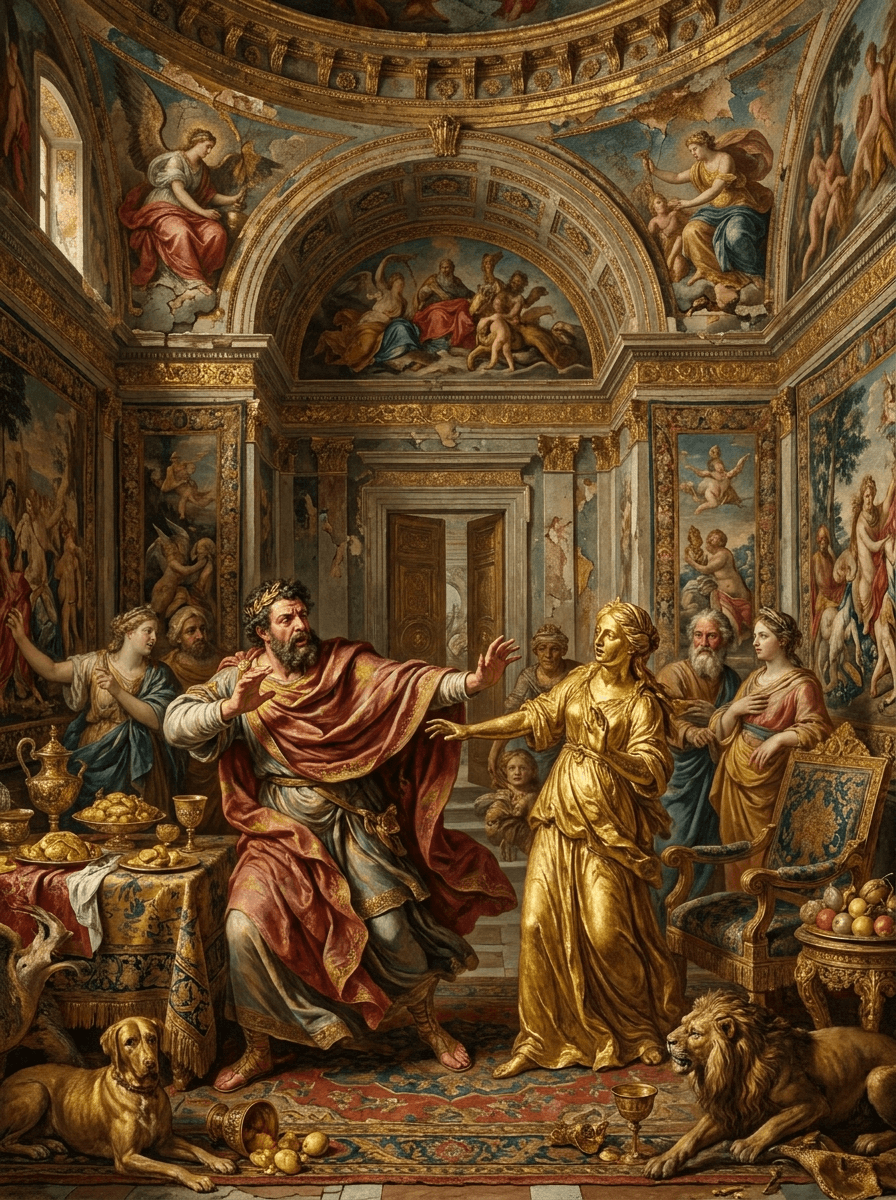
Midas left Dionysos with his blood still warm from joy. On the road, he broke a branch from an oak tree. The moment it touched his hand, the rough bark began to shine; the leaves stiffened and glittered; the whole branch became gold. He picked up a stone from the roadside, and the stone grew heavy in his palm and turned into a lump of gold. He touched ears of grain, and they became golden. He laid his hand on a doorpost, and it gleamed as though the sun had burned through it.
He could not keep from laughing. He thought there was no one in the world more fortunate than he. When he returned to the palace, he touched the edge of a table, and it became gold. He touched the back of a chair, and it too became gold. The servants stared in speechless astonishment, while Midas felt only that all this beauty had come too swiftly and wonderfully, like a dream.
He ordered a feast to be prepared, so that he might celebrate the day properly.
Gold That Could Not Be Eaten
The servants brought bread, meat, fruit, and clear water. Midas sat down and reached for a piece of bread. The instant it entered his hand, it became a hard, cold piece of gold. He froze, then reached for the meat. It too turned to gold between his fingers. Still unwilling to believe it, he picked up a grape, and the round, juicy fruit lost all its moisture and became a little golden bead.
Midas’ smile faded.
Thirst came over him, and he lifted a cup of wine to drink. But as soon as the red wine touched his lips, it hardened like gold at the rim and would not flow. He called for water, but when the clear water touched his hand, it lost the nature of water and became cold, gleaming metal.
Hunger rose in his belly, and thirst burned in his throat like fire. The room was filled with golden radiance, yet there was nothing on the table he could eat and not one drop in the cup he could drink. Only then did Midas understand that he had not asked for wealth. He had asked for a disaster that could imprison a living man until he died.
He looked at his hands. A little while before, he had thought them a divine treasure; now they seemed terrifying. He dared not touch his robe, or his bed, or the people near him. He stood far from his servants, afraid that one careless movement might harm them.
So Midas left behind the glittering palace and hurried to find Dionysos. He no longer stood proudly, as he had when the gift was granted. He bowed his head and pleaded with the god, driven by hunger, thirst, and fear.
“Take back this gift,” he said. “I was wrong. Gold cannot be eaten. Gold cannot quench thirst. I would rather be a poor man without this power than starve in the midst of gold.”
When Dionysos saw him humbled in this way, his anger was gone, and he told Midas how he might be saved.
“Go to the river Paktolos,” said Dionysos. “Follow the stream upward until you find the place where the clear water rises. Immerse your head and body there. Let the river wash your hands, and with them wash away your fault.”
The River Carries Off the Gold
Midas did as Dionysos told him.
He came to the banks of the Paktolos. The water ran between stones, cool against the roots of the grass along the shore. Midas did not trouble himself over royal dignity or royal garments. He stepped into the water, bent down, and thrust his hands into the current. Then he cupped the water over his head and let it stream through his hair and down his face.
The dreadful power left his body, as if some invisible film had been carried away by the river. Midas touched a pebble on the bank, and it did not become gold. He lifted water in his hands, and it remained water, spilling back between his fingers into the stream. At last he could drink. He knelt in the shallows and drank the cool river water in great gulps, as though life itself had been restored to him.
From that time onward, the sand of the Paktolos was often said to carry a golden gleam. People claimed it was the trace left behind when Midas washed the power of the golden touch from his hands.
Midas returned to his own land, now afraid of gold. He turned away from many of the splendid things in his palace and often went out among the hills and woods instead. He liked to hear the pipes of shepherds and to watch the sheep move slowly across the slopes. Yet a man who escapes one danger does not always learn how to judge rightly. Before long, Midas brought shame upon himself in another matter.
Reed Pipes and Lyre Strings
Among the wild places lived a god named Pan. He made his home in the woods, moved lightly among rocks and shade, and often played upon his reed pipes. The pipes were made of reeds of different lengths bound side by side, and their sound carried the breath of hill wind and pastureland. Shepherds stopped to listen, and even the flocks seemed soothed by the music.
Pan loved the sound of his pipes. Once, growing prouder and prouder as he played, he boasted that his music could surpass Apollo’s. Apollo was the god of light and a master of the lyre. When the strings beneath his hand sounded, their music was clear and ordered, like sunlight falling on clean stone steps.
Since the two gods were to compete, they asked the mountain god Tmolos to judge between them. Tmolos sat upon the slope, his hair and beard like leaves spread over the mountain. First he listened to Pan. Pan puffed out his cheeks, and the reed pipes gave out a rough, lively sound, like wind moving through a valley, like a shepherd calling to his flock at dusk. Midas stood nearby listening, nodding again and again.
Then Apollo took up his lyre. His fingers moved across the strings, and the music unfolded slowly: clear, bright, and filled with a power that made all noise seem improper. The trees appeared to fall silent; the hillside itself seemed to listen. When Tmolos had heard enough, he turned his head toward Apollo and declared him the victor.
All accepted the judgment except Midas. He thought Pan’s pipes suited his own ears better, and he said aloud that Tmolos had judged wrongly.
Apollo heard Midas’ words and turned to look at him. The god’s gaze was no longer gentle.
“Ears like yours,” said Apollo, “which cannot tell good sound from bad, should not keep the shape of human ears.”
As soon as he spoke, Midas felt his ears grow hot and itch. He raised his hands to them and found that his own ears were gone. In their place hung long, large donkey’s ears, soft and drooping on either side of his hair. He cried out and tried to cover them with both hands, but they were too large to hide.
The Secret in the Ground
Midas was filled with shame and fear. From that day on, he refused to show his head in public. He ordered a broad turban to be made and wrapped his hair and ears tightly beneath it. He wore the turban when he held court. He wore it when he ate. Even when he walked in the palace garden, he would not take it off.
But a king must have his hair cut. At last the servant who trimmed Midas’ hair saw the donkey’s ears. Midas fixed him with a stern look and commanded him to tell no one.
The barber, terrified, promised again and again. When he left the palace, his lips were pressed tight together, as though a live bird had been shut inside his mouth. But the secret grew heavier and heavier within him. He could not tell his wife, could not tell his friends, could not let even half a word slip during laughter at a feast. As the days passed, he felt his chest would burst.
At last he went to a lonely place and dug a small hole in the earth. He looked all around and, seeing no one, bent his mouth close to the opening and whispered, “King Midas has donkey’s ears.”
Then he filled the hole with earth at once, stamped it flat, and felt a little lighter. He thought the secret had been buried in the ground and would never come out again.
But after some time, reeds grew from that spot. Day by day they rose higher, their narrow leaves trembling in the wind. And when the wind blew through them, the reeds rustled as if someone were whispering close to the earth:
“King Midas has donkey’s ears.”
The wind blew again and again, and the reeds repeated the words again and again. The secret escaped the hole in the ground, traveled to the roadside, and passed into human ears. Midas could hide his ears beneath a turban, but he could not cover the voice that had spread abroad. So people remembered this king: the man who once turned all things into gold, and who later, because he could not hear true music, wore a pair of donkey’s ears that could not be hidden forever.