Greek Mythology
The Madness of Heracles and Eurystheus — Greek Mythology
Heracles had built a household and a place of honor in Thebes, but Hera sent madness upon him, and with his own hands he killed his children. When his senses returned, he went to Delphi to ask the oracle what he must do. From that day on, he was forced to obey Eurystheus, king of Mycenae, and began a long road of humiliating labors.
Article
Summary
In his youth Heracles won glory by defending Thebes, married Megara, and had children. Yet Hera never ceased to hate this son born to Zeus and a mortal woman. She waited until the hero had something he cherished most, and then she struck him with madness. In that madness, Heracles no longer recognized his wife and children. His own house seemed to him a battlefield, and those dearest to him appeared as enemies. He killed his children and Megara with his own hands. Only when he came back to himself and saw the blood and bodies on the floor did he understand that the disaster could never be undone. Burdened with the guilt of killing his own kin, Heracles went to Delphi to consult the oracle. The god commanded him to leave Thebes and submit himself to Eurystheus, king of Mycenae, serving through long labors as the path toward purification. Eurystheus had power over Heracles not because he was stronger, but because Hera had once contrived to have him born before Heracles, giving him the claim to rule. And so the mightiest of heroes had to stand before a fearful king and receive one deadly command after another. From that time, Heracles set out on the road of his labors. He had lost his family, and now he lost his freedom as well. Eurystheus, seated on his throne, used both oracle and kingship to drive him toward tasks no ordinary mortal could imagine.
Peaceful Days in Thebes
Even as a young man, Heracles had already shown strength beyond other men. He was tall and broad, his arms as solid as bronze pillars. In archery, club-fighting, chariot-driving, and wrestling, he surpassed those of his own age. When Thebes later came under pressure from its enemies, he stepped forward to fight for the city, drove back its attackers, and restored honor to the Thebans.
For this, the people of Thebes respected him. The king gave him his daughter Megara in marriage, and the city celebrated their wedding. On that day, cups passed from hand to hand through the hall, torches cast their light against the walls, and the young hero sat beside his bride as if he had at last stepped out of battle and into peace.
Before long, children were born to them. When they were small, they would clutch his fingers and tug at them; when they grew a little older, they ran through the courtyard, pretending wooden sticks were weapons. When Heracles looked at them, his heart softened. He had fought wild beasts and waded through blood on the battlefield, but at home he was simply a father, a husband, a man in the Theban palace who could lay his weapons down.
But Hera in heaven had not forgotten him.
Heracles was the son of Zeus, and his mother, Alcmene, was only a mortal woman. Hera hated Zeus’s betrayal, and she hated the child who had carried the blood of the king of the gods from the moment of his birth. Long before, when Heracles was still an infant in his cradle, Hera had sent two venomous snakes crawling toward him. The child could not yet speak, but he stretched out his small hands, seized the serpents by the neck, and strangled them alive.
From that day, Hera knew he would not be easily destroyed. So she waited. She waited for him to grow, for him to take a wife and have children, for his heart to bind itself to what he could least bear to lose.
Hera Sends Madness
One day Heracles was at home. Outside, the sunlight was bright; people moved through the courtyard, and the voices of his children were near. No hostile army pressed against the gates. No beast sprang from the wild. No oracle had warned him that disaster was about to fall.
Yet disaster came then.
Hera cast madness into his heart. At first, perhaps, the world darkened before his eyes, and a clamor like bronze striking bronze rang in his ears. Then the pillars of the house, the thresholds, the faces of those he loved—all changed before him. He no longer knew his home. He no longer knew his wife or children. It seemed to him that enemies had burst into the hall, that savage shapes had surrounded him.
The hero’s strength did not leave him, but his mind was covered in a blinding mist.
He reached for his weapons. His family cried out and tried to flee. Megara came toward him, trying to call him back to himself. The children did not understand what had happened; they only knew that their father had suddenly become terrifying. But Heracles saw them as the offspring of enemies, and he heard his wife’s cries as the shouting of a battlefield.
In that moment, the halls of Thebes no longer seemed like a home, but like a field of slaughter entered by a god of madness. Doors were struck open. Vessels overturned. The footsteps of children scattered in confusion. Heracles pursued them as though he were chasing foes, and with his own hands he killed his children. Megara too did not escape the ruin.
When the madness withdrew, only silence remained in the house.
When Heracles came back to himself, he did not see victory. He did not see fallen enemies. He saw his children lying in blood. He saw his wife’s body grown cold. He saw that the weapon in his hand was stained with the blood of those closest to him.
He could not believe that he had done it. But the bodies on the floor did not lie, and neither did the cries in the house. Children he had held only a little while before would never again open their eyes and call him father.
Heracles stood there as if struck by lightning. The strength that men had once admired had become the most dreadful thing in the world. He had not been defeated by enemies or wild beasts. He had been defeated by a madness sent by the queen of the gods.
The Guilt After Waking
The Thebans gathered at a fearful distance and did not dare come near. Some wept for the dead. Some whispered among themselves. Others watched the weapon in Heracles’ hand, terrified that the madness might seize him again.
Heracles himself was afraid.
He put the weapon down and would not touch it. He wanted to die; he wanted to flee somewhere no human eyes could find him. Could a man who had killed his own children remain in his house? Could he sit before an altar and pray to the gods? Could anyone still call him a hero?
He left the room heavy with the smell of blood, his heart like stone. He had to learn how such pollution could be washed away, how he was to bear a disaster wrought by his own hands. So he went to seek an oracle.
To the ancient Greeks, the murder of one’s own kin was not a thing that could be ended with weeping. Blood had clung to the killer, and he had to be purified; he had to hear the judgment of the gods. Heracles made his way to Delphi, climbing the mountain road and the stone steps before the temple, until he came to the sanctuary of Apollo.
There were cold springs there, and curling smoke, and altars, and the seat of the god. Heracles brought his guilt before the divine presence and asked where he should go and how he could go on living.
The oracle’s answer was hard.
He must leave Thebes and obey Eurystheus, king of Mycenae. Not for a single day, not for one campaign, but for years of service. Whatever Eurystheus commanded, Heracles had to do. Only in this way could he seek a path of atonement for the blood on his hands.
From then on, the old name Alcides receded, and people more often called him Heracles—a name bearing Hera’s shadow, as if to say that his suffering could not be separated from her.
Why Eurystheus Could Command Him
If strength alone were measured, Eurystheus was far beneath Heracles. He was not the infant who had strangled snakes with his bare hands, nor the hero who could turn the tide of battle alone. He sat on the throne of Mycenae, relying more on kingship and divine decree than on courage.
Yet fate had brought Heracles before him.
Before Heracles was born, Zeus had boasted among the gods that a child of the line of Perseus would soon be born, and that this child would rule over those around him. Hera heard the words and seized her chance at once. She caused the goddess of childbirth to delay Alcmene’s labor, and she hastened the birth of another child of the same house. That child, born first, was Eurystheus.
And so Heracles, who was meant to shine among men, had already been placed behind Eurystheus before he had even opened his eyes. Eurystheus was born first, and with that first birth came the claim to rule. Years later, after Heracles had become guilty of killing his own kin, the oracle sent him to Eurystheus and commanded him to obey this king.
For Heracles, this was harder to endure than battle.
If the enemy were a beast, he could rush forward and grapple with it. If it were an army, he could swing his club and smash through shields. If the mountain road were harsh, he could climb it step by step. But now he had to bow his head to a man who was not as brave as he was. Eurystheus sat on the throne, while he—son of Zeus, hero of Thebes—had to stand below and wait for commands.
Eurystheus feared him too.
The king knew Heracles’ reputation, and he knew the power in those arms. If a man who had strangled venomous snakes and carved a path of blood through battle were to storm the palace in anger, who could stop him? So Eurystheus used the oracle to command him, yet dared not come too close.
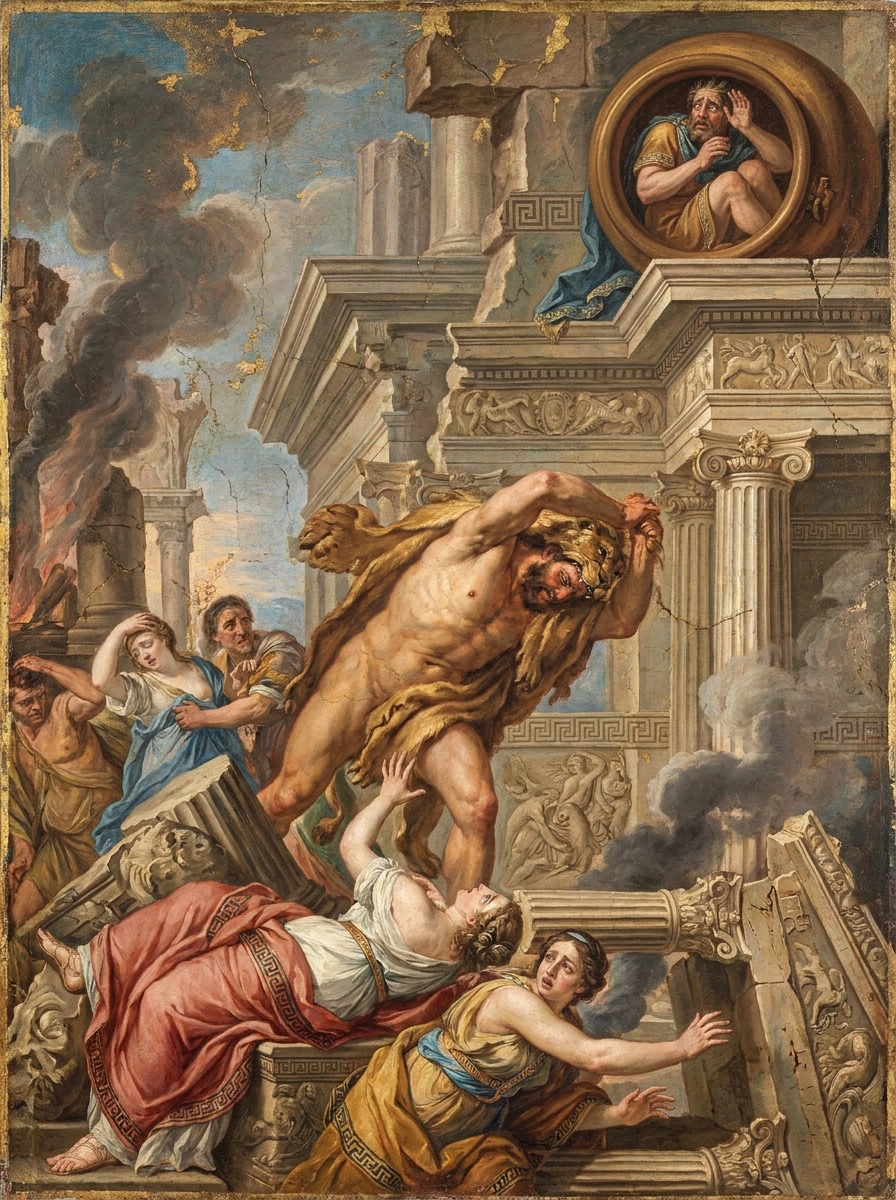
In some tellings, Eurystheus later even had a bronze jar prepared for himself. Whenever he heard that Heracles was returning with some terrible prize, he panicked and hid inside it, sending a herald to give orders in his place.
The First Command Falls
When Heracles came to Mycenae, there was no joy of triumph in him. He had not come to receive honors, nor to take his place at a feast. He came carrying guilt.
The palace gates were high, and the stone walls were cold. Eurystheus sat within, with the dignity of a king and a fear he could not entirely conceal. Since the oracle had ordered Heracles to serve him, he began to assign him one nearly impossible task after another.
These tasks would later be known as the Labors of Heracles.
Eurystheus did not send him on ordinary errands. He commanded him to go into the wilderness and face beasts that had destroyed many lives; to enter marshes, valleys, deep forests, and shores where ordinary men dared not tread; to bring danger itself back with him, so the king might know the order had been fulfilled.
When Heracles heard these commands, he did not immediately rebel.
He could hate Hera. He could despise Eurystheus. He could loathe the madness that had taken his family from him. But his children were dead, and Megara was dead. If he turned and fled, his guilt would remain. If he killed Eurystheus, there would only be more blood.
So he accepted the command in silence.
He took up his bow, slung the quiver across his back, gripped his heavy wooden club, and left the gates of Mycenae. Behind him sat the king who feared him. Ahead lay one perilous place after another. Hera’s anger had not ended, and Eurystheus’ commands would not end.
From that moment on, Heracles was no longer merely a young hero who won by strength. Through the long labors, he would go again and again to the edge of death, and again and again return bearing wounds. His guilt began in his own house; his road of atonement began before the throne of Eurystheus.
This was the result of Heracles’ madness: he lost his wife and children, and he lost his freedom as well. To cleanse the blood from his hands, he had to obey a fearful man armed with kingship, and accomplish deeds almost no one else could have done.