Greek Mythology
Lycaon and the Judgment of Zeus — Greek Mythology
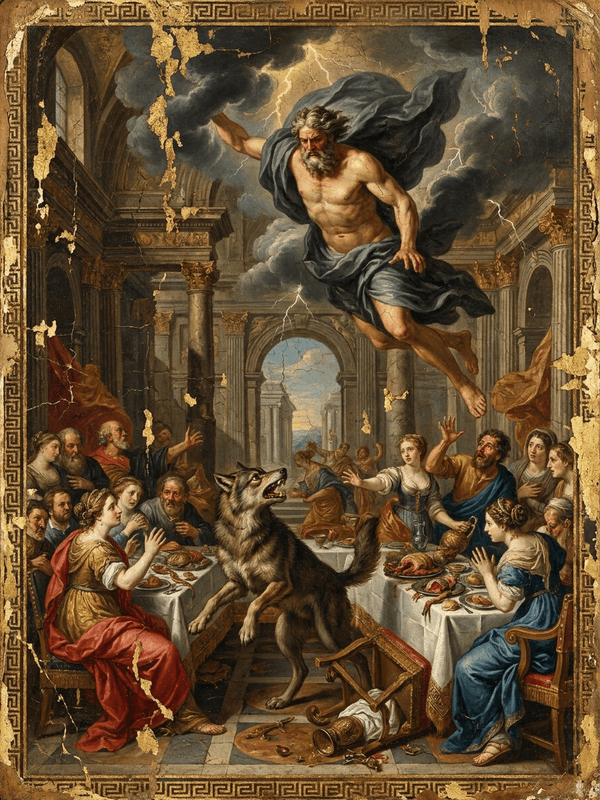
Lycaon, king of Arcadia, heard that Zeus had come down among mortals and deliberately set a dreadful feast before him to test the god. Zeus saw through the crime, burned the palace, changed Lycaon into a wolf, and brought judgment upon the wickedness of humankind.
Article
Summary
Zeus came down to Arcadia in mortal guise and entered Lycaon's hall, intent on seeing whether the rumors about human wickedness were true. Lycaon answered that visit with a test of his own, secretly mixing human flesh into the feast he set before the god. Zeus saw through the crime at once, overturned the table, and let divine fire consume the palace. Lycaon fled into the wilderness, where his body hardened into a wolf's shape and his voice was reduced to a hoarse howl. From that time on, people spoke of him as a wolf, and the tale stood as the start of Zeus's harsh judgment on a corrupt generation.
Zeus Hears the Evil Rumor of the Earth
In the earliest days, human beings had already spread across the earth.
They knew how to plow fields, build houses, drive chariots, and offer cattle and sheep to the gods at their altars. Yet as the years passed, human hearts did not always grow better alongside human skill. There was plundering in the valleys, deceit before city gates, and travelers who vanished from the roads without cause. The weak cried out, and often no justice came.
Those cries reached Olympus.
Zeus sat on high and heard the complaints carried upward by the winds. He had seen human wrongdoing before, but this time the rumors grew darker and heavier. Some said altars had been fouled with blood. Some said hosts murdered the guests who had trusted their roofs. Some said kings scorned the gods and counted wickedness as cleverness.
Zeus did not wish to judge by rumor alone. He took on the likeness of a mortal and came down from the clouds, passing along mountain roads, through fields and towns, looking closely at each place in turn. He walked dusty tracks and saw the ruts of robbed wagons. He passed deserted thresholds and saw cold hearths where no master remained. At last he came to Arcadia, where a palace stood among the hills. Its lord was named Lycaon.
The Palace in Arcadia
Lycaon was king of Arcadia, a land of forests and stony slopes. Oaks grew thick there, and at night wild beasts could often be heard howling far away. His palace was not splendid like the great cities by the sea, but it had broad halls, heavy wooden doors, and long tables for feasting.
When Zeus entered the city, evening had already fallen. Some who saw the stranger noticed an unusual majesty about him and began to whisper, “This is no ordinary man. A god may have come among us.”
The people dared not treat him lightly. Some lifted their hands in prayer; others bowed low beside the road. Torchlight fell across the face of Zeus, and the longer they looked, the more afraid they became.
But when Lycaon heard the whispers, he only laughed coldly.
He stood before the palace gates and looked at the stranger. There was no reverence in his heart, only suspicion and pride. He said to those around him, “If he is truly a god, he ought to withstand a test. If he is not, then how ridiculous it is that everyone kneels before him.”
So he welcomed Zeus into the palace, outwardly as though receiving an honored guest, while in secret his mind had already turned toward evil.
The Test in the Night
Fires were lit in the hall, and servants brought wine and meat. Lycaon sat in the master’s place, keeping his eyes fixed on Zeus. He wanted to find some flaw in the stranger’s expression, but Zeus watched everything in silence, as if he already knew what lay hidden in the dark.
The more Lycaon watched, the more resentful he became.
At first he planned to murder the guest during the night. If the stranger was truly a god, no blade could harm him. If he was only a mortal pretending to divinity, then he could die in the palace, and no one would dare speak against the king.
But even that was not enough. Lycaon wanted to devise a still crueler test, one that would force this supposed god to reveal the truth with his own mouth.
He ordered a feast to be prepared, and in secret he committed a terrible deed: he had human flesh cut apart and mixed among the sacrificial meat, some of it boiled, some roasted, seasoned with spices and fat, then laid on platters and brought to the table. The board that should have honored both guest and god had been defiled by the foulest crime.
Firelight trembled through the hall, and the bronze vessels glimmered dark red. The servants lowered their heads and dared not look at what lay on the plates. Lycaon, however, pretended that nothing was amiss. He raised his cup and said to Zeus, “Guest from afar, take your meal.”
His voice was steady, but challenge glinted in his eyes.
The Overturned Table
Zeus did not reach for the food.
He looked once at the meat on the table, and then at Lycaon. In that moment the flames in the hall seemed to sink as if pressed down by a wind, and even the reflections in the wine cups grew still.
Zeus had seen through everything.
He was no guest caught unaware. He was the king of the gods, come down to test the evil of humankind. Lycaon had set a feast with murderous hands, had tried to tempt a god with polluted food, and had mistaken wickedness for wit. Such a crime needed no further questioning and no delay.
Zeus overturned the table.
Platters, cups, and pieces of meat crashed to the floor, and grease spattered across the stone. Those in the palace cried out. Then the fire of thunder lit the rafters, as if daylight had split the night in two. Lycaon’s palace was struck by divine wrath. Wooden pillars burned, curtains curled into tongues of flame, and shadows thrashed wildly along the walls.
At last Lycaon was afraid.
He sprang from his seat, no longer testing, no longer mocking. He rushed out of the hall, through the smoking colonnade, and fled beyond the palace into the wilderness. Behind him the roof burned; before him lay the dark forested hills. He tried to shout, to call his servants, to curse the god who had destroyed his house.
But his voice had changed.
The King Becomes a Wolf
No sooner had Lycaon reached the open ground than a rough howl forced its way from his throat.
In terror he looked down and saw his fingers curling inward. His nails hardened and lengthened into an animal’s claws. His arms dropped to the earth, his spine arched, and his clothing clung to his body, turning into dusky gray fur. His mouth thrust forward; his teeth grew sharp; saliva dripped from his lips.
He still kept the fierce look he had worn as a man, but those eyes were now set in the face of a wolf.
Once he had murdered people in his palace; now he could only spring at livestock in the wild. Once he had used a human voice to mock the gods; now, when he opened his mouth, only a wolf’s cry came out. Once he had sat on a throne and made others afraid; now, at the smallest sound, he himself would turn and flee into the trees.
Later, when people spoke of Lycaon, they often said that he had not been changed into something wholly different. His heart had always been wolfish in its savagery. Zeus had merely made his outward shape match what was already within.
The Judgment of the King of the Gods
Lycaon’s palace became a blackened ruin. Charred beams lay fallen across the ground, and stains of wine and blood remained on the stone steps. The people stood far off and dared not come near. They knew this had not been an ordinary fire, but the judgment of a god falling upon a royal house.
There is another tradition about Lycaon’s family: it says that his sons, too, committed the same impious crime against the gods, and that Zeus struck them down with thunder, leaving only a very few alive. Whichever version is told, the ending is the same: the palace of Arcadia fell because of wickedness, and Lycaon’s name was forever joined to the wolf.
When Zeus returned to the heights, his anger had not cooled.
He had seen with his own eyes that human corruption was no mere rumor. If such a feast could be served in a king’s own hall, if the laws of sacrifice and hospitality could be trampled so completely, then the evil on earth had grown so deep that it had to be cleansed.
And so the story of Lycaon became more than the punishment of a single king. It became the beginning of judgment upon that whole generation of humankind. People remembered the overturned table, the burning palace, and the howl that fled into the wilderness. Whenever a wolf cried in the mountains at night, the old people would say: that is Lycaon’s shadow, still running through the dark.