Greek Mythology
Iphigenia at Aulis — Greek Mythology
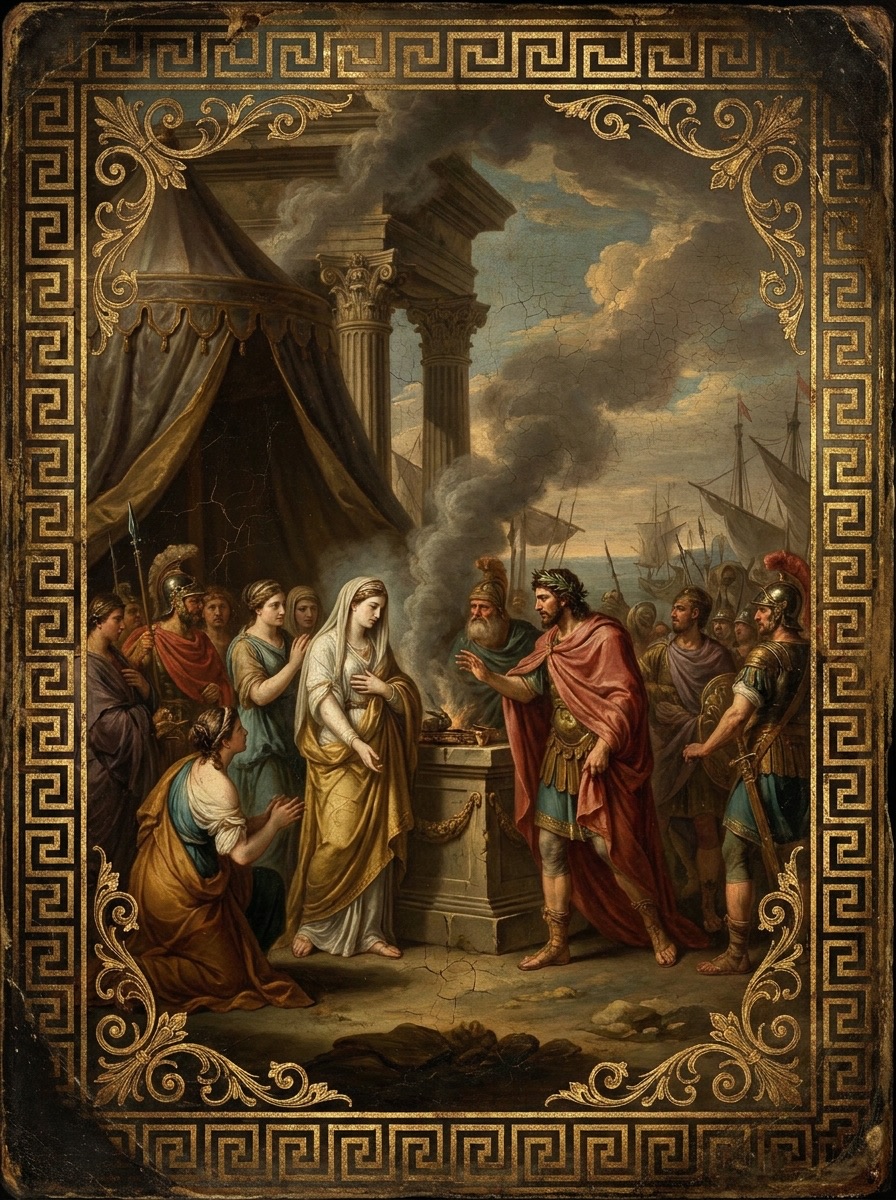
The Greek army is trapped at Aulis, with not a breath of favorable wind over the sea. The seer declares that only by sacrificing Agamemnon’s daughter Iphigenia can the fleet sail for Troy. Agamemnon wavers between a father’s love and a commander’s duty, until Iphigenia herself walks toward the altar—only for Artemis to take her away before the knife falls.
Article
Summary
Before the Greeks can truly sail for Troy, the kings and heroes of many lands gather their ships at Aulis. Yet the wind dies, the sails hang slack, and the army waits day after day on the shore. Calchas the seer declares that Artemis is holding the fleet back: Agamemnon, commander of the expedition, must sacrifice his own daughter Iphigenia. At first Agamemnon cannot accept such a demand, but the army's impatience, Menelaus' pressure, and the burden of command press in on him. He writes to Clytemnestra, falsely saying that Achilles wishes to marry Iphigenia and asking her to bring the girl to Aulis. Soon after, he regrets the deceit and tries to recall the order, but Menelaus intercepts the second message; by the time the brothers quarrel and soften, Clytemnestra has already arrived with Iphigenia and the young Orestes. Iphigenia believes she has come for a wedding and greets her father with joy, while Clytemnestra is proud that her daughter will marry the greatest young hero in Greece. But when Achilles appears, the truth comes out: he has promised no marriage, and his name has only been used to lure the girl to the altar. Clytemnestra shields her daughter in fury, and Iphigenia kneels before Agamemnon, begging him to let her live. Achilles is enraged that his name has been used to deceive them and promises to protect Iphigenia. But the soldiers have heard the oracle and clamor for the sacrifice so the fleet may sail. Iphigenia sees her mother's tears, Achilles' anger, her father's helplessness, and the voice of the whole army outside the tent. At last she stops hiding. She says she will go to the altar for the Greeks, asking her mother not to plead further and Achilles not to fight the entire host for her. At the altar Iphigenia will not be dragged; she stands beneath the knife by her own will. Agamemnon covers his face, Clytemnestra is broken by grief, and Calchas lifts the sacrificial blade. Just before it falls, the tale says Artemis carries the girl away and leaves a deer in her place. The wind rises, and the Greek fleet sails for Troy; yet Iphigenia's name, and the hatred planted in Clytemnestra's heart, travel with the war back into the houses of the Greek kings.
The Fleet Held at Aulis
The kings and heroes of Greece had already come to Aulis.
The bay was crowded with black ships, their prows turned toward the open sea, their masts standing one after another in the morning mist. Warriors from Argos, Sparta, Pylos, Salamis, and many other cities had pitched their tents along the shore. They sharpened spears, mended oars, leaned hide-covered shields against wooden posts, and waited only for a fair wind to carry them across the water to Troy.
But the wind did not come.
On the first day, the sea lay flat as a dull bronze mirror. On the second, the sails still drooped uselessly. Many days passed. Seabirds flew between the masts, but the ships did not move. At first the soldiers complained of the weather; later they began to complain of their commander. Some sat by the ships scoring planks with their knives. Others flung empty wineskins down onto the sand. At night, campfires burned in clusters, lighting face after impatient face.
Agamemnon was king of Mycenae and commander of the whole great army. His brother Menelaus stood beside him, more anxious than any other man there. Helen had been taken away by Paris, prince of Troy, and this expedition had begun for Menelaus’ sake. Now a thousand ships lay idle on the shore, and every hero watched Agamemnon to see whether he could lead the army out.
Agamemnon summoned Calchas the seer.
Calchas understood the signs in the flight of birds, and the hidden traces left when gods were angry. He stood for a long time beside the altar. The smoke from the fire rose straight upward, undisturbed by wind. At last he spoke: Artemis would not let the fleet leave the shore. There was only one way to appease her anger. Agamemnon must sacrifice his own daughter, Iphigenia, to the goddess.
At those words, it was as if a block of ice had fallen inside the tent.
Iphigenia was still in the palace at Mycenae. She was no warrior. She had boarded no ship, and she had not raised a spear in the oath sworn for Helen. She was simply the daughter of Agamemnon and Clytemnestra, a young girl still able to lean trustingly against her mother’s side.
When Agamemnon heard the seer’s words, his face changed. He sent the others away and kept only Menelaus with him. Outside the bay there was no sound of waves, but inside the tent it felt as though a storm were pressing down.
A Letter Sent Home
At first, Agamemnon refused.
He was the commander, but he was also a father. He thought of the colonnades of his palace, of his daughter as a little child running to clasp his knees, of the sound of her voice when she called him father. To bring such a child into the camp and then thrust her before the altar—only to imagine it chilled his heart.
Yet the army had been trapped too long. The chiefs gathered together, and their voices grew harder by the day. Odysseus, quick of mind, knew that if the soldiers scattered, the expedition would be finished. Menelaus pressed him even more fiercely. For the sake of recovering Helen, he said, the kings of Greece had sworn an oath; Agamemnon could not draw back at the decisive hour.
Driven between pressure and shame, Agamemnon at last wrote a letter.
In it he said nothing of an altar and nothing of the goddess. He told Clytemnestra to bring Iphigenia to Aulis, because the great hero Achilles was willing to take her as his wife. Such a marriage would be a glory beyond measure. Surely the mother would rejoice, and the daughter would suspect nothing.
When the letter was sealed, Agamemnon gave it to an old servant and ordered him to hurry through the night to Mycenae.
But not long after the message was sent, Agamemnon regretted it.
Night deepened. The fires in the camp sank low, and from far off came the neighing of horses and the snoring of soldiers. Alone in his tent, Agamemnon paced back and forth, his thoughts turning darker and more tangled. He took up a writing tablet and wrote another letter, telling his wife not to come and saying that the first message was to be disregarded. He pressed the second letter into the old servant’s hands and urged him to overtake the earlier messenger and stop him at any cost.
The old man was just leaving when Menelaus caught sight of him on the road.
Suspicious of his haste in the night, Menelaus seized the letter and read it. At dawn, the two brothers quarreled in the camp. Menelaus accused Agamemnon of shrinking back in the face of battle. Agamemnon answered him: Was he truly to murder his own daughter for the sake of one woman?
At last even Menelaus softened. He thought of Iphigenia’s age. He imagined Clytemnestra arriving with the girl, and the look she would wear when she learned why she had been summoned. He was no longer as hard as before. If the deed was too cruel, he told his brother, then let the fleet break apart and go home.
But it was already too late.
In the distance, dust rose from the road. The sound of wheels approached. Queen Clytemnestra of Mycenae had arrived at Aulis with Iphigenia and the little boy Orestes.
The Bride Enters the Camp
When Iphigenia stepped down from the chariot, the soldiers in the camp turned to look.
She believed she had come for her wedding. Her mother had prepared her garments, and attendant women carried chests filled with woven cloth for the marriage rites. Clytemnestra, too, came with a mother’s pride. She believed her daughter was to marry Achilles, the most famous hero in all Greece.
As soon as Iphigenia saw Agamemnon, she ran to him joyfully. She embraced her father and asked why his face was so troubled, and why he did not kiss her as he did at home. Agamemnon looked at his daughter, but the words stuck in his throat. He wanted to avoid her eyes, yet could not bear to turn away.
Clytemnestra asked when the wedding would take place, where the offerings had been prepared, and when the bridegroom would come to receive his bride. Agamemnon faltered and said only that everything would be arranged.
Before long, Achilles came before the queen.
He knew nothing of this “marriage.” When Clytemnestra greeted him with the proper courtesies and treated him as her future son-in-law, Achilles was astonished. He said he had never asked Agamemnon for the girl’s hand and had never agreed to marry Iphigenia.
Only then did Clytemnestra feel as though the ground beneath her feet had split open. She pressed for the truth, and little by little it came to light: the wedding was false, the letter was bait, and Iphigenia had been brought to Aulis to be sacrificed to Artemis.
The queen was furious.
She gathered little Orestes in her arms and drew Iphigenia close beside her, standing before her daughter like a wild mother guarding her young. She cursed Agamemnon for using the name of father to lure his own child to death. When he returned to Mycenae, she asked, how would he face the empty room where his daughter had lived? How would he face the household he had destroyed with his own hands?
Agamemnon had no answer.
At first Iphigenia did not understand. But when she realized that she was to be led to the altar, terror rose over her at once. She knelt before her father, grasped his robe, and begged him not to kill her. She said she had seen so few days, had not yet married, had not become a mother. To see the sunlight and hear human voices, she said, was sweet enough; let her live.
Agamemnon’s face was full of anguish, but there was no longer any clear path of escape around him.
The Greek army had heard the prophecy. The soldiers spread the news through the camp, and many gathered together, shouting that they must sail. If Agamemnon drew back, the army might mutiny; if the army dissolved, the oaths of all the kings would become a laughingstock. Worse still, although Achilles was willing to protect Iphigenia, he discovered that even his own men might not obey him. Once a crowd had been driven mad by war and waiting, not even a hero’s fame could stop stones and spears.
Achilles Draws His Sword
When Achilles learned that his name had been used to deceive them, he was furious.
He was not Iphigenia’s betrothed, but he felt that his honor had been drawn into the matter. If people said that Achilles had lured a girl to the camp with the promise of marriage and then stood by while she was killed, how could he endure it? He told Clytemnestra that he would stand with her and Iphigenia. If anyone dared to take the girl by force, he would draw his sword and fight.
Clytemnestra clung to him as to the last post still standing in a flood. She knew Achilles was the strongest young hero in the Greek army. If he would protect her daughter, perhaps there remained one narrow hope.
But the noise in the camp grew louder and louder.
Soldiers crowded near the altar. Some shouted the name of Artemis, others cried out for Troy, and others said that the whole army could not be left to rot at Aulis for the sake of one girl. Odysseus and the other chiefs understood as well that the matter had now been forced into the open. It could no longer be hidden.
Achilles made ready to resist the crowd. But Iphigenia slowly grew calm.
She saw her mother’s face covered with tears. She saw Achilles, willing to risk his life for a girl who had never truly been promised to him. She saw her father standing like an old man nailed to the ground. And from outside the tent she heard the voices of thousands of armed men. No single plea could drown out that sound.
Then she made a decision that stunned them all.
Iphigenia no longer hid behind her mother. She wiped away her tears, stood upright, and told Clytemnestra not to plead for her anymore. She was willing to die for the Greeks. If the goddess truly required this offering, and if the fleet could leave Aulis only in this way, then she would go to the altar.
When Clytemnestra heard this, her heart felt as though it had been cut open. She held her daughter and would not let go. Iphigenia, in turn, comforted her mother. She asked her not to hate all the Greeks, and not to make her death more bitter than it already was. Then she turned to Achilles and thanked him for wishing to save her, but begged him not to fight the whole army for her sake.
It was not because she did not fear death.
She was afraid. She was young. Sunlight still lay on her face, and though the wind had failed, the smell of the sea still hung in the air. She knew there would be a knife beside the altar. She knew her mother would weep. She knew that if she walked there, she would never return to Mycenae. But she also knew that every eye was fixed upon her, and that the prophecy, the army, and her father’s weakness had closed around her, layer after layer.
So she pressed her fear down into her heart and went out by herself.
The Girl Before the Altar
The altar stood in an open place outside the camp.
Split wood had been piled there, and beside it were set clear water and baskets filled with barley grains. The priests wore white garments. The soldiers stood at a distance in a ring, speaking in low voices. The bay was still windless. The sails hung limp, like broad pieces of gray-white cloth.
When Iphigenia came, the crowd opened a path for her.
She did not let anyone drag her, and she did not cry out. She walked toward the altar as if she were walking toward her wedding—only there was no song, no laughter beneath a bridal crown, only the sound of her mother weeping as others held her up. Agamemnon dared not look at her. He covered his face with his robe, as if by doing so he could hide from what he had done.
Iphigenia asked the priest not to touch her. She said she would stand of her own will, and would give her life to the goddess. When the people heard this, they fell silent. Even the soldiers who had been shouting moments before were struck quiet by the courage of the girl before them.
Calchas came near the altar. The knife was lifted, and its cold edge flashed beside the fire.
At that instant, a wonder occurred.
Later tradition said that Artemis did not allow the knife to fall upon Iphigenia. At the last moment, the goddess carried the girl away and set a deer upon the altar in her place. When those present came back to their senses, the blood beneath the blade was not a maiden’s blood, but the blood of a wild deer. The people by the altar were too astonished to speak. Calchas proclaimed that the goddess had accepted the offering, and that the fleet could sail.
Iphigenia was gone.
Some said Artemis had taken her to far-off Tauris, where she served the goddess. Others remembered only the sudden miracle before the altar at Aulis. Clytemnestra had lost her daughter, and the wonder did not make the hatred in her heart fade away. Agamemnon kept his place as commander, but he carried back into his own house a wound that could never heal.
Then at last the surface of the sea stirred.
First a faint ripple pushed in from far away. Then the wind rose. Sails swelled, and ropes snapped and cracked. Soldiers ran to their ships, rowers took their places on the benches, and helmsmen looked toward the open water. The stillness of Aulis was broken. At last the Greek army left the shore and sailed for Troy.
But behind that favorable wind remained the name of a girl. Iphigenia had walked to the altar at Aulis, and from that day onward, before the expedition had even reached Troy, grief and hatred had already been planted in the houses of the Greeks.