Greek Mythology
The Wanderings of Io — Greek Mythology
Io was a young woman from the land around Argos. When Zeus desired her, she was drawn into the wrath of the queen of the gods. Changed into a white heifer and guarded by the hundred-eyed Argus, she escaped only to be driven on by a gadfly, wandering far from home until at last she recovered her human form in Egypt.
Article
Summary
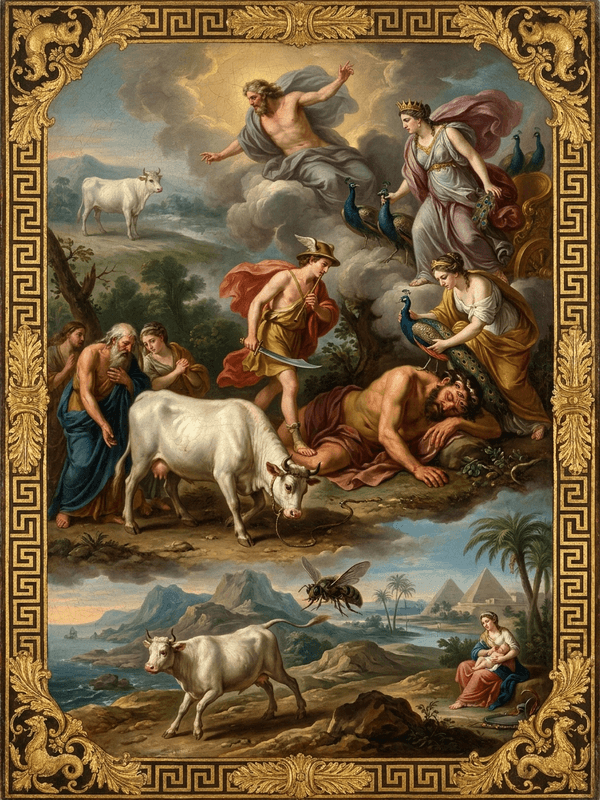
Io was the daughter of the river god Inachus. Zeus desired her and covered the fields with cloud and mist, hoping to hide what he was doing from watchful eyes. Hera sensed that something was wrong and came at once. Zeus hurriedly changed Io into a white heifer. Hera saw through the trick, but did not expose it; instead, she asked Zeus to give her the animal. Hera set the hundred-eyed Argus to guard Io. Io was tethered in the open country, unable to speak and forced to graze on grass. Once she met her father and her kin, and with her hoof she traced her name in the dust. Only then did Inachus understand that the white heifer before him was his daughter, though he had no power to save her. Zeus pitied Io and sent Hermes to rescue her. Disguised as a herdsman, Hermes played his pipe and told stories until one by one Argus's eyes sank into sleep. Then he killed him. Hera gathered the eyes of Argus and set them in the tail feathers of the peacock. Though Io was freed from her guard, Hera sent a gadfly to pursue her. Io fled far from her homeland, crossing coasts, wastes, and mountains, tormented by stings and terror. At last she reached Egypt, where she regained her human shape beside the Nile and gave birth to her son Epaphus. There her long wandering finally came to an end.
The Girl in the Mist
In the country around Argos there were many clear-running streams, with reeds and green grass growing along their banks. Io, daughter of the river god Inachus, often walked there. She was young and beautiful, and she was said to have served the goddess near the sacred places of Hera. When people saw her then, she was still only a mortal girl, her hair falling over her shoulders, her feet on the damp earth, perhaps carrying flowers as an offering to the goddess.
One day Zeus looked down from on high and saw her. The king of the gods did not always keep mastery over his heart. When he saw Io passing by the river, desire took hold of him, and he descended from the clouds to pursue her.
Io was afraid. She did not know what this sudden god meant to do, and she turned and ran. She fled across the grass toward her father's waters, but the steps of a god are swifter than those of a mortal. Zeus did not want others to see what was happening, so he spread a thick veil of cloud and mist over the fields. Daylight darkened without warning. Hillside, woodland, and riverbank vanished under the vapor, as though night had come down before its time.
From heaven Hera noticed that untimely darkness, and suspicion stirred in her at once. She knew Zeus too well. On a clear day, a cloud covering the earth was not merely a change in the weather. She parted the clouds and came swiftly to the fields of Argos.
Zeus heard her coming. There was no time to send Io away, so he hastily used his divine power. When Hera drew near and the mist lifted, there was no girl in the grass, only a small white heifer. Her hide shone like snow, but her eyes were not the eyes of an ordinary beast. In them there was still a human fear.
Hera looked at the heifer and showed no anger. Calmly she asked Zeus where the animal had come from. Zeus said that the earth had just brought it forth.
Hera did not believe him. Nor did she accuse him. She only smiled a little and said that, if that was so, he should give her the lovely creature as a gift.
Zeus was trapped. If he refused, he would be admitting that the heifer concealed some secret; if he gave her away, Io would fall into Hera's hands. After a moment's hesitation, he had no choice but to surrender the heifer to the queen of the gods.
From that moment Io lost her human voice. She tried to cry out her name, but only a low bellow came from her mouth. She tried to reach out for help, but saw only her forelegs planted in the grass. Her mind still remembered her father, her homeland, and her former life, yet her body had become that of a cow.
The Watchman with a Hundred Eyes
Hera had the heifer, but she was not satisfied. She knew Zeus would not easily give Io up, so she summoned the hardest of all guards to deceive: Argus Panoptes, the all-seeing one.
Argus was no ordinary man. His body was covered with many eyes; the tale said he had a hundred. Even when he slept, not all his eyes closed at once. Some would shut, while others remained open. By day and by night, he could keep watch over whatever had been placed in his charge. Hera entrusted Io to him and ordered him to guard her closely, allowing no one near.
So Io was led out into the open country. Argus fastened her with a rope, letting her graze in the fields by day and driving her to some cold place at night. She could not return home, could not enter a house, could not tell anyone what had happened to her. When the wind blew from the river, she could smell her homeland, but all she could do was lower her head and chew the grass.
Once she came to the river of her father Inachus. The water moved slowly over the stones, just as it always had. She saw her father and her sisters on the bank, grieving and searching for her. Io hurried toward them, touched their hands with her muzzle, and looked at them with pleading eyes. Her family thought only that this was a gentle cow, and they stroked her head.
Io was pierced with sorrow. Since she could not speak, she scraped at the dust with her hoof. Stroke by stroke she wrote her name, and then the misfortune that had befallen her. When Inachus saw the words on the ground, he understood that the cow before him was his lost daughter. He fell beside her, clasped her neck, and cried aloud. But Argus soon came and coldly dragged Io away. Her father could not rescue his child from the command of the goddess. He could only watch as she was taken from him.
Zeus saw this from afar and pitied her. He wanted to save Io, but he could not openly contend with Hera over her, so he summoned clever Hermes. Hermes wore winged sandals on his feet and carried the wand that brings sleep. Zeus ordered him to kill Argus and set Io free.
Hermes did not rush in armed for battle. He knew that Argus had too many eyes, and that force alone might not succeed. He dressed himself as a herdsman, drove a flock before him, took up a shepherd's staff, and carried a reed pipe. Slowly he came near the place where Argus was keeping watch.
Argus sat on a height above the white heifer, his many eyes looking in every direction. When he saw the herdsman, he sensed no danger and allowed him to come closer. Hermes sat on a stone and began to play his pipe. The thin music drifted over the grass like wind through reeds. Argus listened with curiosity and asked where such an instrument had come from.
So Hermes began to tell a story. He spoke of a woodland god who pursued a water nymph named Syrinx. The nymph fled to the riverbank, and when there was no way onward, she begged her companions to change her shape. The god reached out to seize her, but in his arms he found only a cluster of reeds. When the wind passed through them, they made a soft sound, and so he cut the reeds into pipes of different lengths and fashioned the instrument.
Hermes told the tale slowly, and from time to time the pipe sounded again. One by one the eyes of Argus grew heavy. Some closed, while others struggled to remain open. After a while even the last of them began to sink. Hermes watched for the moment, touched him with the god-sent drowsiness of his wand, and when the hundred-eyed guard had fallen completely asleep, he drew his blade and struck off his head.
Argus fell to the ground, and his many eyes could guard Io no longer. Hera later gathered those eyes and set them into the tail feathers of her beloved peacock. From then on, when a peacock spread its tail, the feathers seemed filled with bright staring eyes.
Io was free of her watcher at last, but her suffering was not over.
The Road of the Gadfly
When Hera learned that Argus was dead, her anger burned hotter than before. She would not allow Io peace, and sent a gadfly to torment her.
It was no ordinary little insect. It pursued the white heifer relentlessly, burrowing close to her hide and stinging her with its sharp bite. Io, maddened by pain, kicked dust into the air and fled along the riverbanks. When she tried to stop and breathe, the gadfly buzzed at her ear. When she plunged into the woods, it followed her there. When she rushed toward the water, she still could not shake off that tiny, cruel pursuer.
So Io's long wandering began.
She ran from the land of Argos, over ridges and through barren country. She came to the seashore, where the waves washed over her hooves. She followed unfamiliar rivers, and when she bent to drink, the face reflected in the water was still the face of a cow. She could not ask the way as a person would, and she could not tell villagers who she was. When people saw a white heifer racing toward them as if mad, some cried out and fled, while others took up sticks to drive her away. Io could only go on.
She passed through so many places that later generations tied some of their names to her journey. The strait she crossed was said to be linked with a cow; the broad lands of the east also kept the shadow of her pain. At night, when the gadfly drew back for a little while, she would collapse on the ground, her body smeared with mud and sand, her eyes turned toward the stars. She still remembered that she had once been the daughter of Inachus, once able to speak with a human voice. Now her pleas could only become low, mournful cries.
During her long flight she came to the region of the Caucasus. There the rocks rose steeply, and the wind cut cold through the cliffs. She saw a suffering god fastened to the stone: Prometheus. Zeus had punished him because of fire and humankind, and there on the mountainside he endured his torment. Though Io could not tell him her whole story in human speech, Prometheus knew who she was, and he knew how far she still had to go.
He told Io that her suffering would not end at once. She must wander farther still, crossing many lands, worn down by fear and exhaustion. Yet in the end she would come to Egypt, and beside the Nile she would regain her human form. In time she would bear a child, and from her descendants a great hero would arise.
Those words could not stop the gadfly's sting, but they gave Io a small, faint hope. She began to run again, her hooves striking the stony ground, her figure vanishing down the distant road.
Peace Beside the Nile
Io pressed on toward the south until at last she reached Egypt. The Nile flowed broad across the land, with damp earth and tall reeds along its banks. She had been tormented almost past endurance. Dust clung to her white coat, and in her eyes there remained only the pleading of one who had wandered too long.
There, at last, Zeus brought her peace. Hera's anger too came to its end. In Egypt Io recovered her human shape. No longer did she stand on four hooves; no longer was she forced to lower her head and graze; no longer could she weep only with the voice of a cow. She had hands again, and a human face, and speech, as though she had awakened from a nightmare that had lasted across the world.
Later Io gave birth to her son Epaphus. His name was bound to the touch of Zeus, for Io's fate had begun with the desire of the king of the gods and had come to rest in a far-off land. When Epaphus grew up, he became an important figure in the traditions of Egypt. His descendants multiplied, and the stories of many royal houses and heroes would later extend from that bloodline.
But for Io herself, the deepest memory was not the glory of her descendants. It was the road from home to exile. She had been the daughter of a river god, then a speechless white heifer. She had written her name with a hoof before her father, only to be dragged away by the hundred-eyed watcher. She had escaped Argus, only to be driven by a gadfly across mountains and seas. Only when the waters of the Nile spread beside her did she finally stop.
So the story of Io remained in the names and legends of many places. When people spoke of the white heifer, of hundred-eyed Argus, or of the eye-like markings on the peacock's tail, they remembered the girl whom the gods had drawn into disaster, and who wandered all the way to Egypt before she found rest.