Greek Mythology
Gaia and Uranus — Greek Mythology
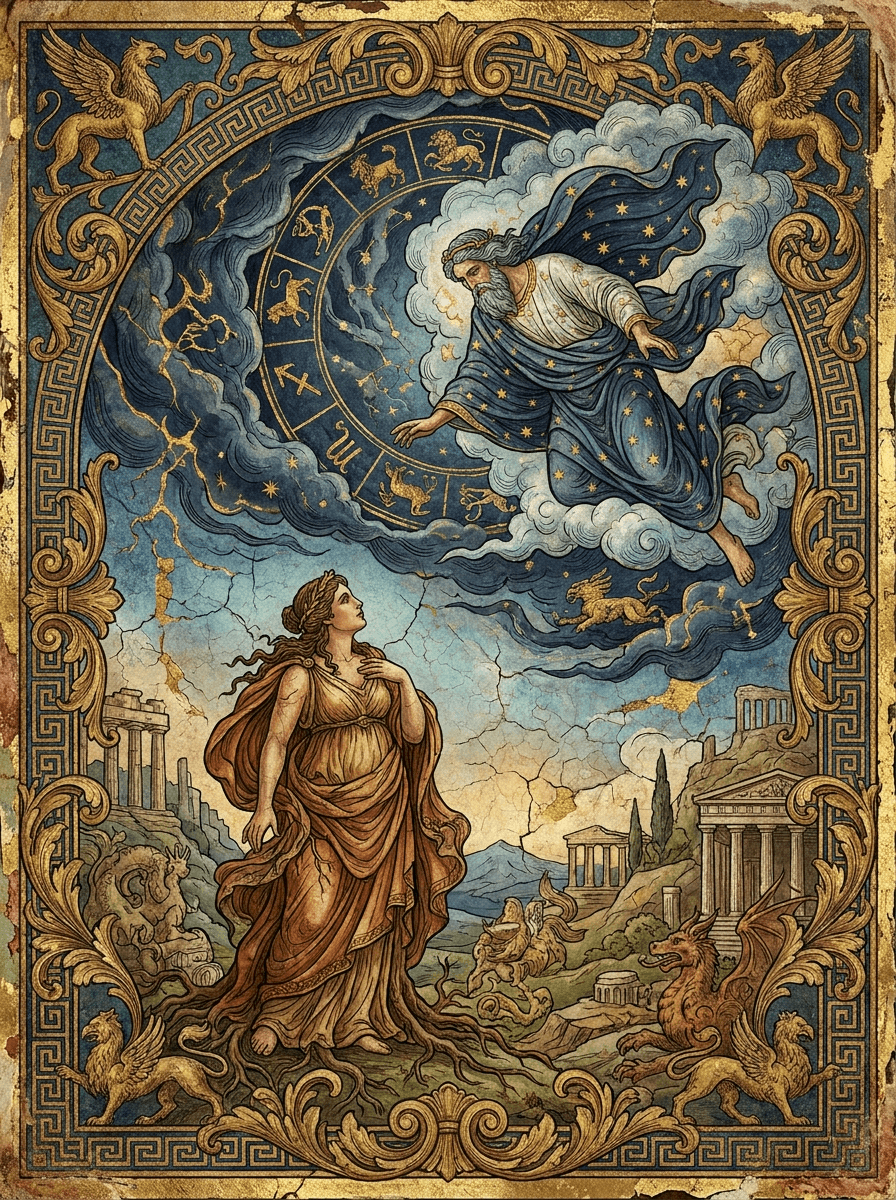
Gaia, the Earth, brought forth Uranus, the Sky, and with him became the mother of many mighty children. But Uranus feared those children and forced them down into darkness. At last Gaia could bear it no longer. She fashioned a pale-gray sickle and called on her youngest son, Cronus, to strike back; from that blow, the oldest order of divine power was split open.
Article
Summary
Uranus and Gaia came together, and one after another their formidable children were born: the twelve Titans, three one-eyed Cyclopes, and three Hundred-Handers. Yet when Uranus saw how terrible these children were becoming, disgust and fear rose in him. He would not allow them to come into the light, but thrust them back into the depths of the Earth.
The Earth Awakens First
In the earliest time, the world was not yet the place later generations would know. There were no city walls, no fields under cultivation, no ships crossing the sea, and no gods seated in honor on Mount Olympus. The old tales say that before all things were clearly divided, first there was Khaos, the personified chasm of confusion; after Khaos came Gaia, the Earth.
Gaia was not a goddess standing in a palace. She was the broad Earth herself: the power by which mountains rose, plants took root, and rivers ran through valleys. She lay there in her vastness, with black soil, stone, and deep caverns all belonging to her. Many gods, many monsters, and many heroes would one day trace their beginnings back to her.
Alone, Gaia brought forth Uranus. Uranus was the high Sky, spread above the Earth like a vast vault, covering her from end to end. At night, starlight hung upon him; by day, clouds drifted across him. Gaia also brought forth the mountains, whose peaks would later become the dwelling places of nymphs. She brought forth the surging sea as well, its waters striking the shore and curling into white foam among the rocks.
So Earth and Sky stood facing one another. Uranus pressed down from above, while Gaia below bore the weight of all things. Before long, new life was born between them.
The Children in Darkness
The children of Gaia and Uranus were no ordinary gods.
First came the twelve Titans. They were tall and strong, filled with the power of an ancient race of gods. Among them was Oceanus, like the stream that encircled the world; there were Coeus, Crius, Hyperion, and Iapetus; and there were Theia, Rhea, Themis, Mnemosyne, Phoebe, and Tethys. The youngest son was named Cronus. He had done nothing yet, but his name already held the storm that would one day break loose.
Afterward Gaia bore three Cyclopes. Each had a single eye in the middle of his forehead, and their gaze was as fierce as thunder-fire. Their names were Brontes, Steropes, and Arges, names that carried the echo of thunder, lightning, and brightness. Later still, Gaia bore three Hundred-Handers: Cottus, Briareus, and Gyges. Each had a hundred hands and fifty heads, and when they stirred, it was as if an entire valley shook.
From the moment they were born, these children possessed a frightening strength. Uranus looked on them and felt no joy. He did not want them walking in the bright space between Earth and Sky; he did not want to hear their footsteps thundering across the ground. Whenever Gaia gave birth, he forced the child back into the depths of the Earth and would not let it come forth.
So Gaia’s body was filled with groaning. Her children were crushed in darkness, unable to stretch their arms, unable to see the sky, unable to set foot upon their mother’s land. The Titans endured in silence; the Cyclopes’ anger flashed in the dark; the many arms of the Hundred-Handers had no room to move. Gaia bore it all, and her pain grew heavier. She was their mother, and she was the Earth; every struggle of the children imprisoned within her was like stone rolling inside her breast.
Still Uranus covered her from above. He would not yield, and he would not let those children leave the dark.
The Pale-Gray Sickle
At last Gaia would endure it no longer.
Deep within the Earth she sought out hard material and brought forth a pale-gray metal. Drawn from soil and stone, it shone with a cold light. From it Gaia forged a great sickle, its blade curved like a new moon, and like the still claw of a beast waiting to strike.
She called her children to her. In the darkness, the Titans heard their mother’s voice and lifted their heads one by one. Gaia told them that their father Uranus had done a cruel thing: he had hidden his own children in darkness and forbidden them the light of day. Someone must stand up, she said, punish Uranus, and bring this suffering to an end.
When the children heard her, fear seized them. Uranus was the Sky, pressing above them night and day; his power was too ancient, too immense. Who would dare raise a hand against the heavens? Silence spread through the dark, broken only by the low breathing of the imprisoned gods.
Then the youngest, Cronus, spoke.
He did not hesitate as his brothers did. He took the sickle from Gaia’s hand, and its cold handle settled into his palm. Cronus promised his mother that he would do the deed. Gaia heard him with pain and gladness mingled in her heart. She told him her plan: he must hide in wait and strike when Uranus came to her as he always did.
So Cronus crouched in the place his mother had prepared for him. There were no lamps around him, only the smell of earth and stone and the muffled breathing of his brothers in the distance. He tightened his grip on the sickle and waited for the Sky to descend.
The Sky Is Cut Open
When night came, Uranus covered the Earth once more. As he had done countless times before, he bent down from above, never imagining that someone was already waiting in the dark.
At that instant Cronus thrust out his hand. With one hand he seized Uranus; with the other he swung the pale-gray sickle. The blade flashed through the darkness, and the ancient Sky cried out in pain. Uranus was grievously wounded. He recoiled from Gaia and could no longer press her close as he once had.
Drops of blood fell upon Gaia. The Earth did not swallow them in vain. In time, from that blood were born the Erinyes, the spirits of vengeance; from it also came the Giants and the nymphs of the ash trees. All of them carried the force left by that ancient bloodshed, remembering the injury that had taken place between Earth and Sky.
Cronus cast the severed part into the sea. It fell into the water, and the waves heaved, gathering layer upon layer of white foam. Long afterward, the fairest of goddesses, Aphrodite, would rise from that sea-foam and enter the world of gods and mortals. Her birth belongs to another story, yet its root reaches back to the upheaval of this night.
Uranus was forced away from the Earth. He rose into the heights, and from then on Sky and Earth were divided. Between them there was room for wind, cloud, light, and the flight of birds. Gaia was no longer completely pinned beneath him, and the children trapped in darkness now had a chance to come forth.
Yet this did not bring peace.
Cronus Takes the High Seat
Cronus had acted for his mother and overthrown Uranus. Among the Titans he took the highest place, and the ancient rule of the gods passed into his hands. Rhea became his wife, and the Titans began to move in the new space between Earth and Sky.
But before Uranus withdrew, he had seen the hardness in his son. He knew that Cronus had used violence to seize his father’s place, and he left behind a terrible warning: one day Cronus too would be overthrown by his own child.
Those words sank like a black stone into Cronus’s heart. For the moment he had triumphed. Power was in his hands, and the Sky had retreated into the distance. Yet he was not truly at peace. What he had done had set a precedent among the gods: a son could rise against his father, and a new god could cast down an old one.
Gaia was at last released from the weight that had oppressed her. Uranus no longer lay close against her, and a gap opened between Earth and Sky. Mountains could stretch upward, sea winds could blow across the shore, and later gods and living beings could move through that open realm.
But the pale-gray sickle, the ambush in the dark, and the cry of the wounded Sky never vanished from the tale. They remained at the beginning of the oldest stories, telling those who came after that the world of the Greek gods was not settled and secure from the start. It took shape step by step from the suffering of the Earth, the rebellion of the children, and the retreat of the Sky.