Greek Mythology
Disasters on the Greeks’ Homeward Voyages — Greek Mythology
After Troy had burned to ashes, the Greek host thought they needed only to raise sail and go home. But the crime committed in the goddess’s temple had not been forgotten, and on the voyage back, storms, reefs, and the fires of revenge waited for them one after another.
Article
Summary
After Troy fell, the Greeks thought they had only to divide the spoils, raise their sails, and end ten years of war by returning home. But on the night the city was taken, Oilean Ajax dragged Cassandra away from the image of Athena where she had sought protection, committing sacrilege in the goddess’s shrine. The Greek leaders did not truly punish him, and Athena’s anger settled over the sea of their return. Before leaving Troy, the Greek chiefs quarreled over whether they should first remain and sacrifice to appease the gods. Menelaus wanted to sail home quickly, while Agamemnon argued for staying to perform rites, and the army split into different fleets. Nestor and Diomedes left early and avoided the deeper quarrel, but many others hurried away with treasure, captives, and guilt still unatoned. Disaster first overtook Oilean Ajax. A storm scattered his ships, and Athena and Poseidon let the waves tear the vessels apart. Ajax briefly climbed onto a rock and thought he had escaped divine anger, but he boasted that he would survive even against the gods’ will. Poseidon heard him, split the rock, and swept him into the sea. Another disaster came from the vengeance of Nauplius. His son Palamedes had been falsely destroyed by the Greeks, and the chiefs had not saved him. When the Greek ships sailed by night near Euboea, Nauplius lit false fires at Cape Caphereus, luring exhausted sailors to think they had found a safe harbor; many ships struck the reefs, and victors died in the dark water before reaching home. After that, the Greek returns became many separate fates. Menelaus and Helen wandered long at sea, Agamemnon reached Mycenae only to be killed in his own palace, and Neoptolemus avoided the worst of the sea by taking an overland road with his captives. The fires of Troy had gone out, but divine anger, old revenge, and the crimes of war sailed with the victors, teaching them that taking the high city did not mean finding peace.
The Burned City and the Silent Goddess
After Troy was taken, the fires burned through the city all night.
Greek warriors climbed out from the belly of the Wooden Horse. The gates were opened, and the troops who had been lying in wait by the ships poured into the streets. Palaces collapsed. Roof beams cracked and spat in the flames. Old men fell beside their thresholds, and children cried in the smoke, searching for their mothers. By the time dawn began to pale the sky, Troy, which had once stood high above the plain, was nothing but smoke, ash, and broken walls.
The Greeks hurried to carry their plunder down to the shore. Golden cups, bronze cauldrons, embroidered cloths, weapons, and the captive women of Troy were all brought to the ships. Agamemnon received Cassandra. Neoptolemus received Andromache. Odysseus received Hecuba. The men believed that ten years of bitter war had at last come to an end: they had only to hoist their sails, cross the Aegean, and see again the hills and fields of their own homes.
But one thing remained in the ruined city like a thorn left in the flesh.
In the confusion of the sack, Cassandra fled to the temple of Athena. She threw herself beside the goddess’s image and clung to it. Her hair had fallen loose over her shoulders, her robe was stained with soot, and her fingers gripped the sacred statue with all her strength. By ancient custom, anyone who fled to an altar or an image of a god for protection was not to be dragged away by violence, even if that person was an enemy.
But Oilean Ajax burst into the temple. He was the leader of the Locrians, quick in body and fierce in temper. When he saw Cassandra, he seized her and tried to tear her away from the statue. Cassandra struggled, and the image itself was pulled and shaken, as though the goddess too had been insulted.
At that moment Athena did not strike him down with thunder or fire. In the temple there were only footsteps, cries, and the clash of weapons.
But the goddess remembered.
The Quarrel by the Shore
The next day the Greek leaders gathered by the sea. The ships had already been dragged down to the water’s edge. The oarsmen dried their blades, and the sailors coiled the ropes. Everyone wanted to leave that land of corpses as quickly as possible.
But Menelaus and Agamemnon began to quarrel.
Some said they should sail at once and take advantage of the wind. Others said the gods had already shown their anger and must be honored with sacrifice, above all Athena. Agamemnon did not want to depart in haste; he wished to remain and make offerings. Menelaus, however, was eager to bring Helen back to Sparta and would not willingly lose another day.
Their quarrel divided the army. Many followed Menelaus and busied themselves with pushing their ships into the sea. Others stayed with Agamemnon on the shore, preparing victims for sacrifice and hoping to set out only after the divine anger had been softened.
Old Nestor was there as well. He had lived long, had seen too many wars and quarrels, and had no wish to be drawn into fresh ruin. So he and Diomedes, while the sea could still be crossed, took their fleets and sailed away first. The wind filled their sails; their ships rode over the waves and slowly left the coast of Troy behind. Later people said they escaped the worst disasters of the return because they did not linger until the quarrel deepened.
Most of the Greeks were not so fortunate.
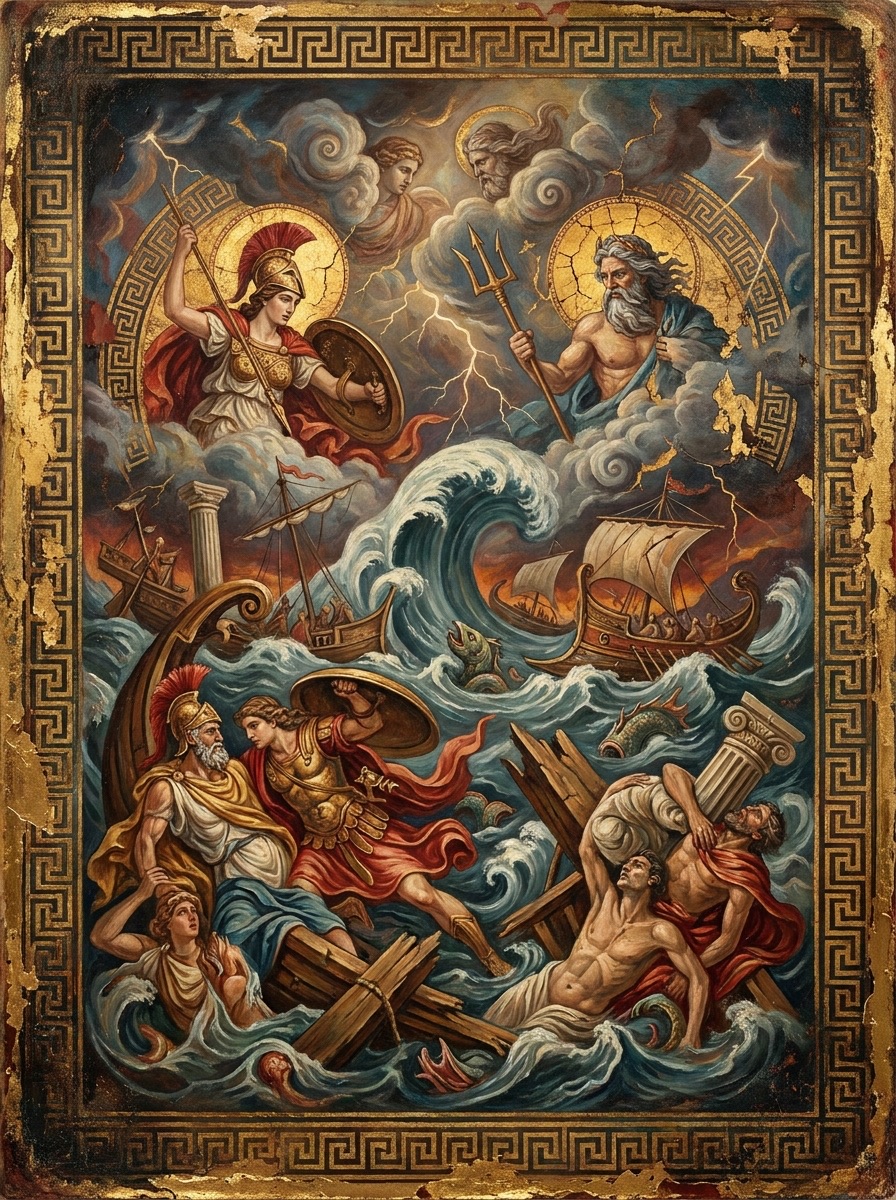
They set out with ships heavy with treasure and captives. Bronze vessels filled the holds, weapons were lashed to the decks, and white sails rose on the masts. At first the sea seemed calm enough, almost willing to carry the weary warriors back to their native land. Yet beyond their sight, Athena had already turned to Poseidon, god of the sea, asking him to make these proud homecomers taste the bitterness of the deep.
Oilean Ajax’s Ship
Disaster caught Oilean Ajax first.
When his fleet was out upon the sea, the sky suddenly changed. Black clouds pressed in from far off. The wind first worried the corners of the sails, then hurled itself upon the ships like a wild beast. Waves rose high. Masts groaned and bent. Sailors shouted as they tried to reef the sails, and the oarsmen strained to keep the hulls steady, but wave after wave crashed down, flinging men across the decks.
Athena would not allow Ajax a peaceful return. She shattered his fleet with storm winds and drew lightning across the black sea. Planks split. Masts snapped. Soldiers clutched at broken timbers and tumbled in the surf. Ajax’s own ship was broken apart, but he fought his way out of foam and wreckage and managed to climb onto a reef.
The rock jutted above the water, surrounded on every side by white breakers. Ajax was soaked through, his fingers cut by the stone, but he was alive. Standing there amid the wind and waves, he believed he had escaped the gods’ hand.
He should not have spoken then.
Looking out over the raging sea, he boasted that even against the will of the gods, he had saved himself from the deep.
The words reached Poseidon. The sea god lifted his trident and struck the rock. It split down the middle; the water roared up, and the ground vanished beneath Ajax’s feet. The waves swallowed him. His voice disappeared into the storm, and not even his body returned to his homeland.
The man who had violated the temple died at last in the sea god’s waters.
The False Fire at Cape Caphereus
But the death of Oilean Ajax did not end all disaster. The Greek fleet had already been scattered. Some ships turned north, some south, and some groped through the darkness, searching for a course. On every deck men peered into the night, hoping to see the familiar fire of a friendly coast.
At that moment another man’s hatred was waiting by the sea.
His name was Nauplius, and he was the father of Palamedes. Palamedes had been unjustly killed by the Greeks at Troy. Many leaders knew the wrong that had been done to him, yet none had saved him. Nauplius was old, but he had not forgotten his son’s blood. For years he had waited. When these victors sailed back from Troy, he began his revenge.
Near the island of Euboea stood a dangerous headland called Cape Caphereus. Its rocks were sharp, and at night the currents around it were treacherous. A ship drawn toward that shore could easily be smashed upon the reefs.
There Nauplius lit fires.
From far away, the flames looked like a harbor signal, as though someone on shore were telling the ships: here is a place to land; here is a safe passage. Exhausted sailors saw the light and felt their hearts ease. They thought at last they had found shelter from the storm. They turned their rudders and pointed their prows toward the fire. The night wind blew, and the sound of the surf hid the roaring beneath the rocks.
By the time the ships drew near, it was too late.
Reefs suddenly rose out of the darkness. Keels struck stone. Planks split. Oars snapped. Cargo and men were hurled together into the sea. Some seized ropes. Some clung to broken boards. Some still wore heavy armor and sank as soon as they hit the water. Spoils, gold, shields, and bodies rolled together in the waves, while the fire still flickered on the shore, as if watching coldly over it all.
Many men who had survived the swords of Troy died in this way on the road home.
Divided Roads Home
From then on, the Greeks’ return was no longer the return of a single great army. It became a scattering of separate fates.
Menelaus sailed with Helen, but storms drove him far off course. He wandered long across the sea and came to distant lands, unable for many years to reach Sparta. Of those who left Troy with him, some were scattered, some were lost, and others had to put in at strange coasts to mend their ships and search for fresh water.
Agamemnon too left Troy in time. He brought Cassandra and a shipload of treasure back to Mycenae. The waves did not swallow him on the way, but another disaster was hidden inside his own house. His wife Clytemnestra and Aegisthus had long been waiting for him. Steam rose in the bath chamber; cloth was cast around the returning king; the blade fell. The commander of the Greeks at Troy did not die on the battlefield, but in his own palace. Cassandra did not escape death either.
Neoptolemus did not take the same direct sea route as the others. Following counsel, he led his people by land and avoided the worst of the shipwrecks. He carried Andromache away with him, and with her he carried the lingering grief of Troy’s royal house. The city had burned, but the tears of the defeated followed the victors along the road.
Many others left no clear names behind. Some ships broke apart beside reefs. Some men were driven by the wind to unknown islands. Some reached home only to find that their houses had changed in their absence. Ten years of war had consumed their youth, and the road home took what little good fortune remained.
The Sea After Victory
The Trojan plain slowly vanished behind them, and the pillars of smoke were scattered by the wind. The sea spread out once more, glittering by day and black beyond sight at night. But for the Greeks, that sea was no longer merely the road to home.
They had taken the high city. They had carried off its wealth. They had also brought aboard their ships the sin committed in a temple, the injustice done on the battlefield, and the hatred they had sown among themselves. The storm came, and the fleet was scattered. The false fire shone, and warriors died beside the rocks. Some wandered in distant places; some reached home only to fall within their own doors.
So when people told the story of the Trojan War, they did not speak only of how the Wooden Horse entered the city. They also spoke of how the returning ships broke apart in the dark winds of the sea. Victory did not bring the Greeks peace. After Troy fell, what truly waited for them was a homeward road lit by divine anger, by waves, and by old revenge.