Greek Mythology
Dionysus and the Pirates — Greek Mythology
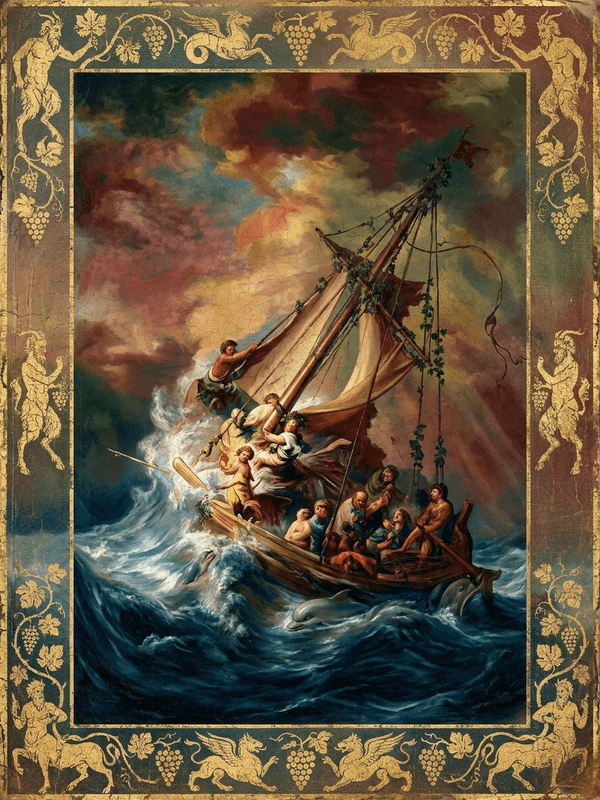
Young Dionysus stands alone by the sea and is seized by pirates who mistake him for a wealthy boy. They mean to sell him, but once their ship is out on the water, vines, wild beasts, and divine signs appear around them. In the end, the pirates leap overboard and are changed into dolphins.
Article
Summary
A band of pirates sails along the coast in search of cargo or captives and sees a finely dressed boy standing alone by the sea. Taking him for the son of a wealthy family, they decide to carry him far away and sell him for gold. They come ashore, bind his wrists, and push him onto the prow of their ship. The boy does not struggle, yet the ropes slip loose from his hands by themselves. The helmsman senses danger and urges the captain to return him to shore, warning that the stranger may be a god or a child beloved by the gods. The captain and crew think only of ransom and slave markets, so they mock the warning, raise the sail, and steer out to sea. Once the ship reaches open water, divine signs break out around them. Sweet wine wells up through the seams of the deck, grapevines climb the mast, ivy tangles the sail and ropes, and the ship stands motionless as if held by a giant hand. The boy rises with a god's majesty; a lion appears at the prow, and the shape of a bear moves across the deck. At last the pirates understand that they have not captured a rich boy at all. In terror, the pirates throw themselves into the sea, where their bodies change in the waves: arms become fins, backs arch, and they turn into dolphins. Only the helmsman, who had urged the others to release the boy, is spared. Dionysus tells him not to be afraid and reveals that he is the son of Zeus and Semele; afterward, whenever sailors saw dolphins following a ship, they remembered this punishment of greedy men upon the sea.
The Strange Boy on the Shore
A sea wind blew in from the coast, and the waves struck the rocks again and again. On that day, a band of pirates was sailing a long ship along the shore. Salt had darkened the hull; the oarsmen’s arms were bare, and their eyes searched the land for cargo—or people—they might seize.
Before long, they saw a boy.
He stood alone beside the sea, wrapped in soft robes. His hair was dark, and there seemed to be a faint radiance about his shoulders. He did not look like a fisherman, nor like a shepherd who had lost his way. There was no bundle at his feet, no servant at his side. He simply stood there, gazing out over the water. The pirates looked at him, and greed stirred in their hearts.
“He is some rich man’s child,” the captain murmured. “Take him. Sell him far from here, and he will bring us a handsome price in gold.”
The ship drew in toward the shore. Several strong pirates leapt down, crossed the slippery stones, and closed around him. The boy did not run. He did not cry out. He merely turned his head and looked at them. That made the pirates think their task would be easy. They bound his wrists with rope and pushed him aboard.
The boy sat at the prow, calm and still, as though he were not a captive at all, but a guest invited to make the voyage.
The Helmsman’s Warning
There was a helmsman on the ship, a man who had spent many years reading wind and water. He was more cautious than the others, and as he watched the boy, unease grew in him.
The rope had clearly been wound around the boy’s hands, yet it loosened by itself, as though invisible fingers had untied it, and slipped down onto the deck. The boy made no attempt to flee. He only lifted his eyes and looked quietly at the men around him.
The helmsman’s heart tightened. He hurried to the captain and said, “Do not carry him away. This boy is no ordinary mortal. Perhaps he is a god, or a child beloved by the gods. Let us set him back on shore while there is still time.”
Some of the pirates laughed. Others cursed him for a coward. The captain refused to listen. He looked at the boy’s fine clothing and thought only of ransom money and slave markets. Why should he give up wealth already in his grasp?
“Hold your tongue,” the captain said. “Raise the sail. We are not going back.”
So the sail was hauled up the mast, and the wind filled the cloth. The ship moved farther and farther from land. The rocks on the shore grew small, and the white break of the waves fell away behind them. The pirates believed their prize was secure. Some began to argue over where the boy should be sold; others reached toward his garments, feeling the fabric and guessing what it might be worth.
Still, the boy did not struggle.
Wine Across the Deck
When the ship had reached the open sea, the first strange sign appeared.
Liquid began to seep through the seams of the deck. At first it was only a little; then more and more came welling up. The pirates bent down and smelled it—and found it was wine, rich and sweet. It had not been poured from a jar. It had not leaked from the hold. It flowed from the planks like spring water, spreading slowly along the rowing benches, the ropes, and the gunwales.
Some cried out. Some stooped to touch it. The wine soaked their feet, while its fragrance grew stronger, until the whole ship seemed steeped in the scent of ripening grapes.
Then green shoots sprang up beside the mast. Slender vines pushed out from cracks in the wood and climbed with astonishing speed, twining around the mast, winding over the yard, and hanging down in heavy clusters of grapes. Ivy crept up from the sides of the ship as well, leaf upon leaf, tangling itself through the white sail and the ropes.
The oarsmen tried to row, but the oars seemed caught fast in the sea. No matter how they strained, they could not move them. The sail bellied in the wind, yet the ship stood still upon the water, as though some huge hand had seized it from below.
Now at last the pirates were afraid.
The helmsman shouted again, “I told you! Release him! Beg him for mercy!”
But it was already too late.
The God Revealed
The boy rose from the prow.
The sea wind lifted his robe, and the fragrance of wine and the leaves of the vine gathered around him. The pirates saw his face change. He was no longer merely a beautiful youth; he bore the majesty that belongs only to a god. His eyes seemed to burn from within, and in his hair there was the shadow of grape leaves and ivy.
Then a low growl sounded on the ship.
A lion stood at the prow, its mane bristling, its paws pressed against the planks, its eyes fixed upon the pirates. The shape of a bear moved amidships, its heavy body forcing a path across the wine-wet deck. The pirates staggered backward toward the stern, shoving one another, each man thinking only of himself.
The captain, who had been the fiercest of them all, turned pale. He tried to draw his knife, but his fingers shook so badly he could not grip the hilt. Some men fell to their knees. Some cried aloud. Some tried to hide below in the hold, but the vines had already choked the pathways of the ship.
Dionysus looked upon them.
He did not need to shout curses. He did not need to lift a thunderbolt. The wine, the vines, the beasts, and the motionless ship had already taught these greedy men the truth: the one they had carried off was no rich boy, but a god.
The Pirates Leap into the Sea
Terror flared through the ship like fire. One pirate could bear it no longer and vaulted over the side into the sea. Another followed him. Then more and more hurled themselves from the ship into the waves, preferring the deep water to another moment before the god.
But the instant they struck the sea, their bodies began to change.
Their legs fused together. Their arms shortened into fins. Their skin grew smooth, their backs curved, and their mouths and noses thrust forward. Men who only moments before had shouted and cursed now gave shrill cries amid the spray, and in the blink of an eye they had become a school of dolphins.
The dolphins circled the ship, leaping above the surface and sinking again into the dark-blue water. Some trace of human panic seemed still to cling to them, as though they could not understand why the sea had suddenly claimed them. Waves broke over their backs and washed the scent of wine from the ship’s side.
Only the helmsman had not leapt overboard. He knelt on the deck with his head bowed, not daring to look at Dionysus.
Dionysus came to him and said, “Do not be afraid. You recognized a god, and you urged the others to let me go. You are not like them.”
Only then did the helmsman raise his head, though his whole body was still trembling.
Dionysus told him that he was the son of Zeus and Semele, the god who brings grapes, wine, and ecstatic revel. He spared the helmsman’s life and released the ship from the miracle that had held it fast. The vines slowly loosened. The scent of wine faded. The sea wind once more filled the sail.
Afterward, whenever people saw dolphins racing beside a ship, they remembered those pirates. They had tried to sell a god as merchandise, and in the end they remained forever in the waves, swimming after sails and shadows through the foam.