Greek Mythology
Dionysus and Pentheus — Greek Mythology
Dionysus returns to Thebes to compel the city to acknowledge him as the son of Zeus and Semele. The young king Pentheus refuses to honor the god, hunts down his women worshippers, and is finally torn apart by his own mother and aunts in their divine frenzy.
Article
Summary
Dionysus returns to Thebes to make the city acknowledge him as the son of Zeus and Semele, and to clear his mother from the charge that she had lied. He enters in the form of a young stranger, bringing drums, ivy, wine, and women devotees. Under his power, the women of Thebes leave their doorways and looms, put on fawnskins, and hurry up Mount Cithaeron. The young king Pentheus sees only disorder in the city and calls the new rites a foreign deception. Old Cadmus and the seer Tiresias urge him to honor the god, but Pentheus orders the women seized and the stranger arrested. Dionysus is brought into the palace without resistance, yet iron chains cannot hold him: the palace shakes, fire flares beside Semele's old tomb, and the king strikes only a phantom when he rushes after his prisoner. A herdsman comes down from the mountain and tells Pentheus that the women are not merely drunk or mad. They make water, wine, milk, and honey flow from the earth, and when men try to seize them, they tear cattle apart with terrifying strength. Anger and curiosity divide Pentheus. Dionysus uses that desire, persuading him to dress as a woman so he can spy on the rites, then leads the king to Mount Cithaeron. There Dionysus sets Pentheus high in a pine tree and reveals him to the frenzied women as the man who mocked the god. Agave, blinded by divine madness, does not know her own son; she sees only a beast and joins Ino, Autonoe, and the others in dragging him down and tearing him apart. She carries his head back to Thebes, believing it to be a lion's, until the god's mist lifts and she sees the blood in her hands. Dionysus then appears and declares the royal house punished, and Thebes can no longer deny his name.
The God Returns to Thebes
The stone walls of Thebes still remembered the hands of Cadmus. Long ago he had come there in obedience to an oracle, slain a great serpent, sown the dragon’s teeth, and founded the city. Later the gods gave him Harmonia as his bride, and at their wedding the golden cups were filled to the brim, while the lyres rang from dusk deep into the night.
But the city remembered something more painful as well. Semele, daughter of Cadmus, had once been loved by Zeus. Hera, jealous of her, contrived to make her ask Zeus for a dreadful promise: that he would come to her in the full splendor of his godhead. Zeus had sworn, and he could not take back his word. So he entered her chamber with thunder and lightning. No mortal body could endure the blazing presence of a god, and Semele fell amid the fire. The child in her womb was not yet ready to be born, but Zeus rescued him, sewed him into his own thigh, and brought him forth when the time had come.
That child was Dionysus.
Yet not everyone in Thebes believed the tale. By the wells people whispered that Semele had merely fallen into shame and used the name of Zeus to hide it; that the thunderbolt had killed her because she lied. Semele was dead and could not defend herself. The child was carried far away and reared elsewhere. In time he wandered through many lands, teaching people to plant vines and press dark red wine, filling the mountains with drums, flutes, and cries of joy.
When Dionysus had grown, he returned to Thebes.
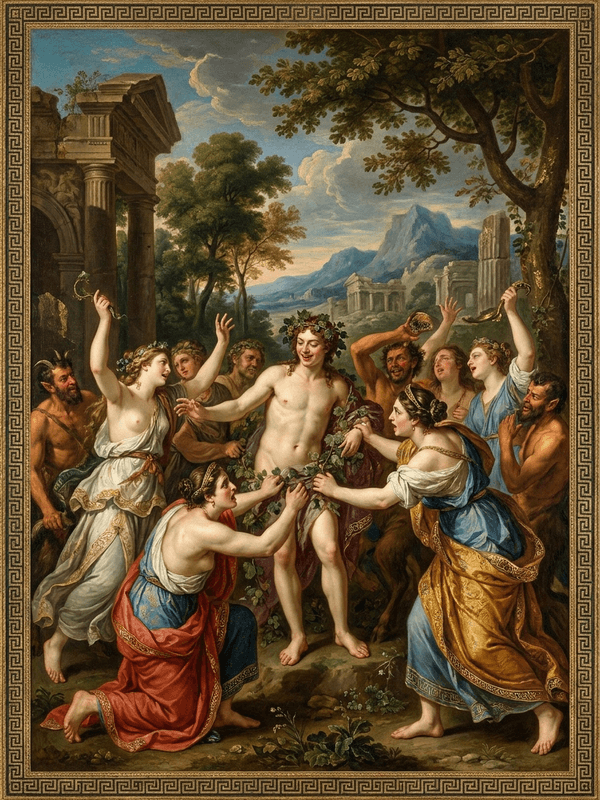
He did not enter the city in the visible majesty of an Olympian god. He came in the form of a young stranger, his long hair falling over his shoulders, a gentle smile on his face. Around him followed women devotees from the region of Lydia. They wore fawnskins, crowned their heads with ivy, and carried the thyrsus, the staff of Dionysus twined with vine leaves. They sang unfamiliar songs and moved lightly, like a wind blowing out of deep valleys.
Dionysus had come with a clear purpose. He wanted Thebes to acknowledge him as the son of Zeus, and he wanted the city to know that Semele had not lied.
Drums in the City
The god’s power first fell upon the women of the palace and the city.
One day, many Theban women suddenly laid down their work. Threads were left untended beside the loom; water in jars was not poured into basins; garments drying before the doors were not brought inside. As if they heard the far mountains calling, they came out of their houses, wrapped themselves in fawnskins, took up the staffs of Dionysus, and set off for Mount Cithaeron.
Among them were the daughters of Cadmus. Agave, Ino, and Autonoe were seized by the god’s rapture. In ordinary days they were women of rank in the city; now they ran through the woods with loosened hair, crying out the name of Dionysus. Some said they could strike the ground with their staffs and bring water springing up. Others said the wild beasts of the mountain came gently near them, and that young deer lay in their arms to suckle.
When the young king Pentheus heard these reports, his face darkened.
Pentheus was the son of Agave and the grandson of Cadmus. When Cadmus grew old, the kingship passed into his hands. He was young, hard-willed, and eager to make everyone understand that Thebes had laws of its own and was not a place to be thrown into confusion by any foreign drumbeat.
He stood before the palace while his attendants reported what had happened: women leaving home for the mountains, drums and songs in the night, and more and more people in the city calling the stranger a god. The longer Pentheus listened, the angrier he became.
“This is no god,” he said. “He is a trickster who uses scent, music, and wine to bewitch people.”
He ordered the city gates shut. He sent men to seize the foreigner who led the rites, and commanded soldiers to go up the mountain, capture the women, and bring them back.
The Old Men’s Warning
At that moment two old men came toward the palace.
One was Cadmus, white-haired, with a thyrsus in his hand. The other was the blind seer Tiresias. Though he could not see the road before him, he knew many things hidden from those with clear eyes. Both men had put on the dress of Dionysus’ worshippers and were preparing to go up the mountain and dance.
When Pentheus saw his grandfather dressed that way, he was both astonished and ashamed.
“You too?” he said. “One of you is the old founder of the city, the other a seer whom all men honor—and now you dress like this and join those women in their madness?”
Tiresias did not grow angry. Slowly he urged Pentheus not to take the power of the new god lightly. Wine, he said, eases human grief and lets the weary sleep in peace; since mortals receive such gifts from the gods, they should offer sacrifice in return. Cadmus too pleaded with his grandson. Even if Pentheus doubted, he should not set himself against a god. To acknowledge Dionysus as the son of Zeus would bring honor to Semele, and Thebes would lose nothing by revering him.
But Pentheus would not listen.
To him their words sounded like weakness. He looked coldly at the staff in Tiresias’ hand and said he would tear down the altar of this new god, seize the foreigner, cut off his long hair, and teach him what the king of Thebes could do.
The old men left with sighs. Cadmus understood that the young man’s anger had overpowered his judgment. Tiresias knew as well that when a god has set the net himself, few mortals can slip through its meshes.
The Captured Stranger
Before long, the soldiers brought in the stranger.
He had not resisted. Ropes bound his hands, yet his face remained calm, as though he were not a prisoner led into the palace but an invited guest. Pentheus stared at him. The stranger’s hair was soft and long, his eyes bright, and about him clung the scent of woodland and wine. The sight only deepened the king’s disgust.
“Where do you come from?” Pentheus asked.
The stranger answered that he came from the East, that he had seen the wonders of Dionysus with his own eyes, and that the god himself had instructed him.
Pentheus asked what those rites did by night, his voice thick with suspicion. The stranger was not provoked. He merely said that the mysteries of a god were not for an impious man to pry into. Pentheus ordered him locked in a dark room near the stables and commanded that his hair be cut and his staff taken away.
The stranger smiled faintly and said, “You do not know what you are doing. You do not even know who you are.”
The words pierced Pentheus like a needle. He ordered the prisoner secured.
But iron chains could not hold Dionysus.
Suddenly the palace shook. The pillars gave a deep groan, and the roof seemed ready to split. Fire flared beside the old tomb of Semele, and smoke whirled upward. Women cried out in the city, and soldiers threw down their weapons and fled in all directions. Pentheus rushed out, thinking the stranger was escaping. He drew his sword and pursued him—only to strike at a phantom.
When he turned back, the true stranger was already standing at the palace gate, his garments in order, the thyrsus still in his hand.
Pentheus was shaken with rage and fear, but he would not bow.
News from the Mountain
Then a herdsman came running down from Mount Cithaeron. Dust covered him, and even when he stood before the king he was still gasping for breath.
He told Pentheus that what was happening on the mountain was no ordinary frenzy. The women were not like drunkards collapsed in stupor. They slept on pine branches and oak leaves, and when they woke they arranged their clothing and moved with quiet dignity. Yet the moment the cry of Dionysus rang out, they rose as though one wind had lifted them all. One woman touched the ground with her staff and clear water sprang forth. Another drew her fingertips across stone and wine flowed out. Sweet milk and honey, too, dripped from the earth and from the vine-wrapped wands.
The herdsman and his companions had tried to seize Agave and bring her as a captive to the king. But as soon as they moved, the women on the mountain saw them. They came after the herdsmen with no swords in their hands, yet with terrible strength. They threw themselves upon the cattle, and even powerful bulls were torn apart. Nearby farmsteads suffered too. Men took up weapons to defend themselves, but the staffs of Dionysus drove them back.
The herdsman knelt and urged Pentheus, “My lord, honor this god. His power is not small.”
When Pentheus had heard him, anger and curiosity divided his heart. The more he forbade the rites, the more he longed to see with his own eyes what the women were doing on the mountain.
Dionysus saw his desire.
He no longer opposed Pentheus directly. Instead he lowered his voice, as though offering a secret plan. “If you wish to see, I can take you. But you must not wear your royal robes or carry weapons. If the women see a man, they will attack at once. Dress as a woman and hide behind the trees; then you will see clearly.”
At first Pentheus was furious and took it as an insult. But the god’s mist had already begun to cover him. He thought of the scenes in the forest; he thought of exposing the whole affair. Slowly his resistance faltered. Dionysus seized the moment and prepared a dress, a headband, and a fawnskin for him.
The young king stood inside the palace while the stranger arranged his long hair and smoothed the folds of the clothing. His eyes were dazed. He even asked whether, dressed like this, he looked like Agave. Dionysus answered gently beside him, like a careful guide.
But what he was leading up the mountain was not a spectator. It was a victim.
The King in the Pine Tree
They came to the foot of Mount Cithaeron. Wind moved through the pines, and from far away came the cries of the women. Dionysus told Pentheus to hide. Then he bent down a tall pine tree and set him upon its top. Once Pentheus had climbed on, the tree slowly sprang upright again and lifted him high into the air.
From there he could see the women on the slope. They gathered among the trees, staffs in hand, vine leaves around their heads, lost in the ecstasy the god had given them.
Suddenly the voice of Dionysus rang out from the sky, clear as thunder falling into a valley:
“Women, I have brought you the man who mocks you and mocks my rites. Punish him.”
For one moment the forest was still.
Then Agave raised her head. She did not see her son. The god had clouded her sight, and all she saw in the tree was a wild beast, like a lion spying on them. She shouted and called her sisters. The women rushed to the pine. Some hurled stones, some threw their staffs, and some seized the trunk and shook it.
Only then did Pentheus come to himself. From the tree he cried out in terror, calling his mother by name.
“Mother, it is I! I am Pentheus, your son!”
But Agave could not hear her son’s voice. She heard only the hunting cry within her frenzy. Together the women dragged the pine down, and Pentheus fell through its branches. His dress tore on the boughs, and his crown was long gone. He reached out and touched Agave’s face, begging her to know him.
But Agave seized his arm as a hunter seizes the paw of a beast. Ino and Autonoe rushed upon him too. In the god’s wild strength they felt no pain and knew no pity. On the mountainside they tore the young king apart.
The earth of Cithaeron was stained with blood. Pentheus could no longer order anyone imprisoned, nor mock anyone again. His voice was broken off amid his mother’s cries.
The Head His Mother Carried Home
Agave returned to Thebes with her trophy.
Her face was bright with excitement, her hair disheveled, and in her hands she held high the head of Pentheus, believing it to be the head of a young lion. All along the way she called for the people of the city to come and see. She had hunted a beast on the mountain, she said, and wanted to offer the glory of it to her father Cadmus.
Cadmus had already heard the terrible news and was returning from the mountain after gathering the scattered remains of his grandson. When he saw his daughter in that state, his heart felt crushed under stone. He did not cry out at once. Instead he kept urging her, again and again, to look carefully at what she held.
“Look at the sky,” he said. “Look at this city. Then look at what you carry in your hands.”
Slowly Agave’s eyes changed. The god’s mist withdrew; the mountain rapture faded. She saw the face clearly. It was no lion. It was her own son, Pentheus.
She screamed. Her arms weakened, and she could scarcely stand. The glory she had boasted of became blood that could never be washed away. She remembered how she had run, how she had seized that body—but it was too late.
Then Dionysus appeared, no longer only the gentle stranger. He declared that the Thebans had dishonored his mother and refused to acknowledge his divine name; that Pentheus had imprisoned his worshippers and mocked his rites. Therefore ruin had come upon the royal house. Cadmus and Harmonia too would have to leave the land and endure their fate far away.
The old man listened in sorrow. He had honored the god, yet still had to pay for the guilt and suffering of his family. Agave held her son’s head in her arms, and her cries echoed before the palace. Only then did the people of Thebes understand that the god who came with ivy and wine did not bring laughter and sweet drink alone. When mortals slighted him and shamed his mother, he could also bring the most terrible punishment of the wild mountains.
From that time on, Thebes could no longer say that Semele had lied. The name of Dionysus remained in the city, together with drums, vine leaves, and the fragrance of wine—and with the blood of Pentheus.