Greek Mythology
Deucalion and Pyrrha — Greek Mythology
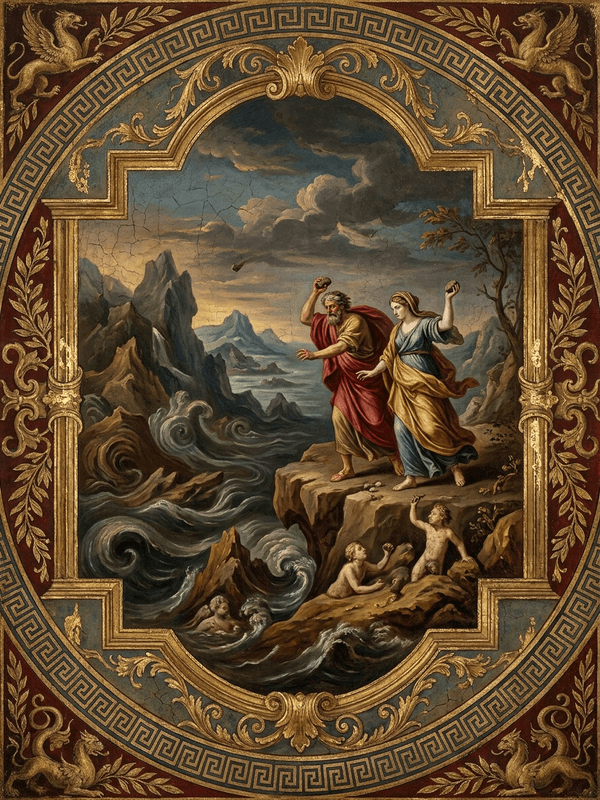
Zeus, disgusted by the cruelty of humankind, sent a great flood over the earth. Only Deucalion and his wife Pyrrha survived, carried in a wooden chest. When the waters withdrew, they obeyed an oracle and cast stones behind them; from those stones, the desolate earth brought forth a new race of human beings.
Article
Summary
Prometheus foresaw the coming disaster and warned his son Deucalion to build a wooden chest. Deucalion climbed into it with his wife Pyrrha, and when the flood covered the earth, they drifted through storm, darkness, and black water until at last they came to rest upon a high mountain. When the rain ended, the world was terrifyingly empty. The two survivors offered sacrifice to the gods and sought an oracle, longing to know how humankind might return to the earth. The answer was strange: they were to veil their heads and throw “the bones of the great mother” behind them. Pyrrha feared the command meant they must offend the dead by disturbing their mothers’ remains. But Deucalion understood the riddle: the great mother was the earth, and her bones were stones. So they obeyed. The stones Deucalion cast became men, and the stones Pyrrha cast became women. After the flood, humankind began again upon the earth.
The Wise Couple Below the Mountains
Deucalion lived among the highlands. He was not the strongest of heroes, nor a king eager for war, but he had a father whose name was known everywhere: Prometheus. Prometheus had long cared for humankind. He understood the designs of the gods above, and he knew that disaster among mortals rarely comes without warning.
Deucalion’s wife was Pyrrha. Her father was Epimetheus, and her mother was Pandora. Pandora had once opened the jar that should never have been opened, and many miseries had flown from it into the world. By Pyrrha’s generation, suffering was no longer only an old tale. It could be seen everywhere.
In those days the hearts of people on earth grew worse with every passing day. A guest entering a house could no longer be sure of bread and fire; he might find a hidden knife instead. Kinsmen deceived one another, and friends no longer kept their oaths. Boundary stones were shifted in secret beside the fields, and hands lifted before the altar were no longer clean. People spoke the names of the gods with their mouths while plotting harm in their hearts.
Zeus looked down from on high and saw all this, and his anger deepened. He would not allow such a generation to keep multiplying beneath the sun.
Zeus Sends the Flood
Zeus summoned the storm clouds and pressed the sky low over the earth. Winds rolled in from the sea, and black rain fell in sheet after sheet, as though every gate of heaven had been opened. At first people fled into their houses and carried sacks of grain to higher places. Soon the water crossed the thresholds, swept away the livestock, and drowned the hearth fires. They climbed onto rooftops, then into the branches of trees, until even the treetops vanished beneath the muddy flood.
Rivers no longer kept to their old beds, and sea waves crossed the sand of the shore. Fields, vineyards, city walls, and temples all lay under one expanse of water. Fish swam where people had once plowed, and dolphins passed among the trees. Wolves and sheep were carried off by the same current; strong men and little children cried out together, but their voices were quickly swallowed by the rain.
Before the flood arrived, Prometheus had warned Deucalion. He told his son to build a sturdy wooden chest, to store food and fresh water, not to cling to the possessions in his house, and not to wait until the water rose around his feet before leaving. Deucalion listened to his father. He and Pyrrha placed what little they could carry inside and sealed the cracks with boards.
On the day the flood came, the waves lifted the chest from the ground. It was no graceful ship, with a tall mast and white sails, but only a heavy box pitching in the rain. Deucalion braced himself against its side, while Pyrrha clutched her wet garments close. They listened to the roar of water outside and did not know how much of heaven or earth still remained.
They drifted for many days. By day they could not see the sun; by night they could not make out the stars. Sometimes the chest was carried up onto the crest of a wave, and sometimes it slid down into the trough as if the black water meant to swallow it. Pyrrha thought of her parents and of the home drowned beneath the flood, and she could not keep from weeping. Deucalion could only hold her hand and say that if the gods had allowed them to live, then surely there was still something left for them to do.
The Chest Comes to Rest on the Mountain
At last the rain weakened. A seam opened in the clouds, and pale gray light fell upon the water. The wind slowly died, and the flood no longer rose. As the waters withdrew, the wooden chest struck hard mountain rock and came to a halt.
They pushed open the lid, and cold wind rushed in. Before them there was no village, no smoke from cooking fires, no lowing of cattle or bleating of sheep. Far-off mountain peaks stood above the water like lonely islands. The ground beneath their feet was slick with mud, and waterweed hung in the cracks of the stones. The silence around them was frightening.
Some traditions say that place was Mount Parnassus; others say they came to rest on another high mountain. But all the stories agree that when the flood withdrew, only Deucalion and Pyrrha stood upon the heights.
First they offered sacrifice to Zeus. They had no splendid offerings, only the poor gifts survivors could manage after ruin. Deucalion kindled a fire, and the wet wood smoked white. Pyrrha stood beside him, her clothing still damp, and bowed her head in prayer to the gods: if they had truly been spared, let the earth not remain empty forever.
The Riddle in the Temple
When the flood had sunk lower, they descended from the mountain and came to a holy place of the gods. It too had been washed by the waters. Mud lay on the steps, and broken branches were scattered beside the altar. Yet the temple still stood, as though waiting in the ruined world for the last people to arrive.
Deucalion and Pyrrha knelt before the god and begged to be told how humankind might return to the world. They did not ask for long life for themselves, nor for gold, silver, cattle, or horses. They looked across the empty land, and one thought filled their hearts: the earth could not be left with only two sets of footprints.
The oracle came, but its words were dark as a riddle: leave the temple, cover your heads, and throw the bones of your great mother behind you.
When Pyrrha heard this, her face changed at once. She dared not act, and she did not wish to. Her mother was dead; their ancestors lay buried in the earth. How could they dig open graves and cast about a mother’s bones? She would rather go on weeping in the wilderness than commit such an outrage against the dead.
Deucalion, too, was silent for a long while. He paced before the temple, looking down at the mud and the stones beneath his feet. Then suddenly he stopped.
“The gods would not command us to do evil,” he said. “The great mother spoken of here must not be our own mother, but the earth, who nourishes all people. Her bones are the stones lying on the ground.”
Pyrrha was still afraid, but she knew her husband’s answer was sound. The earth receives rain and footsteps alike; people eat the grain she brings forth, and when they die they return to her embrace. It was no strange thing to call her the mother of all.
Stones Become People
So the two did as the oracle had told them. They covered their heads, drew their garments up to veil their faces, and did not look back. As they walked forward, they picked up stones from the ground and threw them behind them.
At first, when the stones struck the wet earth, nothing happened beyond the sound of their falling. But after a little while, the stones seemed to soften beneath unseen hands. Their sharp edges dulled, and their surfaces were no longer cold. The stones cast by Deucalion gradually formed shoulders and arms, rose upright, and became men. The stones cast by Pyrrha took on faces and bodies and became women.
These newborn people did not come into the world crying from swaddling clothes. They stood up out of stone. Their bodies were strong, and their nature carried something of stone’s endurance. On the land washed clean by the flood, footsteps sounded once more, and voices were heard again. The barren slopes and valleys no longer belonged only to wind and mud.
When Deucalion and Pyrrha saw human figures growing more numerous around them, their fear slowly faded. They knew the old generation had been carried away by the flood, and a new one had risen from the stony bones of the earth. Later, Deucalion and Pyrrha had children of their own, and the most famous of their sons was Hellen. Many Greeks traced their ancestry back to him and said that, after the flood, human life began again from this surviving couple and from the people born of stones.