Greek Mythology
Demeter at Eleusis — Greek Mythology
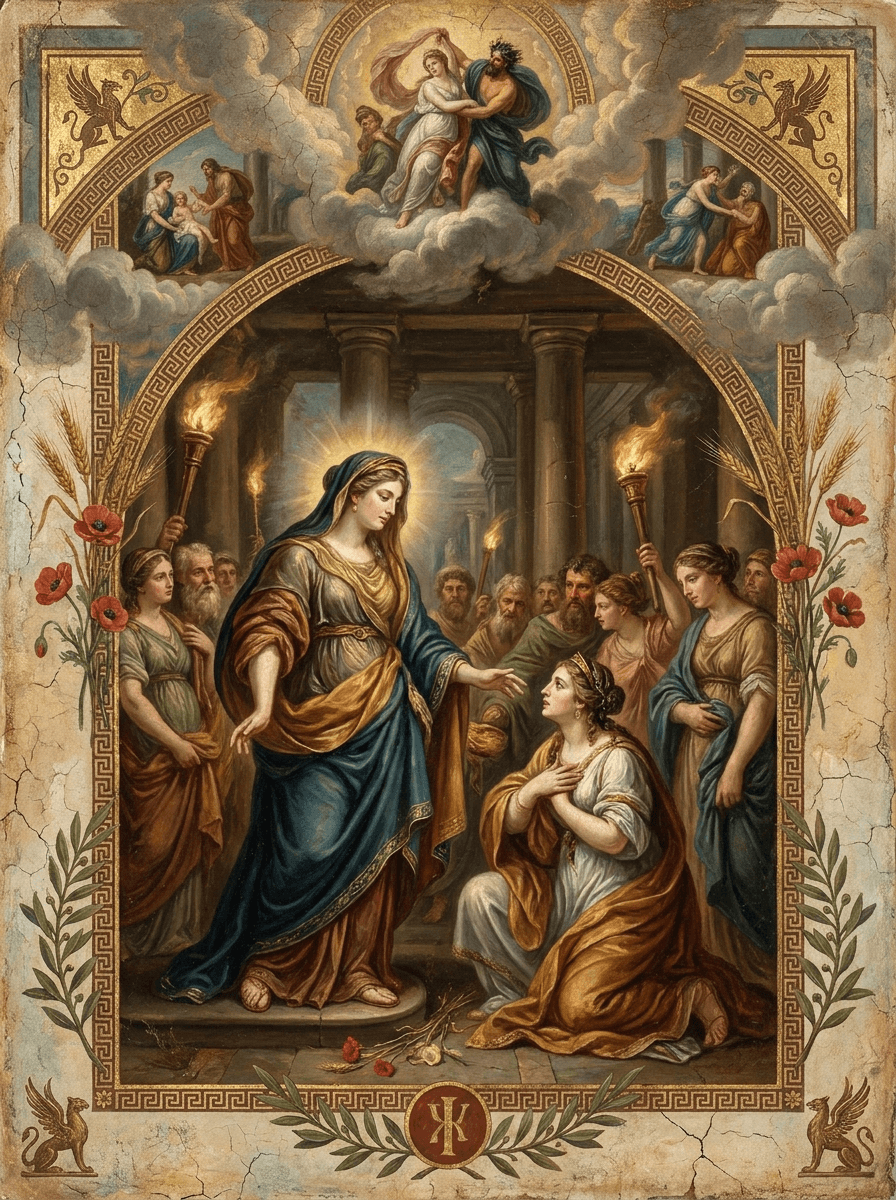
After Persephone was carried down to the underworld by Hades, Demeter came in the likeness of an old woman to Eleusis, where she nursed the little prince Demophon in the royal house. She meant to grant the child immortality by divine power, but his mother’s terror broke the rite. At last Demeter revealed herself, ordered a temple to be built, and left that land forever marked by her grief and her gift.
Article
Summary
Demeter revealed her true form, reproached mortals for failing to understand the works of the gods, and commanded the people of Eleusis to build her a temple. She took up her dwelling there, still grieving for her daughter, and the earth ceased to bear grain. In time the gods were forced to seek Persephone’s return, and from then on Eleusis became one of the great places where people honored Demeter.
The Old Woman by the Well
After Persephone vanished, Demeter searched the earth like one driven out of her senses.
She had heard her daughter’s cry, but she had not seen who carried her away. The voice had come from far off, as though swallowed at once by valleys and sea. Demeter tore the veil from her head, put on dark clothing, and took torches in her hands. Day and night she would not rest. She crossed mountains, riverbanks, pasturelands, and city gates, asking every god and mortal she met, “Have you seen my daughter?”
No one could give her an answer that eased her heart.
She no longer returned to Olympus, nor would she sit among the gods. Divine ointments, sweet wine, pure food—she touched none of them. She only went on, like someone pushed forward by pain. At last she hid the radiance of her godhead and changed her shape into that of an old woman, her face dim, her shoulders bent as if a long road had weighed them down.
So she came to Eleusis.
Outside the city stood a well, its shade falling across the stones. Demeter sat there like an old woman long exiled from home, with nowhere left to go. She said nothing, but kept her head bowed. The water at her feet looked dark; in the distance the roofs of the city shone in the sun, yet no warmth seemed to reach her.
Before long, the daughters of Celeus, king of Eleusis, came out to draw water. They carried bronze pitchers to the well and saw the strange old woman sitting there, simply dressed and sorrowful in appearance. The girls stopped. They could not bring themselves to pass her by.
They asked where she came from, and why she sat alone outside the city.
Demeter did not reveal her true name. She said she was called Doso, that pirates had seized her far from home, and that she had escaped when she found the chance. Now, she said, she had wandered to this place. She knew how to tend children and manage a household; if some kindly person would take her in, she would gladly serve.
The princesses pitied her. They remembered that their mother, Metaneira, had a young son who needed a trustworthy nurse, and they said to the old woman, “Wait here, please. We will go back and ask our mother.”
They filled their vessels and hurried back into the city, telling the queen about the old woman at the well.
The Child in the Palace
When Metaneira heard her daughters’ story, she told them to bring the old woman to her.
Demeter followed the princesses into the royal house. As she crossed the threshold, everyone inside felt something strange. Though she wore the form of an old woman, there was still a majesty about her that could not be hidden. She stood beside a pillar in silence, her head nearly touching the roof beam, and the doorway seemed lit by an unseen brightness.
Queen Metaneira sat within, holding her infant son Demophon. The child was still small and lay in his mother’s arms. Seeing the old woman’s silence and grief, the queen invited her to sit and ordered wine to be brought. Demeter refused with a shake of her head. She wanted no wine and no rich food, but only a drink mixed from water, barley, and mint. The servants prepared it as she asked, and then she took it and drank.
The queen entrusted the child to her.
From that time on, Demeter remained in the palace and cared for the little prince Demophon. When she lifted him, she did so gently, as though holding something precious. In her arms the child did not cry or fuss, but slept peacefully. By day she did not feed him with mortal milk, nor nourish him with ordinary food. She reared him with the breath of a goddess and passed her hands softly over his body. Day by day Demophon grew, his face bright, his limbs strong, as if he were a child of the gods.
All in the palace saw it and marveled. Metaneira was especially glad. She had only hoped her son would grow safely; now, seeing him as though guarded by blessing itself, she honored the old woman more and more.
But Demeter had another purpose in her heart.
She had lost her own daughter, and longing tormented her night and day. Perhaps for that very reason, she came to feel a special tenderness for the child in her arms. She wished to free Demophon from the fate of mortals, so that age would not seize him and death would not carry him away. In a mortal body there is a perishable part, and fire must burn it out. Such a gift from a goddess was not something an ordinary mother could understand.
So, whenever deep night fell, when the palace was quiet, the servants slept, and the hearth held only a red glow, Demeter carried the child to the fire. She murmured words known only to the gods and placed Demophon in the flames.
The fire wrapped around the child, but did not harm him. He lay among the flames as calmly as if he lay in his mother’s embrace. Demeter kept watch beside him, meaning to burn away, little by little, the mortal breath within him and make him deathless.
This went on for several nights.
The Cry in the Firelight
At last Metaneira grew suspicious.
She loved her child, and though he was thriving, she could not help wondering what the old woman did with him at night. One evening she rose quietly, passed through the shadowed rooms, and came to the hearth.
There she saw the sight most terrifying to a mortal mother: her own son lying in the flames.
Tongues of fire leapt around the child, their red light shining on his face. Demeter stood beside the hearth, solemn and intent, as though she were carrying out a task of the highest importance. But how could Metaneira understand that? She thought only that her child was about to burn. Her heart lurched, and she screamed.
“My child!”
She rushed forward, crying out and reproaching the old woman.
When Demeter heard the cry, she knew the work was ruined. Mortal fear had broken the design of a goddess, and the child could no longer receive the immortality she had meant to give. She lifted Demophon out of the fire and laid him on the ground. Then the mask of old age vanished from her face.
The room blazed with light.
No wandering old woman stood there now, but Demeter herself, goddess of grain. She was tall and radiant, her golden hair falling over her shoulders, her garments shining, and fragrance filled the whole palace. Metaneira trembled with fear, understanding at last that the stranger she had sheltered was no mortal woman, but a mighty goddess.
Demeter spoke in grief and anger. Mortals, she said, were short-sighted; they did not know the gifts of the gods, nor could they recognize the true good hidden in fate. She could have made Demophon immortal and given him honor forever. Now his mother’s cry had destroyed that work, and the child would grow as mortals grow, still destined one day to face age and death.
Yet because Demophon had been nursed in her arms, he would still receive honor.
The goddess then commanded the people of Eleusis to build her a great temple and altar beside the city. She herself would teach them the sacred rites, so that they would know how to worship her, how to seek her favor and appease her anger in solemn ceremony.
When she had spoken, she no longer remained in the palace. The queen and her daughters were overcome with fear and did not dare sleep all night. They lifted the child from the floor, washed his body, placed him again in his mother’s arms, and sent messengers to tell King Celeus what had happened.
The Temple of the Goddess
The next day, Celeus gathered the people of Eleusis and told them the goddess’s command.
No one dared delay. They chose the place, hauled stones, raised walls, set up the roof, and built the altar. People labored in the dust, while the sounds of hammers and cart wheels rang out. When the temple was finished, Demeter left the palace and took up her dwelling there.
But her heart had not returned to the light.
Her daughter Persephone was still in the underworld, and the mother’s grief had no end. Demeter sat alone in the newly built temple. She would not see the gods; she would not go back to Olympus. She kept the land from sprouting and the seeds from breaking through the soil. The fields grew hard and dry. Furrowed earth showed no green. Granaries emptied, and offerings on the altars dwindled. Without grain, mortals could not sacrifice to the gods; and though the gods dwelt on high, they too felt the weight of this sorrow.
Zeus could no longer pretend not to know. One after another, he sent messengers and gods to persuade Demeter to return to Olympus, promising her honors and gifts. But Demeter had only one answer: unless she saw her daughter, she would not let the earth bring forth grain again.
At last the gods had to find a way for Persephone to come back from the underworld to her mother. When mother and daughter were reunited, Demeter’s grief at last began to loosen. She held Persephone close and asked what had happened beneath the earth. But Persephone had already eaten the pomegranate seeds of the underworld, and so she could not remain beside her mother forever. For part of each year she had to return to Hades; for the rest, she came back to the earth and lived with Demeter.
Demeter accepted this fate. She softened the soil again, let the seeds sprout, and made the ears of grain bend in the wind. The fields of Eleusis bore harvest once more, and people again brought offerings before the altars.
From then on, the people of Eleusis remembered the day the goddess came to the well, and they remembered the firelight in the palace at night. They worshiped her according to the rites Demeter had handed down. That well, that temple, and the sorrow of a mother searching for her daughter all remained in the story of Eleusis.