Greek Mythology
Cronus Overthrows Uranus — Greek Mythology
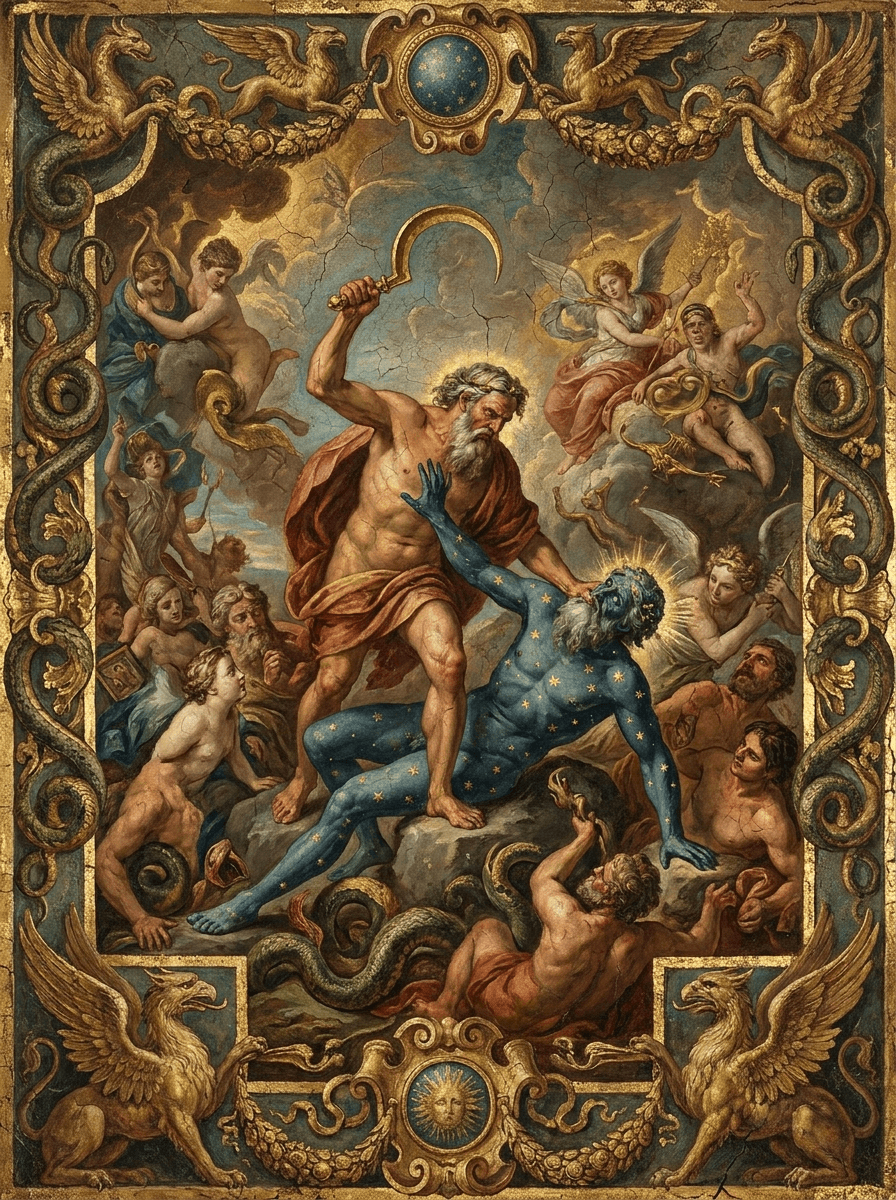
Uranus presses down upon the earth and hides his newborn children in the depths of darkness. In her anguish, Gaia fashions a pale, flint-gray sickle and calls on her children to rise against their father. The youngest Titan, Cronus, answers her. At night he lies in wait beside his mother and cuts away Uranus's power, overthrowing the ancient king of the sky.
Article
Summary
Among the earliest gods, Gaia the earth brought forth Uranus the sky, and with him she bore many mighty children: the Titans, the one-eyed Cyclopes, and the Hundred-Handed Ones. But Uranus loathed the terrible strength of his children. He would not let them come into the light, but forced them back into the depths of the earth, so that Gaia suffered day and night. At last Gaia could endure it no longer. In secret she made a hard sickle and summoned her children, asking who among them would punish their cruel father. The others feared Uranus, but the youngest, Cronus, stepped forward. He hid the sickle in his hand and, according to his mother's plan, waited in the darkness of night. When night came, Uranus descended as usual and stretched himself over the earth. Cronus suddenly reached out, seized his father, and with the sickle cut off his generative organ, flinging it far away. Uranus recoiled in pain, and from then on the sky no longer pressed tightly against the earth. The blood that fell upon the ground gave birth to the Erinyes, the Giants, and the ash-tree nymphs; the part cast into the sea drifted amid the waves and would later bring forth another divinity. Cronus thus became the new ruler, and the Titans took their place between earth and heaven. Yet Uranus left hatred behind as he fell, and Cronus learned a dangerous truth: if a father could be overthrown by his son, then no new king could be certain of his throne forever.
Cries Beneath the Earth
In the earliest age, there were no cities, no ships, no altars such as mortals would later build. Gaia, the broad earth, lay vast and wide; mountains rose from her body, and the sea beat against the low shores. From herself she brought forth Uranus, the sky. He arched high above her, before the stars had settled into the firm order of later nights, and everything between earth and heaven seemed newly awakened.
Gaia and Uranus came together, and child after child was born. First came the twelve Titans, towering in form and deep in strength: Oceanus, Coeus, Crius, Hyperion, Iapetus, and Cronus, the youngest among them; and among the goddesses, Rhea, Themis, Mnemosyne, Phoebe, Tethys, and Theia.
After them three more children were born. Each had a single round, bright eye set in his forehead, burning like fire, and powerful arms capable of making dreadful thunderbolts. They were called the Cyclopes. Later still, Gaia bore three sons even more astonishing: each had fifty heads and a hundred arms, and when they stood upright they seemed as overwhelming as mountains. When they moved, the earth itself seemed to shudder with them.
But when Uranus looked upon these children, he felt no father's joy. He feared them, and he hated them. He would not allow them to walk in the light or lift their heads toward the sky. Before they could stretch their limbs, he thrust them one by one back into the depths of the earth and shut them in darkness.
The children struggled inside their mother. Their enormous bodies were cramped; their arms struck against stone with a dull, imprisoned sound. Gaia bore their weight and pain. The mountains seemed to press upon her breast, and in the deep valleys there was something like a low weeping. Still Uranus came down from above and covered her, refusing to let the children out.
Gaia Forges the Sickle
At last Gaia could bear it no longer. She did not cry out aloud, for the sky was above her. She hid her anger in her heart and secretly drew from her own body a hard, pale-gray stone, shaping it into a curved sickle. Its edge shone coldly, like a new moon, but colder than moonlight.
She summoned her imprisoned children and said to them, "Your father has wronged you first, and he has wronged me as well. If any of you will listen to me, let him punish him. As long as he presses the earth down like this, you will never see the light outside."
Silence passed through the darkness. The great children heard their mother's words, and anger stirred in them; yet when they thought of Uranus's power, none dared answer. The sky had always been unreachable. Who could stretch out a hand and touch him? Who would dare be the first to raise a weapon against his father?
Then Cronus, the youngest, spoke. He was the last-born among his brothers, but his heart was the hardest, and he knew better than any of them how to wait for the right moment. He said to Gaia, "Mother, I will do this. Our father was the first to act with cruelty. He should not press us down forever."
Gaia heard him with both joy and fear. She gave Cronus the pale-gray sickle and told him where to hide and when to strike. Cronus took the weapon; its cold handle lay against his palm. He said no more, but concealed himself in the dark place his mother had chosen, silent as a stone.
The Ambush in the Night
When night fell, Uranus came to Gaia as he always did. He bent down from above, the vast sky covering the earth as though he meant to force everything back into darkness. He did not imagine that his own son was hidden nearby, holding the newly made sickle in his hand.
Gaia lay still and gave no sign. Cronus held his breath and waited until Uranus came closer. In that moment the whole world seemed wrapped in heavy cloth. Only the muffled breathing of the children deep within the earth, and the oppressive sound of the sky descending, could be felt.
Suddenly Cronus thrust out his left hand from the darkness and seized his father. With his right hand he lifted the sickle, and its blade flashed coldly through the night. Then he cut off Uranus's generative organ and flung it away from him.
Uranus trembled with pain. The sky-father, who had pressed so heavily upon the earth, at last drew back. No longer could he force the children into their mother's body as before; no longer could he pin Gaia beneath his shadow. For the first time there was space between earth and sky, and the children in darkness knew that their father's power had been cut away.
Blood Falls Upon the Earth
The severed part flew far off, and blood spilled as it went. Where the drops fell upon Gaia, the earth did not swallow them in vain. Before long, from those stains arose the Erinyes, the avenging goddesses. They remembered crimes committed among kin; they remembered bloodshed and betrayal. In later days, whenever someone harmed a close blood-relative, they would follow and give the guilty no rest.
From the blood also came the mighty Giants. They appeared clothed in a rough, wild strength, as though they had grown out of cracks in the rock. Then came the Meliae, the nymphs of the ash trees, bound to woodland and to hard timber; in later tradition, the shafts of war spears were connected with that tree.
As for the part Cronus had cast away, it fell into the surging sea. The waves carried it to and fro, and white foam gathered around it. Its full result would be revealed only later. On that day, one could only see a strange stirring on the water, as though new life were being conceived within the sea.
From then on Uranus withdrew from the earth and rose into the heights. He had been overthrown, but his anger did not vanish. It was said that he gave these sons the name "Titans" in reproach, accusing them of having stretched out their hands too far and warning that punishment would one day come upon them. Whether Cronus heard the words or not, they remained like a shadow over the new race of gods.
The New King Takes the Heights
After Uranus drew away, Cronus became the most powerful of the Titans. He had overthrown his father, relieved his mother's long suffering, and opened a way out for the brothers and sisters who had been crushed in darkness. The ancient king of the sky no longer ruled all things, and the Titans began to stand at the center of the world.
Yet the throne Cronus gained was not a secure one. By his own hand he had proved a terrible truth: even the highest father could be dragged down by a son, and even the strongest rule could be cut apart in the night by a sickle. He had once held that cold, bright blade, and so he understood better than anyone that if fear took hold of a new king's heart, sooner or later he might hear footsteps coming from his own children.
After that night, sky and earth were divided. Gaia was no longer pinned beneath the heavy weight of Uranus, and many new gods and spirits entered the world because of that shedding of blood. Cronus stood on the side of victory and became the new ruler; but the wound and curse of Uranus remained in the oldest memory of the world.