Greek Mythology
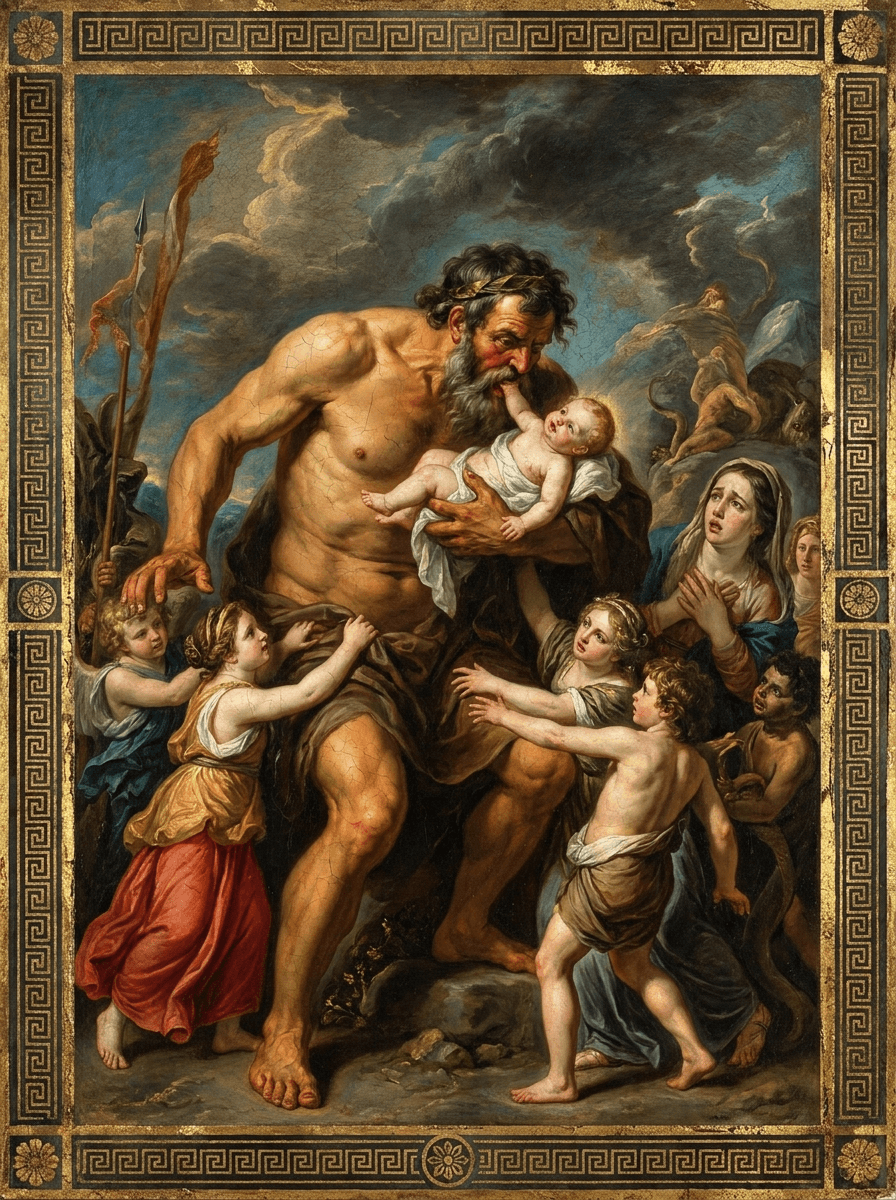
Cronus Devours His Children — Greek Mythology
After overthrowing his father, Cronus became lord of the heavens, but he feared that his own children would one day seize his throne. So, as each child was born, he swallowed the infant whole. At last Rhea could bear it no longer. With the help of Gaia and Uranus, she hid her youngest son, Zeus, and deceived Cronus with a stone wrapped in swaddling cloth.
Article
Summary
When the child was born, Rhea carried out the plan. Cronus did not look closely. He swallowed the bundle, believing he had destroyed another threat. But the true child, Zeus, had already survived in a hidden cave on Crete. In the moment Cronus swallowed the stone, he swallowed the beginning of his own defeat.
Cronus Takes the Throne
Cronus had once been the bravest and most ruthless of the Titans.
Before him, Uranus, the sky god, pressed himself down upon the earth and would not allow his children to see the light. Those children lay trapped deep within their mother Gaia, with no room even to stretch their limbs. Gaia, in agony, fashioned a pale gray sickle and asked which of her children would dare act for her. Many were silent. Only Cronus took the sickle and hid in the darkness, waiting for his father.
Later, when Uranus came down to lie upon the earth, Cronus suddenly reached out and cut away his father’s power with the sickle. The sky withdrew from the earth, and at last the world had wide space between them. Cronus became the new ruler, and the race of Titans rose with him.
Yet those who sit on thrones often fear nothing more than losing them.
After Uranus was wounded, he left behind a terrible warning, and Gaia too knew the same fate: one day Cronus would be overthrown by his own child. The prophecy did not break at once like thunder, nor did it turn into a blade, but it lay in Cronus’s heart like a hard stone. When he remembered how he himself had taken the heavens from his father, he became all the more certain that his children would do the same to him.
So Cronus began to watch his wife, Rhea.
The First Child Taken
Rhea too was a goddess of the Titans. After she was joined with Cronus, her first child was born.
It was a daughter, Hestia. She should have lain in her mother’s arms, hearing the soft crackle of the fire by the hearth, and grown in time to guard the flame of every home. But she had scarcely come into the world, and Rhea had not yet held her securely, when Cronus approached.
Rhea saw the look in his eyes and was startled. It was not the gaze of a father looking upon his child. It was the look of a gatekeeper who has seen an enemy slip through the crack of a door.
Cronus reached out with his great hands and seized the infant. Rhea cried out and rushed after him, but he did not turn back. He opened his mouth and swallowed the child whole.
The palace fell suddenly silent. The baby’s cry was gone. Only Rhea remained, standing there with empty arms.
After swallowing the child, Cronus showed no joy. He merely felt his heart ease a little. If the prophecy said that a child would overthrow him, then a child inside his belly could never grow up, never take up a weapon, never steal his throne.
He thought he had found the surest possible defense.
One After Another Vanishes
Before long, Rhea bore Demeter.
This daughter would one day be bound to ears of grain, tilled fields, and harvests. But then she too was only a newborn child. Rhea wrapped her in swaddling cloth and held her tightly against her breast. She knew Cronus would come, so she hid inside, unwilling to let his footsteps draw near.
But Cronus came all the same.
He did not listen to Rhea’s pleading. He did not look at the infant’s tiny fingers. He took the child and swallowed her into his belly again.
Next came Hera.
By the time Hera was born, Rhea was no longer merely frightened. Anger had begun to burn in her heart. She drew back with her daughter in her arms and cried out to Cronus, “Will you hide all your children in darkness?”
Cronus answered coldly, “So long as they cannot take my throne, darkness is the best place for them.”
And so Hera too was swallowed.
Later Rhea bore two sons: Hades and Poseidon. One would one day rule the chill realm of the dead; the other would shake the sea with his trident. But at birth they were just as helpless, just as unable to resist their father’s hand.
Each time, Rhea heard the brief cry of a child. Each time, Cronus came. Each time, the child vanished from her arms.
The gods do not die as mortals do. Those children, swallowed into their father’s belly, were not torn apart and destroyed; they were imprisoned in a place without daylight. They could not grow up and stand upon the earth. They could not speak so their mother might hear them. They could not reach out and touch one another. Cronus locked them inside his own body and believed he had locked fate away with them.
But Rhea suffered more with every passing day.
She was a mother, yet she could not raise her children. She was a goddess, yet again and again she lost the lives she held in her arms before her husband. At last she understood that if she remained silent, every child would be swallowed, and Cronus’s fear would never end.
Rhea Appeals to the Earth
Once more, Rhea became pregnant.
This time she did not wait until the child was born to weep and cry out. While Cronus was away, she left their dwelling and went to seek her parents. She descended toward the deep places of the earth and pleaded with Gaia; she also sought counsel from Uranus, whom Cronus had once overthrown.
Gaia heard her daughter’s words and knew that the prophecy had reached its turning point. She did not tell Rhea to endure. She did not command her to surrender the child. The earth goddess remembered the pain she had suffered when Uranus oppressed her, and she remembered how Cronus had once lifted the sickle. Now the old child had become the new oppressor, and fate had circled back upon itself.
Gaia said to Rhea, “When the child is near birth, leave this place and go to Crete. There are mountains there, and caves, and earth enough to shelter him. Once the child is born, hide him away. As for Cronus, bring back a stone. Wrap it well in swaddling cloth and place it in his hands.”
As Rhea listened, her heart beat fast. To deceive Cronus was no small thing. He had swallowed five children without hesitation. If he discovered her trick, his anger would fall like a storm.
But she had no other path left.
She held the plan in her heart and waited for the day of birth.
The Cave on Crete
When the child was nearly ready to be born, Rhea left Cronus’s side. She came to the island of Crete. Sea wind moved among the rocks, rough trees clung to the slopes, and wild bees flew near the mouth of a cave. Here the earth seemed like an open hand, hiding secret caverns in its palm.
In those mountains, Rhea gave birth to her youngest son.
He was Zeus.
From the moment he came into the world, the child was never seen by his father. Rhea held him close and soothed him in a low voice. She knew she could not remain for long. Cronus would soon learn that she had borne a child, and he would certainly demand the newborn.
So Rhea placed Zeus under the protection of the earth and hid him in a cave on Crete. The cave was cool. Moist traces gleamed along the rock walls. Outside, the stones of the mountain blocked the eyes of anyone watching from afar. There the infant Zeus was kept safe, his cries hidden from Cronus’s ears.
Then Rhea found a stone.
It was heavy, and just the right size to pass for a baby. Rhea wrapped it layer upon layer in swaddling cloth, covering every hard edge until, from the outside, it looked like a sleeping child. She lifted the bundle into her arms, sorrow and fear twisting together in her heart. What she held was not her son, yet she had to pretend that it was. She had to give up the false child in order to save the true one.
When all was ready, she returned to Cronus.
The Stone in the Swaddling Cloth
Cronus was waiting for her, just as she had expected.
When he saw the bundle in Rhea’s arms, a dark gleam passed through his eyes. To him it was not a newborn son. It was the hand reaching out from the prophecy, the enemy who might one day seize his throne.
Rhea did everything she could to keep herself calm. She did not hold the bundle too tightly, nor did she let her gaze linger on it for too long. If she showed even the smallest sign of reluctance, Cronus might grow suspicious.
Cronus reached out for the child.
Rhea placed the swaddled stone in his hands. In that moment, as her fingers left the cloth, it felt as though her heart were being torn open. But she did not cry out. She did not weep. She only lowered her head and waited for fate to pass through this narrow gate.
Cronus did not look closely.
He had already swallowed five children, and the motion had become terribly familiar to him. He believed Rhea would never dare deceive him. He believed that once a newborn entered his belly, it could never rise against him. So he lifted the swaddled bundle and swallowed cloth and stone together.
The heavy stone dropped into his body.
Cronus thought he had won again. He thought the sixth child too had been shut away in darkness, and that the prophecy had been forced down a little farther. He did not hear the baby crying in the cave on Crete. He did not see how the earth guarded that child.
Rhea stood before him, but in her heart she already knew: the most dangerous step had passed.
Her son was alive.
The Mistake in the Darkness
After swallowing the stone, Cronus still sat on high and still ruled the gods as before. His five children remained trapped inside his belly, unable to return to their mother. From the outside, nothing seemed to have changed.
But everything had changed.
The true Zeus had not been swallowed. He lived on, day after day, in the hidden cave on Crete. The stone walls concealed him. The earth protected him. He was far from his father’s eyes and hands. The more Cronus believed himself safe, the more quietly fate moved forward.
The stone wrapped in swaddling cloth became the first thing he had failed to see clearly.
He had once overthrown his father through courage, yet out of fear he swallowed his own children. He tried to lock the future inside his belly, but the true future had slipped away into a corner of the earth. Rhea had lost five children; at last she had saved the sixth.
From then on, Cronus still had his throne, his palace, and his majesty. But in the mountains of Crete, beyond his sight, a child had escaped his devouring mouth. On the day Cronus swallowed the stone, he also swallowed the beginning of his own defeat.