Greek Mythology
Creon’s Decree — Greek Mythology
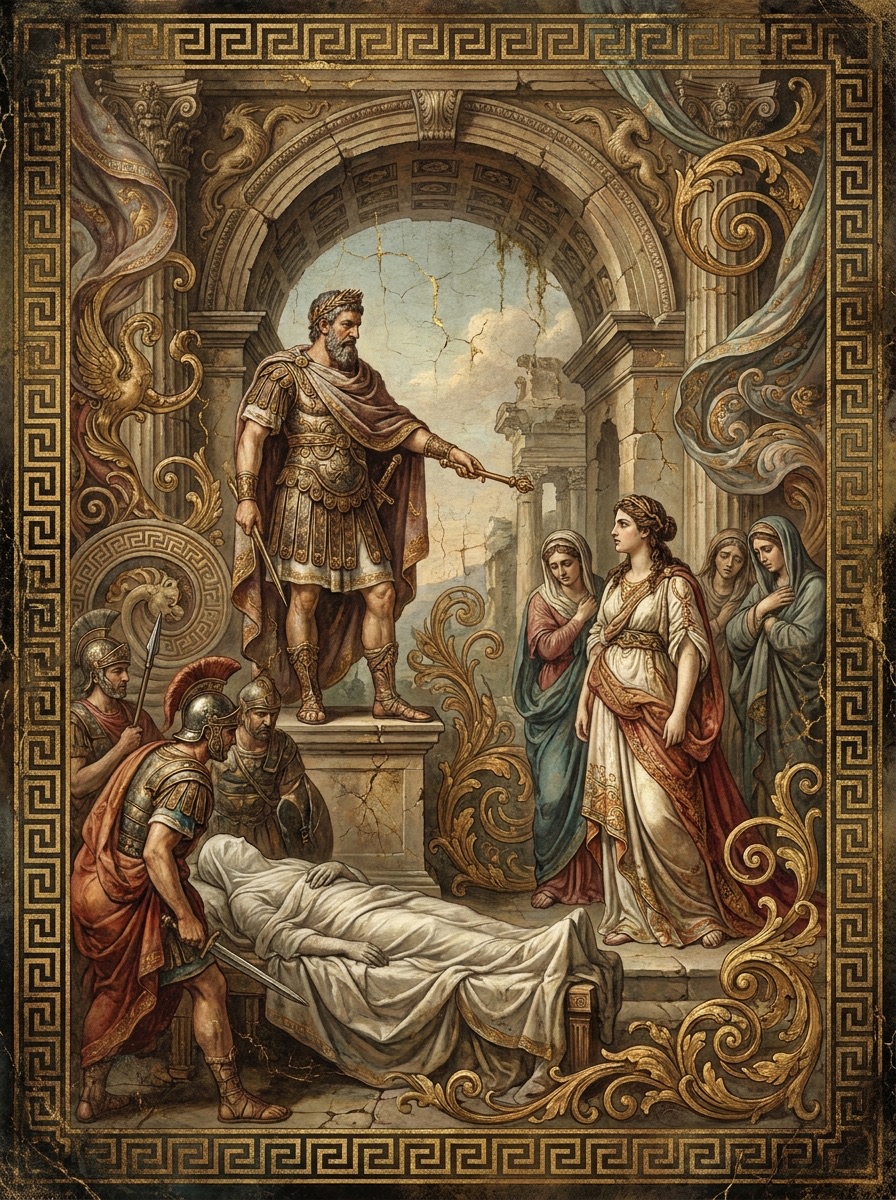
Thebes has barely survived the assault of the Seven, and the two sons of Oedipus lie dead by each other’s hands. Creon takes up the kingship and commands that Eteocles, defender of the city, be buried with honor, while Polynices, who attacked it, must be left unburied. With that decree, he drives the whole city into the narrow space between fear and defiance.
Article
Summary
After the battle of the Seven against Thebes, the walls still stood, but both sons of Oedipus lay dead near the gates. Eteocles had died defending the city, while Polynices had attacked his homeland with an Argive army. Their blood had fallen into the same Theban earth, yet the city would soon be forced to divide them into loyal defender and traitor. Creon took up the kingship after the battle and stepped forward to steady a city that had barely survived fear. He declared that Eteocles should receive full funeral rites because he had fought for Thebes. Polynices, however, was not to be buried or mourned; his body would lie exposed outside the walls. Anyone who defied the order would be put to death. When Antigone heard the decree, she went to her sister Ismene. To Antigone, Creon could rule the living, but he could not erase the burial owed to the dead; a brother born of the same mother could not be left to birds and beasts. Ismene feared the king’s order and the punishment of death, and begged her sister to endure, but Antigone resolved to bury Polynices even if she had to act alone. The guards set over the corpse first discovered that a thin layer of dust had been scattered over the body, and they hurried to report it to Creon. He saw this as a test of his new authority and ordered them to find the offender. Later, when blown sand swept over the field, Antigone came again to the body, poured dust and libation for her brother, and was seized by the guards. Before Creon, Antigone did not deny what she had done. She said that the king’s command was new, while the gods’ and kinship laws concerning the dead were older. Creon could not tolerate open defiance of the law he had just proclaimed, and Antigone would not let fear outweigh burial and family duty. The war outside the walls was over, but Creon’s decree opened a new tragedy inside the city.
Bodies Beneath the Walls
At dawn, Thebes still smelled of smoke.
Outside the gates, the dust of battle had not yet settled. Broken chariot-poles lay crooked by the road; shields had overturned in the ditches; spears stood buried in the mud or lay snapped in two. The sentries on the walls had not slept all night. Their fingers still clung to the cold stone battlements. Far off, crows dropped toward the ground, then rose again at the sound of men’s voices, their black wings beating through the pale gray light.
The battle had come too close. The enemy had not been strangers from across the sea, nor mountain raiders hungry only for plunder. The man who led the assault was Polynices, son of Oedipus. He had grown up within these very walls. He knew the gates, the palace, and the ancestral altars of the city. Now he had returned in armor given by foreign allies, bringing the chariots of Argos and seven great captains with him, to demand the throne from his own brother.
His brother Eteocles had held the city from within.
The two had once been meant to share power by turns. But when Eteocles sat upon the throne, he would not give it up. Polynices was driven out, wandered in exile, and at last found marriage and support in Argos. He did not come back alone. He brought an army: seven shields advancing upon seven gates, horses and iron wheels cutting deep ruts into the earth.
The people of Thebes held the city.
But the price of holding it was heavy. Blood stained every gate, and the most dreadful place of all was where the two brothers met. Eteocles and Polynices rushed at one another with spears in hand, like men past all hearing of counsel. The spearpoints pierced bodies born of the same blood, and the brothers fell almost at the same time. One died defending the city, the other trying to seize it; one lay amid the city’s praise, the other amid its hatred. Yet when their blood ran into the ground, it did not run apart.
By morning, Thebes was still alive, but both sons of Oedipus were dead.
Creon Takes the Throne
The palace could not remain long without a ruler.
Old Oedipus had already left Thebes, and Queen Jocasta had long since died. With both princes gone, the man best placed to take up the scepter was their uncle, Creon. This was not the first time he had stood where danger gathered. When plague struck, he had gone to Delphi for an oracle; after Oedipus fell, he had already helped steady the affairs of the royal house. Now the enemy had only just withdrawn from the fields, and the city’s courage was still unsettled. Everyone watched the doors of the palace, waiting for a voice to tell them what would happen next.
Creon came out.
He stood before the people, the palace behind him newly saved from war, and before him the weary, frightened Thebans, still shaken by victory. Some had cloth bound around wounded arms; some still carried the dust of the walls on the hems of their clothing. Old men leaned on staffs at the edge of the crowd, trying to hear the new king’s first words.
Creon did not speak first of kinship.
He spoke of the city.
As he saw it, Thebes had only just dragged itself free of disaster. What mattered most now was that everyone should know who had been a friend and who an enemy. Eteocles had fought for the city and died guarding its gates; he deserved an honored burial. His body would be washed, wrapped in cloth, and given offerings. He would be laid in the earth amid the mourning of kin and countrymen. Such a man remained a Theban even in death.
But Polynices was different.
Creon said that Polynices had come back with a foreign army to burn the city of his ancestors, destroy the altars of the gods, and make slaves of his own people. Such a man, even if born into the royal house, could not receive the same honor as the defender of the walls.
Then the new king’s command fell upon the city.
Eteocles was to be buried with solemn honor. Polynices was not to be buried, not to be mourned with offerings, not even to be covered by a handful of earth. Whoever defied the king’s order would be put to death.
When the decree was spoken, the crowd fell still, as though a cold wind had passed over it.
By ancient Greek custom, a dead man denied burial could find no peace. Even an enemy, even one who had committed grave wrongs in life, brought shame upon his kin and offense to the gods if his body lay exposed in the open. Yet Creon had only just become king of Thebes, and his words carried the weight of the new scepter. Besides, many in the city truly hated Polynices. The night before, they had heard the siege horns and crouched indoors with their children, fearing that if the gates broke, torches would be hurled into their homes.
So no one answered him openly.
The royal command spread through the city. Soldiers were posted near the body to keep anyone from coming by night. Polynices lay outside the walls in the dust, uncovered and unprotected. The sun rose and shone upon his face and armor. Wind swept along the walls and blew fine earth into his hair.
The Two Sisters Hear the News
Deep inside the palace, Antigone heard the decree.
She was the daughter of Oedipus and the sister of the two dead brothers. Her life had never truly known peace. Her father, after discovering his crimes, had blinded himself and left the city; her mother was dead; her brothers had fought over the throne and killed each other on the same day. She had already lost too many of her own blood. Now one more brother lay outside the city, with no one to gather him for burial.
She went to find her sister Ismene.
It was still early, and the light in the palace was dim. The sisters avoided the others and spoke in low voices beside a doorway. Antigone was urgent, and her words were direct. She asked whether Ismene knew the new king’s command: Eteocles had been granted burial, but Polynices was to be thrown to dogs and birds. Creon had forbidden anyone to mourn him or bury him, she said, and whoever disobeyed would be stoned to death.
Ismene listened, her face turning pale.
It was not that she did not love her brother. She was afraid. She thought of their father’s ruin, their mother’s death, the two brothers who had just destroyed each other; she thought, too, that they were only two women, with no soldiers, no power, and no one to shield them from the king’s anger. She urged her sister to endure. The royal order had been given, she said; the city was in Creon’s hands. If the living rushed against him, they would only add another corpse to the house.
Antigone could not accept that.
To her, Creon was king, but the dead belonged to laws older than any king. When kin died, they had to be washed, mourned, and laid in the ground. She would not leave a brother born of the same mother exposed in the open fields, and she would not let fear decide what she must do.
She asked Ismene to go with her.
Ismene lowered her head, and her voice grew softer and softer. She dared not. She begged her sister not to go, and not even to speak of such a plan to anyone else. If they kept silent, she thought, perhaps they might still live.
When Antigone heard this, her resolve only hardened.
She did not press her sister further. Ismene could stay inside, she said, but she herself would go and bury their brother. If she died for it, she was willing. With that, she turned away, as though she had already placed her life in her own hands and was ready to carry it out beyond the walls.
Ismene remained where she was. She wanted to hold her back, but she did not.
The Men Set to Guard the Dead
The soldiers outside the city were uneasy.
Creon’s order was plain: the body must not be buried. But no one wanted to spend the day guarding a prince’s corpse. The wind grew hot; dust clung to the skin; crows and wild dogs kept testing the distance. The soldiers drove one group away, and another came. Some cursed, some were afraid, and some feared that if anything went wrong the king would pour all his anger upon them.
They did not dare move far off.
Polynices lay on the ground, and the splendor he had carried into battle was gone. His shield had been taken away; his spear had been removed. What remained was a dead man with no rites. From the walls, people sometimes looked down, then quickly turned their faces aside. Everyone knew he had attacked the city. Everyone knew he was also a son of the royal house. Hatred could make men speak cruelly, but it could not make every eye calmly watch a body rot.
Before long, a strange thing happened.
The guards found a thin layer of dust scattered over the corpse. It was no full grave-mound, and no one had set up a marker or made a public offering. Yet it was as if someone had performed the simplest possible rite, sprinkling earth so that the dead man no longer lay wholly naked beneath the light.
The soldiers panicked.
They accused one another: who had fallen asleep, who had stepped away, who had taken money from the dead man’s kin. No one confessed. Their quarrel grew louder and louder, until at last they understood that they could not hide what had happened. If Creon discovered it himself, none of them would escape. So one guard was pushed forward and sent into the city to make the report.
He came to the palace slowly.
Creon sat within, attending to the city’s business like a new king. The guard stammered that he had not come with good news. He circled around the matter, first saying that they had not done it and had not seen who had, and then explaining that the body had not been properly buried, only sprinkled with dry dust in something like a funeral rite.
Creon’s face darkened.
To him, this was not a question of a little dust. Someone was testing his authority. The royal command had only just been given, and already it had been broken. If he let this pass, Thebes would soon fall into disorder again. He suspected bribery; he suspected discontent in the city. In his anger, he ordered the guards to go back and discover the offender. If they failed, they themselves would bear the guilt.
The guard promised in terror and all but fled the palace.
Antigone in the Blown Sand
The soldiers returned outside the walls more anxious than before.
They brushed the dust from the body and hid at a distance to watch. No one dared grow careless again. The sun stood high; the ground burned with heat; the air smelled of blood and dust together. Around midday, a gust of wind drove sand across the field so fiercely that the men could hardly keep their eyes open. They covered their faces with the edges of their cloaks. When the wind passed, they looked again toward the body.
Then they saw a figure approaching.
It was not a strong warrior, nor a servant carrying spade and pick, but a young woman. She had brought no crowd with her, no wagon, no weapon. She came to Polynices’ side and broke into a cry of grief, like a bird returning to an empty nest and finding its young gone. She gathered dry earth in her hands and scattered it over her brother. Then she brought out a libation and gave the dead man the last rites as burial demanded.
The soldiers rushed out and seized her.
She did not run.
They recognized her as Antigone, daughter of Oedipus and niece of the new king Creon. That made them more frightened still. Had they caught an ordinary person, the matter would have been simpler. But they had taken a woman of the royal house, and none of them could know what storm might break inside the palace. Still, the deed was done; the earth had been poured. They had no choice but to bring her back into the city.
Antigone walked between the soldiers, dust on her clothes, with no plea for mercy in her face.
When she entered the palace, Creon looked at her and for a moment was startled. The offender was not a foreign spy, not a hired servant, but his own kin—the dead man’s sister.
He asked whether she knew the decree.
Antigone answered that she did.
He asked again: if she knew it, why had she dared disobey?
Antigone did not claim there had been a misunderstanding, nor did she cast the blame on anyone else. She said that Creon had issued his command, but the gods’ laws for the dead had not been born that day. She could not, from fear of one man’s order, leave her own brother unburied. She knew she would die, but all mortals die; it would have hurt her far more to let her mother’s son be torn by beasts.
Those in the palace listened, and no one dared speak lightly.
Creon’s anger deepened. To him, Antigone had not only disobeyed; she had admitted it before everyone and refused to bow her head. A new king who had just saved the city could least endure having his command treated as nothing. If she escaped punishment, he thought, he would no longer seem a ruler. Kinship could not become a shield for breaking the law, nor could a woman be seen to overcome the king in public.
Antigone did not yield either.
They stood in the same palace, with one unburied body between them. Creon guarded the authority he had just proclaimed; Antigone guarded the kinship and burial rites she believed could not be abandoned. The war outside the walls was over, but inside the city another struggle had begun with that decree, sharper than before.
The Crack Left by the Decree
Creon’s command had been meant to divide loyalty from treason.
In his decree, Eteocles was the defender of the city, and Polynices its attacker. One deserved honor and burial beneath the earth; the other deserved to be left outside in shame. By such a distinction, Creon thought Thebes would remember who had protected it and who had brought disaster to its gates.
But the dead do not speak, and the living carry many thoughts.
The soldiers feared punishment. The people dared not say much. Ismene wavered in terror. Antigone chose to walk toward death rather than let her brother go without a covering of earth. The more Creon demanded obedience from the whole city, the more he found that his command had touched something deeper in the human heart.
Polynices still lay outside the walls, while the thin dust was scattered and swept away again. In the palace, Antigone had confessed what she had done. She had brought no army, seized no throne, opened no gate. She had only lifted dust in her two hands and spread it over her brother’s body.
Yet that handful of earth changed Creon’s decree. It was no longer merely an order concerning the dead.
It fell upon the living, upon a sister’s choice, and upon the royal house of Thebes just as its bleeding seemed to have stopped. The enemy army had withdrawn from the fields, but within the city a new disaster was quietly drawing near.