Greek Mythology
Khaos and the First Gods — Greek Mythology
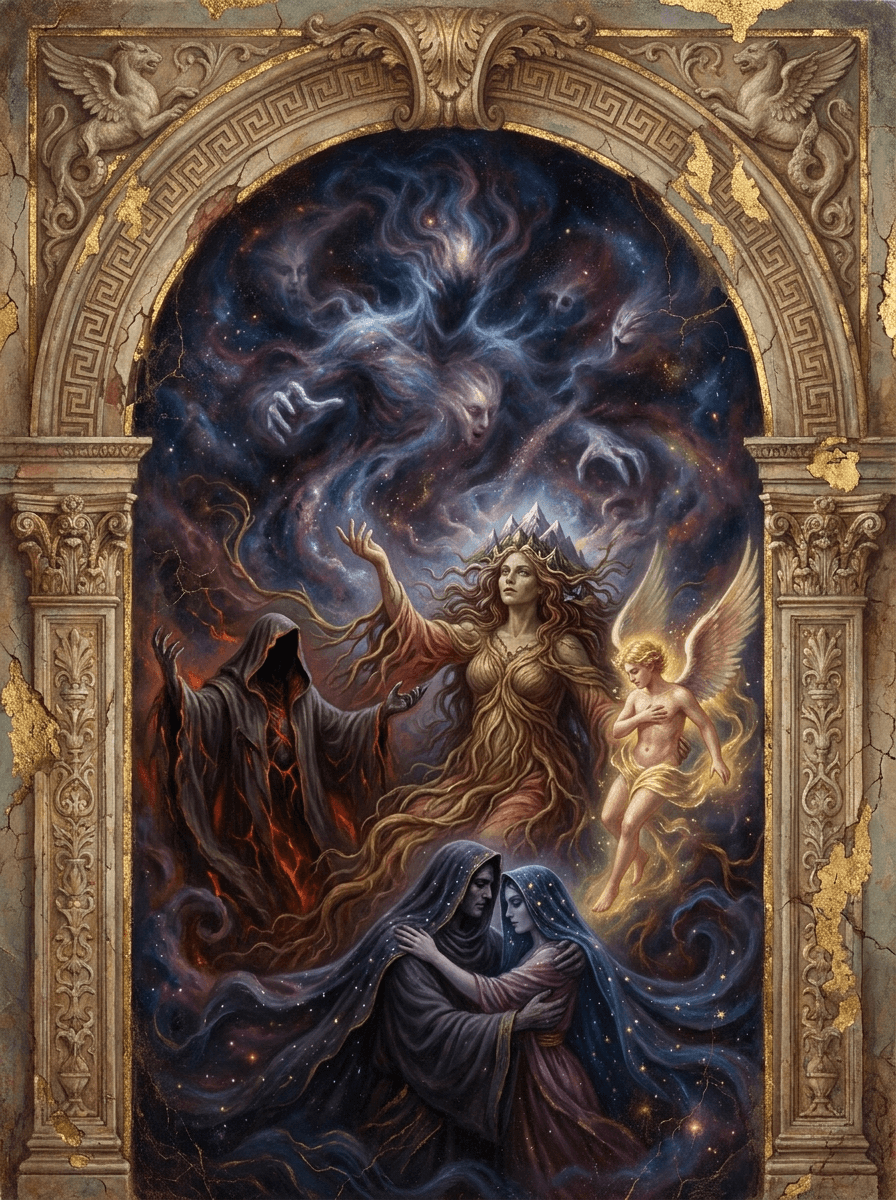
In the earliest time, before there were mountains, seas, or sky, Khaos came first: the personified void, the first great opening in which the world could begin. After Khaos came Gaia, Tartaros, Eros, Night, and Darkness, and from their coming the first gods and the first shape of the world began to appear.
Article
Summary
At the beginning of the story, nothing had yet been divided. There was no earth to stand on, no sky overhead, and no sea beating against a shore. Khaos came first, like a deep and immeasurable gap, holding everything that would one day exist in darkness and silence.
Khaos Comes First
In the earliest time, no one could have said, “The sky is above, and the earth is below.” There were no mountains, no sea, no grass or trees, no birds or beasts. There was no road for day to travel, and no gate through which night could enter. All around was a depth without edge, a hollow place where nothing had yet been set in order.
In that first emptiness, Khaos came first.
Khaos was not a palace, nor a god seated on a throne. Khaos was the personified void itself: a vast opening, a dim and boundless depth. If anyone could have stood in that first age, there would have been no ground beneath the feet and no sky above the head, only a wide and silent emptiness stretching away.
That was the beginning of all things. After Khaos appeared, the world was no longer nothing but silence. Other divine beings began to come forth one after another, like sparks slowly kindling in the dark.
Gaia Finds a Place to Rest
Next came Gaia, the Earth.
She was not empty as Khaos was empty. With Gaia, the world gained something broad and firm enough to bear what would come after. She spread herself out, deep and steady, like the ground beneath all future life. In later ages, the halls of gods, the cities of mortals, the forests, pastures, altars, and graves would all stand upon her.
In the oldest telling, Gaia was not carried in by another god, nor fashioned by another hand. She came of herself and settled into place, like a quiet mother ready to receive everything that would be born.
After Gaia came deep Tartaros.
Tartaros lay far beneath the earth, lower than any mortal mind could easily imagine. It was no ordinary cave, no ditch at the foot of a hill, but a heavy, cold, dreadful depth from which return was not easy. In later stories, defeated ancient gods and terrible monsters would be shut away there. At the beginning, however, it simply lay in silence, like a dark gate at the bottom of the world.
Eros Enters the First Darkness
Then another god appeared, and his name was Eros.
He was not yet the small child later pictured among flowers and feasts. In this oldest story, Eros was the force that drew divine beings toward one another. After he entered the world, the gods did not remain forever alone in their separate stillness. Meeting, union, and birth began slowly to become possible.
With Gaia, with Tartaros, and with Eros, that first emptiness began to stir. The world was not yet crowded with life, but it was no longer as barren as before.
Then Khaos, too, brought forth children.
From Khaos came Erebos, and from Khaos came Nyx. Erebos was Darkness, the shadow of places where no light reaches; Nyx was Night, the great veil spread across the world. They came out of Khaos quietly, without thunder or cry, and laid the first blackness over the young world.
Night Gives Birth to Day
Erebos and Nyx came together: Darkness met Night. In time, they gave birth to Aether and Day.
Aether was the clear brightness of the upper air, like the pure breath of the gods. Day was Day herself. When she appeared, Night no longer covered everything forever. Day came after Night like a heavy curtain being drawn slowly aside.
So the first world had Night, and it had Day. It had Darkness, and it had brightness. Night did not vanish; she would return at her appointed time. Day did not remain forever either; once she had passed, the dark veil would fall again. Later mortals would watch dawn and dusk as ordinary things, but in the oldest stories even this daily change was the trace of divine birth.
Earth Brings Forth Sky
Gaia also began to give birth.
First she brought forth Ouranos, the Sky. He rose high above her and covered the earth like a great bronze vault, or like an immeasurable curtain stretched from side to side. From every direction he bent over Gaia, so that Earth no longer lay alone in the empty deep.
Gaia then brought forth the high mountains. Ridges lifted from her body and reached toward the sky; valleys gathered shadow between them. Later, nymphs would dwell among the trees and springs, beasts would run across the slopes, and wind would pass through clefts in the stone. But at that moment the mountains had only just risen, like the hard bones of Earth standing up from within her.
After them, Gaia brought forth Pontos, the Sea. Water spread along the edges of the earth, dark blue and restless, beating against the new young shore. It was not a little river or a well, but a vast living water, swelling with foam when it rose and leaving wet stones shining when it drew back.
Sky, mountain, and sea all came from Gaia. She did not borrow the power of another god to make them. By herself she brought these oldest places into being. From then on, the gods had a sky above them, an earth beneath them, and the far-off roar of the sea.
The First World Stands Firm
By then, the world was no longer the empty chaos with which the story had begun.
Above was Ouranos covering all things; below was Gaia bearing them. In the depths, Tartaros opened in silence. Nyx brought Night at her hour, and Day followed after. Erebos remained hidden where light could not enter, while bright Aether shone above. Mountains had risen, the sea had spread out, and Eros had opened the way for all the unions and births that would follow.
There was no thunder yet, no rushing chariot, no clash of weapons. The first story is not a loud one. It is more like the slow waking before dawn: first the deep gap, then the weight of earth; first the curtain of night, then the light of day; first the sky stretched over the earth, then the mountains and sea taking their places.
From that time on, gods and living things had somewhere to be born, to walk, to struggle, and to dwell. Later stories would grow louder, and many children would be born from these first divine beings. Rivalries and battles would follow. But here, at the beginning, the oldest world had only just become steady. Darkness, brightness, earth, sky, and sea were all in place, waiting for the next gods to come forward.