Greek Mythology
Callisto — Greek Mythology
Callisto was a maiden in the company of Artemis, but Zeus deceived her and left her carrying his child. Driven from the goddess’s woodland band and later transformed into a she-bear, she was at last lifted into the sky with her son Arcas, becoming the Great Bear and the Little Bear among the stars.
Article
Summary
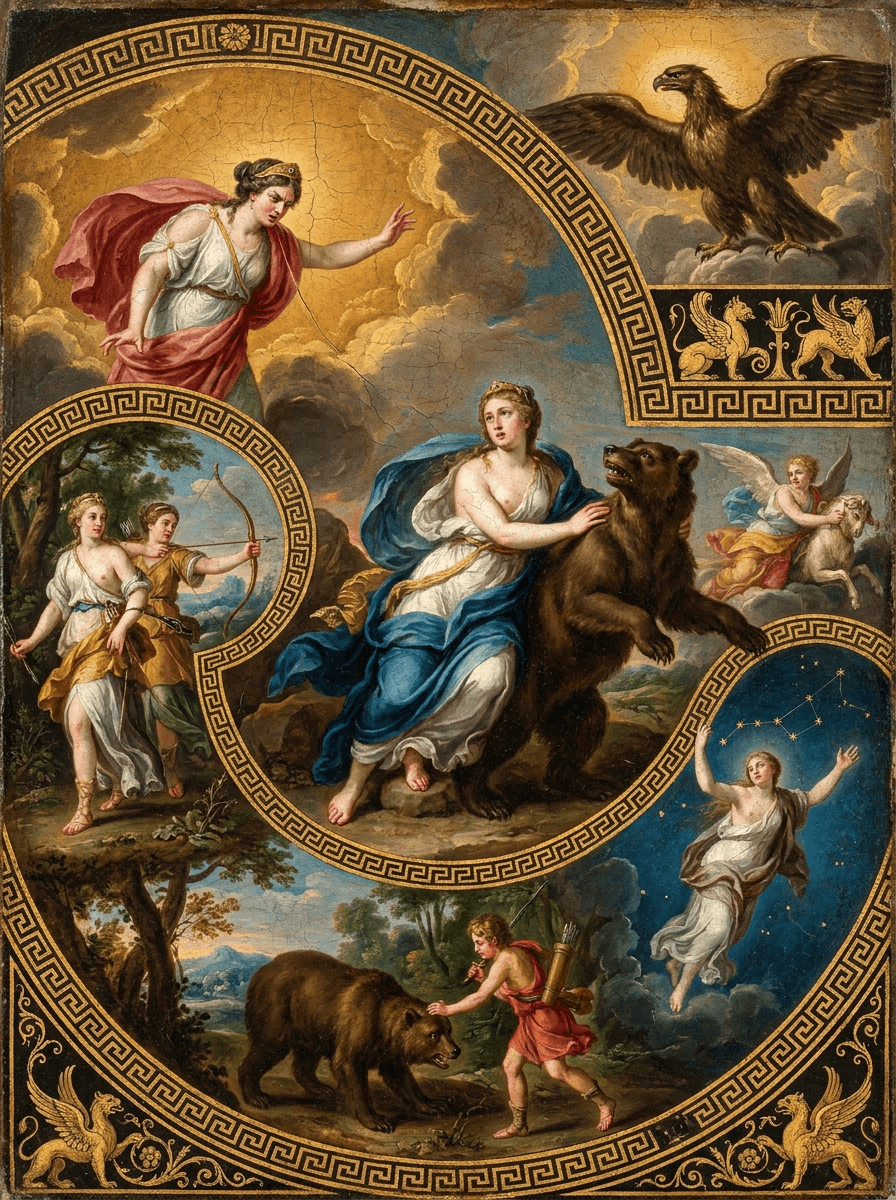
In the mountain forests of Arcadia lived a maiden named Callisto. She hunted in the retinue of Artemis, wearing a short tunic, carrying a quiver on her shoulder, and vowing to keep far from marriage. She ran through the woods more swiftly than many hunters, and for that the goddess loved her. One day Zeus saw Callisto resting alone among the trees, and he came to her in the likeness of Artemis. Callisto suspected nothing, and ruin fell upon her. Afterward she tried to hide her pregnancy, but when the maidens went down together to bathe, her secret could no longer be concealed. When Artemis saw that Callisto had broken her vow, she angrily cast her out of the company. Callisto gave birth to a son, Arcas, but Hera’s jealousy soon found her. The queen of the gods changed her into a she-bear, and Callisto wandered the wild hills with a human heart trapped inside an animal’s body. She could no longer speak with a human voice, and when she saw hounds and hunters, she could only flee in terror. Years later, Arcas grew into a young hunter and met that she-bear in the forest. The mother recognized her son and came toward him, but the son raised his spear. Zeus could not bear to watch mother and child destroy one another, so he lifted them both into the heavens, where Callisto became the Great Bear and Arcas the star set near her as guardian.
The Maiden of the Mountains
Arcadia is a land of mountains, with pine forests, oaks, and cold springs running through the stones. By day, deer passed through the tree-shadows; by night, wolves could be heard calling from far away. The people there knew the bow well, and they knew the name of Artemis, for the goddess often moved through the wild country with her maidens, hunting the beasts of the hills.
Callisto was one of those maidens.
She was of noble birth; some traditions say she was the daughter of Lycaon, king of Arcadia. Yet she did not love the loom in the palace or the songs sung at weddings. She preferred a short hunting tunic, her hair bound back, a quiver across her shoulder, and the path into the woods behind Artemis. She had sworn to live as the goddess lived, far from marriage, keeping her chastity unbroken.
Artemis was fond of her. Callisto was quick-footed and bright-eyed. She could read the print of a deer’s hoof in wet earth and hear, in the wind, the sound of a boar rooting among the leaves. When the maidens drew their bows on the hillside, she was often the first to mark the quarry. The sun browned her face, branches scratched her legs, and she never complained.
In those days Callisto thought the forest would be her whole life. She believed that as long as she followed the goddess with bow and arrows, as long as she held to her vow, misfortune would never come seeking her through the trees.
The One Who Wore the Goddess’s Face
One day the hunting party had ranged for many hours through the mountains. At noon the heat pressed down upon the treetops, and even the birds had grown quiet. Callisto, weary from the chase, left her companions and came to a still clearing. There was soft grass there, and water slipping from a crack in the rock. She laid down her bow, loosened her quiver, and rested beneath a tree.
From above, Zeus saw her.
He knew Callisto belonged to the company of Artemis, and he knew she would not willingly draw near to a man. So he did not enter the forest in his own shape. He took the form of Artemis instead: the goddess’s belt and bow, her way of walking, even the sound of her voice, all so closely copied that she seemed to be Artemis herself.
Callisto heard footsteps and looked up. When she saw “the goddess” approaching, she rose at once. She did not hide or doubt, but went toward the figure with affection and trust. She thought Artemis had come looking for her, and she said she had only been tired and had stopped there to rest.
Zeus, disguised as the goddess, came close. There were no other maidens in the clearing, no hounds, no one to cry out for her. Only then did Callisto sense that something was wrong, and by then it was too late. Disaster fell upon her while the grass remained the same grass, and the spring still ran between the stones; but the life she had known was gone beyond return.
When Zeus departed, Callisto remained beneath the tree alone. She picked up her bow again, but her hands trembled. She went back to Artemis’s company and still followed the goddess in the hunt, still carried her quiver, yet now she kept a silence she could not explain. When the maidens called to her, she answered; when Artemis noticed her quietness, she only lowered her eyes.
Day after day passed, and her body began to change. She tightened her belt more and more and avoided the eyes of those around her. When the mountain wind lifted her tunic, she clutched the cloth in fear. She dreaded the goddess’s discovery and the questions of her companions. But a secret hidden in the body cannot be hidden forever.
The Secret by the Spring
Some time later, Artemis led her maidens out hunting again. From dawn until afternoon they pursued the game, pushing through thorns and scrambling over broken stones, until at last they stopped beside a mountain spring. The water was clear enough to show the moss upon the rocks. The goddess, finding the day hot, told them all to remove their garments and wash the sweat and dust from their bodies.
The maidens laughed as they went toward the water, leaving bows and arrows on the bank. Callisto alone stood apart and would not enter. She said she was not warm; then she said she would stay and watch the weapons. At first the others paid no heed, but when they saw her continually drawing back, they laughingly tried to pull her along. Callisto grew pale, clutched her tunic, and would not undress.
Artemis saw that something was amiss. Her gaze, cold as moonlight in the mountains, fell upon Callisto. The maidens gathered around and loosened her belt. Callisto could hide herself no longer. Her pregnant body was revealed before them all.
The spring fell silent.
There was no place for such a thing in the company of Artemis. The goddess had required the maidens beside her to keep their vows, and Callisto was carrying the child of Zeus. Whether or not this ruin had come by her own will, the anger of the goddess descended all the same. Artemis ordered her to leave and forbade her ever again to follow the hunting band.
Callisto stood beside the water and heard the command as if she had been thrown a second time into the cold spring. She did not defend herself; perhaps she could not. She took up her bow and arrows, but she could no longer walk at Artemis’s side. The maidens who had once hunted with her looked on—some astonished, some silent, some unable to meet her eyes.
From that day, Callisto remained alone in the mountains. She did not return to the carefree band of maidens, and it was hard for her to return to the home she had once known. In time she bore a son and named him Arcas. His cry echoed through the valley. Callisto held him in her arms with joy and fear mingled together, for she knew the child carried the blood of Zeus—and that Hera’s gaze would soon fall upon him.
Hera’s Anger
Hera did hear of it.
Again and again the loves of Zeus came to her ears, and her anger often fell not upon Zeus himself, but upon the women he had approached. Callisto had already lost the protection of Artemis, and now she was alone with her child, with nowhere left to hide.
When Hera came before her, Callisto still had a human shape. Perhaps she tried to beg for mercy; perhaps she tried to speak for herself and for her child. Hera would not listen. The queen of heaven’s jealousy closed over her like a net.
Hera seized her by the hair and hurled her to the ground. Callisto’s fingers began to bend, and her nails hardened into claws. Her arms grew thick and dropped toward the earth. Dark brown fur pushed through her skin and covered her shoulders and back. She tried to cry out, but only a deep animal growl came from her throat. Her face lengthened, and sharp teeth filled her mouth. In a few moments the maiden of the forest had vanished, and on the ground there remained only a she-bear.
Yet her heart had not become the heart of a beast.
Callisto still remembered who she was. She remembered the bow of Artemis, the shame and terror at the spring, and the newborn son she had held in her arms. She looked down at her paws and tried to hold her child, but could only gouge deep marks in the earth. She tried to call the name of Arcas, but her throat gave only a rough roar.
From then on she wandered the mountains of Arcadia. She feared hunters, for a hunter’s spear could pierce a bear’s hide; she feared the wild beasts too, for they could not know that a human mind still lived inside her. When hounds barked, she fled into the thickets. When the moon rose at night, she would come to the spring and look at her reflection. The face in the water was not a maiden’s face, but the shaggy head of a bear.
Sometimes, from far away, she saw the lights of a village and moved toward them despite herself. But when people saw the shape of a bear, they took up torches, stones, and spears, and drove her off with shouting. She could not tell them she too had once been human. She could not tell them she had come to harm no one. She could only turn and run back into the dark woods.
A Mother Meets Her Son
Arcas grew year by year. He did not remain long in his mother’s arms, and he did not know that the she-bear in the mountains was his mother. In time he became a strong young man, skilled in drawing the bow, throwing the spear, and following the tracks of beasts. The wild land of Arcadia raised him and taught him the craft of the hunt.
One day Arcas entered the forest with his hunting gear. The leaves rustled in the wind, and fresh tracks marked the ground. He followed them onward, until suddenly a she-bear appeared from behind the trees.
It was Callisto.
The years had passed, and her body was wholly that of a bear. Only the human memory within her had not gone out. As soon as she saw Arcas, she knew him. A mother knows her child, even when he has grown into a young man with a bow across his shoulder and a spear in his hand. She forgot what she looked like now. She forgot that men are afraid when they see a bear. Slowly, she came toward him.
Arcas did not know who stood before him. He saw a she-bear approaching and thought the beast was about to attack. At once he lifted his spear. He planted his feet and aimed at the bear’s breast. Callisto stopped and made a low sound. In her heart it may have been a call of love; in Arcas’s ears it was only the growl of an animal.
She took one more step.
The spear was about to fly. In another instant the son would have killed his mother with his own hand, and the mother would have died with her unspoken cry trapped inside her.
Then Zeus saw what was happening. He had once brought ruin upon Callisto; now he could not bear to watch mother and son destroy one another. From heaven he reached down with his power, seized Callisto and Arcas, and lifted them out of the forest. The spear did not fall, and the bear’s paw did not touch the hem of her son’s clothing. The woods, the treetops, the springs, and the baying of the hounds all dropped away beneath them.
They rose into the sky, leaving the valleys of Arcadia behind.
The Bears in the Sky
Zeus set Callisto among the stars and made her the Great Bear. He placed Arcas beside her as a neighboring star, a guardian near at hand. When night came and people looked toward the northern sky, they said they were seeing Callisto and her son. The mother no longer fled hounds through the forest, and the son would never drive a spear into his mother’s breast.
But Hera’s anger did not fade. When she saw Callisto set in the heavens, she felt the woman had been given honor. So she appealed to the powers of the sea, asking that the Great Bear should not sink into the waters to rest as other stars did. And so, in the sayings of men, the Bear of the sky forever circles in the north and is never allowed to descend into the sea.
The Arcadians, too, remembered the name of Arcas. He became an ancestral figure bound to that land, while Callisto’s fate remained in the stories of the stars and the mountains. A traveler on a night road, watching the northern constellations slowly turn, might remember the maiden who once ran behind Artemis through the pines.
She had carried bow and arrows through the forest. She had lost her companions beside a spring. She had lived with a human heart imprisoned in the body of a bear. In the end she did not return to the woods of her youth, nor to the goddess’s company. She was hung in the sky, changed into a constellation that people could see whenever they lifted their eyes.