Greek Mythology
Baucis and Philemon — Greek Mythology
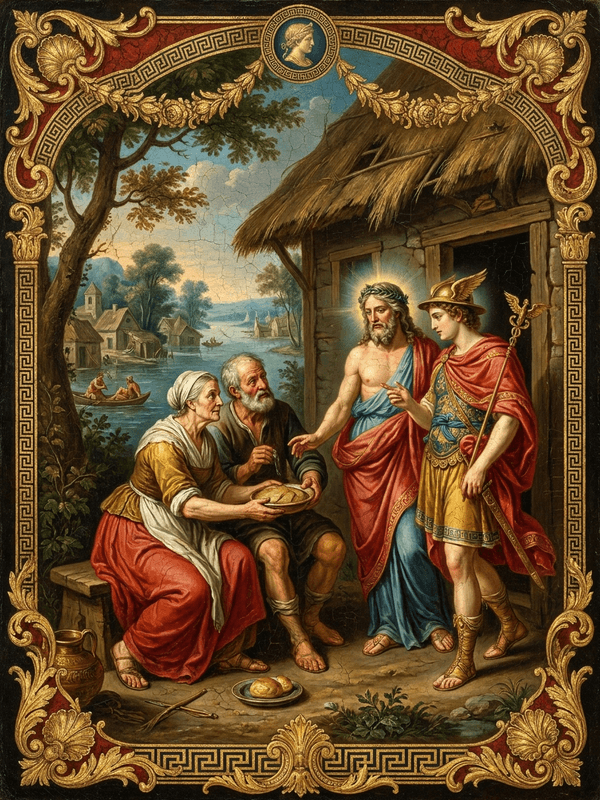
Zeus and Hermes, disguised as ordinary travelers, went from door to door in Phrygia seeking shelter for the night, but only the poor old couple Baucis and Philemon opened their home to them. The two elders welcomed the strangers with all they had, escaped the flood sent as punishment, saw their humble cottage become a temple, and in old age were changed together into two trees standing side by side.
Article
Summary
Zeus and Hermes came to Phrygia in the guise of travelers, wishing to see how the people there treated strangers at their doors. They knocked at house after house throughout the village, but everywhere they were turned away. Only poor Baucis and Philemon invited them into their low thatched cottage. The old couple brought out the little food they owned. They kindled the fire, washed their guests’ feet, set the table, and poured wine, doing everything they could to honor the two visitors. During the meal, the wine in the jar never ran dry, and the couple understood at last that their guests were gods. In their alarm, they even tried to catch their only goose and offer it to them. Zeus stopped them and led the couple up to higher ground. When they looked back, they saw a flood covering the hard-hearted village, while their cottage alone had become a temple. The gods asked what reward they desired. They asked only to serve as keepers of the temple, and, when their time came, to die on the same day, so that neither would have to endure the grief of losing the other. Years later, Baucis and Philemon grew old together before the temple. At last, in the same moment, they were changed into two trees, an oak and a linden, their branches intertwined, standing beside the sacred place as faithfully as they had stood beside one another in life.
Two Strangers on the Road
Long ago, in a valley of Phrygia, there stood a cluster of villages. There were fields and vine arbors, and houses of every size, some broad and well built, others narrow and poor. By day, cattle and sheep grazed on the slopes, and smoke rose from the roofs. At dusk, doors were shut one by one, and the road was left to the homing birds and the wind moving through the treetops.
One day, two strangers came into the valley. Their cloaks were dusty, and each carried a traveler’s staff. They looked like men who had walked a long way. From one end of the village to the other they went, knocking at door after door.
“Give us shelter for one night,” they said. “It is growing dark. We ask only for a place to rest.”
But the people inside either refused them outright or sent them away coldly from behind barred doors. Some disliked their worn clothing. Some feared the inconvenience of strangers. Some would not open at all, but let the dogs bark in the yard. The two travelers kept walking. More and more doors were tried, and the night deepened around them.
At the edge of the village stood a small cottage. It was very low, its walls patched together from clay and branches, its roof covered with reeds and dry grass. When the wind rose, the eaves rustled softly. In that cottage lived an old couple: the husband was named Philemon, and his wife was Baucis.
They had married there when they were young and had spent many years together. They had never been rich. There was little of value in the house and only a small patch of land, yet they helped one another through each day, content with plain food and a quiet life. Philemon mended the fence, gathered firewood, and tended a few fruit trees. Baucis kept the house, heated water, and stitched their old garments. In the evening they sat by the hearth and talked, and though the cottage was small, it was never lonely.
The two travelers came to the cottage door and knocked gently.
Baucis heard them, set aside her work, and went to the door. When she opened it, she saw two weary strangers standing outside. Philemon came forward too and leaned on the doorframe to look at them.
Before the travelers could say much, the old couple had already stepped aside.
“Come in quickly,” Baucis said. “The night wind is cold. Warm yourselves by the fire.”
Philemon hurried to drag out a wooden stool and wiped it carefully with a rough cloth so that the guests might sit. They did not ask where the strangers had come from. They did not ask whether they carried money. They simply brought them to the hearth.
A Poor Household’s Table
The fire inside had nearly died, leaving only a few red coals. Baucis crouched down, fed it with straw and small twigs, and blew on it until the flames leapt up again. Philemon went behind the cottage and brought in a little bundle of wood, which he laid beside the hearth.
The two travelers sat on the low stools. Baucis brought a wooden basin, filled it with warm water, and invited them to wash the dust from their feet. The basin was old, its rim worn smooth and bright, but the water was clean. Bent with age, the couple moved slowly, yet with great care, as though these were not nameless wanderers but honored guests from far away.
Then they began to prepare supper.
It was not a lavish meal. Baucis took down a small piece of smoked meat from the rafters and scooped olives from a jar. She brought out a few eggs, washed some greens, and cut the last bit of cheese from the corner of the house. Philemon picked a few fruits from the garden and took grapes from a wooden rack. They also had a small jar of wine, something they usually saved with care, but now they set it on the table.
One leg of the table was too short, and it wobbled when food was placed upon it. Philemon slipped a broken shard of tile beneath the leg, and the table stood steady. Baucis found an old cloth and spread it over the top. It had been washed almost white with age, but it was spotless. As she worked, she said to the guests, “We have no fine things to offer you. We can only give what we have. Please do not think badly of it.”
The two travelers did not think badly of it. They sat in the firelight, quietly watching the old couple move back and forth.
When the food had been served, Baucis poured wine into the cups. The guests drank a little, and she lifted the jar again to fill them once more. Then something strange happened. The jar was small, and yet the wine inside did not diminish. The cups were emptied, and still the jar poured. She poured again, and it seemed as full as before.
Baucis stopped. Her face changed. Philemon had seen it too. They looked at one another, and in that instant they understood: the guests before them were no ordinary travelers.
The old couple rose in fear, their hands trembling. They remembered the goose in the house, the only one they had, kept as a guard and one of their few living possessions. Philemon said, “We must offer it to our guests. These rough dishes are not enough.”
So the two old people tried to catch the goose. It ran in and out of the cottage, flapping its wings and crying loudly. Philemon, old as he was, could not catch it. Baucis bent low and tried to head it off near the door, but it slipped past her too. At last the goose fled to the feet of the two travelers, as though begging them for protection.
Then one of the travelers stood. He no longer seemed like a silent guest, and his voice carried authority.
“Do not kill it,” he said. “We have seen the kindness in your hearts.”
The Gods Reveal Themselves
The firelight in the cottage suddenly grew bright. The faces of the two travelers seemed to shine through the dust of the road, and they were no longer merely weary men in worn cloaks. Only then did the old couple know who had entered their house: Zeus, and Hermes his messenger.
Baucis and Philemon bowed their heads at once and dared not look directly at them. They apologized again and again, ashamed of their poverty, grieving that they had not set before the gods anything worthy of them.
But Zeus did not reproach them.
“We have gone through this whole village,” he said, “and knocked at many doors. Those houses were broad, and their granaries were full, but not one would let us in. Only you opened your door and gave all you had to strangers.”
Then Zeus told them to leave the cottage and follow him.
The two elders did not hesitate. Supporting one another, they went after the gods. Hermes walked beside them, his staff touching the ground lightly. They climbed the mountain path toward higher ground. The night road was difficult. Stones hurt their feet, and dew lay on the grass. More than once Baucis had to stop to catch her breath, and Philemon held her steady. The gods did not hurry them, but let them climb step by step.
When they reached a higher place on the slope, Zeus told them to look back.
The old couple turned and saw that the village below was no longer peaceful. Water was rushing in from every side, like a lake suddenly awakened. It covered the fields, swallowed the fences, and rose over the doors that had been shut so tightly against the strangers. One roof after another sank beneath it, and only the tops of the courtyard trees remained above the flood. The villagers who had refused their guests were all engulfed by the water.
Only the little cottage at the edge of the village stood apart from the flood. Yet it too was no longer what it had been.
Before the old couple’s eyes, its clay walls became bright stone columns. Its reed roof changed into a golden pediment. Its low doorway rose into the entrance of a temple. Light shone from within like dawn upon new stone. The poor household’s cottage had become a shrine for the gods.
Baucis and Philemon stared in silence, overwhelmed by what they saw.
A Simple Wish
Zeus asked them, “What do you desire? Speak. You have honored strangers and shown reverence to the gods, and you deserve a reward.”
The old couple did not answer at once. They stood on the hillside, with the gods beside them, the unwithdrawn flood below, and their former home gleaming in the distance as a new temple. Philemon looked at Baucis, and Baucis looked at Philemon. After so many years together, much could pass between them without words.
After a while, Philemon said, “If the gods are willing, we would like to guard this temple and serve within it.”
Baucis added, “And one thing more. We have lived our whole lives together. We do not wish one of us to die first and leave the other alone beside a grave. Let us depart in the same moment. Do not make me see his funeral, and do not make him see mine.”
There was no gold or silver in that wish, no throne, no immortality. It was only the truth of two old hearts.
Zeus granted it.
From that time on, Baucis and Philemon lived beside the temple and cared for the shrine that had once been their cottage. Travelers who heard their story came to sacrifice there and to visit the old pair. When the flood withdrew, the valley had changed. The old village was gone, and only the temple remained, standing as a reminder of what had happened.
Year followed year, and Baucis and Philemon grew older still. The veins rose blue on the backs of their hands, and their steps became slow. Yet they still swept the temple together, lit the sacred fire together, and set fresh branches and flowers before the shrine. In the morning, if one woke first, that one gently called the other. In the evening, if one sat by the doorway, the other laid a cloak over their shoulders.
Two Trees Standing Together
At last, one day, they were standing before the temple and speaking together when they felt something strange come over them.
Philemon looked down and saw that his feet seemed held by the earth and could no longer move. Baucis too found that her ankles were hardening, and that her skin was growing rough like bark. They understood that the hour promised by the gods had come.
They did not cry out. They did not struggle. They only reached for one another, hoping to clasp hands one last time. Bark rose slowly from their feet, covered their legs, enclosed their waists, and climbed toward their breasts. Their hair opened into leaves, and their arms stretched upward like branches toward the sky.
While they could still speak, Baucis looked at Philemon, and Philemon looked at Baucis. Together they said, “Farewell, my beloved.”
When the words had passed, both were trees.
One was an oak, and the other a linden. They stood side by side before the temple, their trunks close together, their branches mingling in the wind as though they were still murmuring to one another. In later years, those who came to sacrifice there hung garlands from the boughs, and travelers passing by would stop and lift their eyes.
People said those trees were Baucis and Philemon. They had owned no splendid house and offered no rich banquet, but on the loneliest of nights they had opened their door to strangers. The temple remained in the valley, and the two trees remained beside it, sharing the wind and the rain together for a very long time.