Greek Mythology
Atalanta and Hippomenes — Greek Mythology
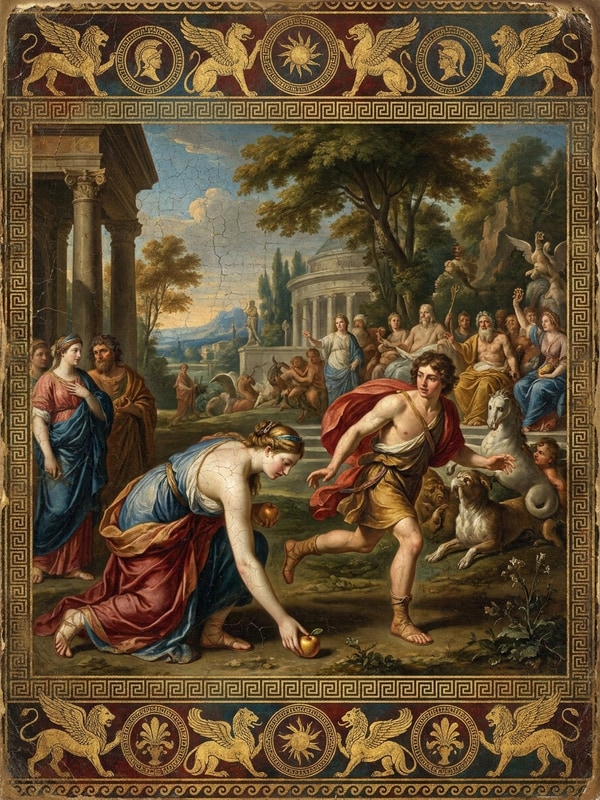
Atalanta was the swiftest of maidens and had no wish to marry. She made each suitor race against her: if he won, she would be his wife; if he lost, he would die. Hippomenes prayed to the goddess of love and used three golden apples to slow her steps. He won the race and the marriage, but when he forgot to honor the goddess who had helped him, a terrible punishment followed.
Article
Summary
Atalanta was abandoned in the wild as an infant, nursed by a she-bear, and later raised by hunters. She grew up running, shooting, and hunting in the woods, freer and swifter than the men who came to admire her. Because she would not be trapped by marriage, and because an oracle warned that marriage would cost her herself, she set a cruel condition for every suitor: defeat her in a footrace and she would marry him; be overtaken by her and die beside the course. Many young men still came, drawn by her beauty and reputation. Atalanta always gave them a head start, then swept after them like wind from the hills, and body after body fell near the finish. Hippomenes first judged the suitors mad, but when he saw Atalanta, the same desire seized him. He entered the race, and although Atalanta urged him to leave while he still could, he would not step back from the danger. Knowing that his own speed could never be enough, Hippomenes prayed to Aphrodite. The goddess gave him three golden apples and taught him to throw them away from the track. As the race began and Atalanta closed on him again and again, Hippomenes cast the apples one by one. Atalanta knew the trick, yet the glittering fruit and her own hesitation drew her aside each time. The last apple cost her the finish, and Hippomenes crossed the line with the last of his strength, winning the marriage by the rule she herself had made. After the victory, however, Hippomenes forgot to fulfill his vow to Aphrodite. The neglected goddess sent a madness over the newly married pair, and in a sacred temple they forgot reverence and offended the deity of the place. Punishment followed at once: their bodies were changed into lions, and they could no longer walk together as human husband and wife. Harnessed instead, they drew a goddess’s chariot side by side.
The Maiden of the Wild Hills
After Atalanta was born, she was not carried like other children into a warm house. Her father had hoped for a son. When he saw a daughter instead, displeasure filled him, and he ordered the infant to be abandoned in the mountains.
The wind moved through the grass. The tracks of wild animals marked the damp earth. A tiny girl lay there in her swaddling clothes, her cries growing weaker and weaker. Yet she did not die. A she-bear came out of the woods, sniffed the child in the wrappings, and did her no harm. Instead, the bear lowered herself beside her and fed her with her own milk.
Later, hunters found the child in the hills and brought her home to be raised. Atalanta grew up among woods and slopes. Her feet were lighter than a deer’s, and her eyes could catch the faint stir of grass far away. She could draw a bow, cast a spear, overtake fleeing beasts, and leap across a stream without wetting the soles of her sandals.
She had no love for the loom in the women’s chamber, nor for anyone arranging a husband on her behalf. She would rather go out at dawn with a quiver on her back, pass through pine woods and stony ridges, and hear the hounds baying ahead of her. Many heard of her beauty and skill and came to ask for her hand. Atalanta refused them.
Some said she had once heard an oracle: if she married, she would lose herself. Others said she had simply seen too many women, once married, shut inside their husbands’ houses, no longer free to run as they had before. Whatever the reason, her mind was fixed. If any man insisted on marrying her, he would first have to defeat her at the thing she did best.
So Atalanta announced a cruel condition.
A suitor might race against her. She would let him start ahead. If he reached the finish first, she would marry him. But if she caught him, he would die beside the course.
The Bodies by the Course
The condition did not frighten everyone away.
Young men are quick to trust their own legs, and just as quick to be blinded by beauty. Some came from far off, and when they saw Atalanta standing at the end of the course, lightly clothed, her hair bound behind her head, a shining javelin in her hand, they forgot every warning they had heard.
The racecourse lay across open ground, with spectators crowded on either side. Wind lifted the dust. Sunlight struck the post at the finish. Before setting out, every suitor believed he still had a chance.
Atalanta never hurried. She stood behind the starting place and watched the man run on ahead. The farther he went, the louder the crowd became. Some shouted his name; others prayed to the gods for him. But when Atalanta bent low and sprang from the ground, dust flew from behind her heels.
She did not slowly make up the distance. She swept across the field like wind from the hills. The man ahead would hear her footsteps behind him, panic would seize him, and his legs would falter. Before he could properly see her shadow, she had already passed him. The finish still stood before him, but he would never reach it.
One fell, and then another. Again and again the earth beside the track was darkened with blood. Yet those who came later saw Atalanta and still could not make themselves turn away.
When Hippomenes arrived, the first thing he saw was those bodies.
He stood among the crowd and listened as people explained the rules of the race. He frowned despite himself. Watching young men still giving in their names, he thought them utterly foolish. To wager one’s life for a woman—this was not courage, but madness.
Then Atalanta came out.
She wore no queen’s crown and no robe of royal splendor. She looked like a hunter newly returned from the woods. Sunlight fell across her face; her expression was calm, but her eyes were bright. She lifted a hand to adjust the band around her hair, and the muscles of her arm tightened lightly with the movement. Hippomenes looked at her and could not speak.
The man who had just been condemning others in his heart now felt the same fire burn through him.
Atalanta noticed his gaze and turned to look at him. She saw a handsome young man, not yet very old, whose eyes held astonishment and a stubborn refusal to retreat. Something stirred in her.
She had seen many boastful men, but this one awakened in her a flicker of pity. She hoped he would not speak, would not give his name, would not send himself down the road to death.
But Hippomenes had already stepped forward.
The Apples Won from the Goddess of Love
When Hippomenes entered the race, a low murmur of surprise passed through the crowd.
Atalanta looked at him and could not help saying, “You are still young. Why should you die for me? Go away. Have the deaths of the others taught you nothing?”
Hippomenes answered, “If I turn back, life itself will be shame to me. If I win, I shall have you. If I lose, I shall at least know for whom I risked everything.”
Atalanta heard him, and her heart grew more troubled. She did not wish to lose, yet she did not wish to see him die. But the rule had already been spoken, and all those gathered beside the course were watching. She could not suddenly change it.
Hippomenes did not truly mean to rely on his legs alone. He knew Atalanta’s speed was astonishing, and without divine aid he had no hope of victory. Before the race, he prayed to Aphrodite, goddess of love and beauty, and begged her to help him once.
Aphrodite heard his prayer. From far away she brought him three golden apples. They were no ordinary fruit: round, heavy, and gleaming, as if sunset and gold had both been sealed within their skins. The goddess gave them to Hippomenes and told him how to use them during the race.
Hippomenes hid the three apples in the fold of his garment. They lay against his breast, cool and weighty, like three chances—or three throws of his life.
On the day of the race, the crowd was larger than ever. Some came to see Atalanta win again; others came to see whether this young man might work a miracle. Atalanta stood behind the starting line, her face graver than usual. More than once she looked toward Hippomenes, as if still hoping he might change his mind at the last moment.
But Hippomenes only tightened his sandals and went to the front.
The signal sounded, and he sprang away.
The First Golden Apple
Hippomenes ran swiftly. Dust rose behind his feet, and the wind cut past his ears. He did not look back. He heard only the cries of the crowd swelling louder and louder.
Atalanta waited for a while, as she always did. Only when the distance between them had grown wide enough did she begin to pursue him.
At first her steps were so light they almost made no sound. But Hippomenes soon heard the wind pressing close behind him. It was not the noise of an ordinary runner; it was like the most agile creature in the woods leaping over stone. She was catching him.
Hippomenes clenched his teeth, drew the first golden apple from his garment, and threw it slantwise toward the side of the track.
The apple fell in the grass and rolled, leaving a flash of light.
Atalanta was already close behind him. She could have ignored the apple, but its gold was too bright, as if someone had set a small piece of the sun upon the ground. The corner of her eye caught it, and her stride hesitated for the slightest instant.
Perhaps she thought: It will take only a moment to bend down. It will not delay me long.
So she veered from the course and reached for the apple. It was heavy in her palm, still shining. By the time she returned to the path, Hippomenes had opened a new stretch of distance between them.
The crowd burst into shouting. Hippomenes did not dare look back. He knew that delay alone would not save him.
Sure enough, Atalanta soon drew near again.
Her breathing was still steady, and her feet moved faster than before. It was as if her own hesitation had angered her, and she meant to give him no second chance. Hippomenes heard her close behind him—so close he could almost imagine her hand touching his shoulder.
He threw the second golden apple.
This time the apple rolled farther, into a hollow on the other side of the course. Atalanta knew perfectly well it was a trick, yet her steps faltered again. The golden gleam flickered among the grass as if calling to her. She bit her lip, but still she turned aside to pick it up.
Hippomenes seized that brief moment and drove himself onward. His chest burned as if full of fire, his legs grew heavier with every stride, and his throat was thick with the taste of dust. The finish was no longer far away—but Atalanta had already returned and was closing on him once more.
The Last Stretch
In the final stretch, Hippomenes could hardly hear the crowd at all. He heard only the pounding of his own heart. He knew he had one apple left, and he knew that if this one failed to delay her, he would die before the finish.
Atalanta was very close.
She watched the young man’s back before her, and her heart was more unsettled than it had ever been in any race. She could pass him at once. Her body knew victory by habit; a few more strides, and she could surge ahead as she had always done. Yet she remembered the look on his face when he had spoken, and the eyes that had refused to turn away.
Did she truly want to win, or did she want him to live?
Just as she was about to overtake Hippomenes, he threw the third golden apple.
This time he hurled it with all the strength he had left. It flew far out from the track, landed on a grassy slope, and rolled a long way before it stopped. Dust flew at Atalanta’s feet. She needed only to ignore it, and the race would be hers. But in that instant, the gold flashed before her eyes, and hesitation flashed through her heart as well.
She turned.
She ran to the slope and bent to pick up the last apple. By the time she raced back to the course, Hippomenes had thrown himself toward the finish.
He was scarcely running now; he was driving himself forward with the last remnant of his strength. The crowd’s shout broke open all at once. Hippomenes crossed the line, staggered a few steps, and caught the post to keep from falling.
Atalanta arrived after him. She had lost.
She stood beside the finish, still holding the three golden apples, her chest rising and falling, sweat on her brow. She did not rage, and she did not flee. She looked at Hippomenes as if she had always known this moment would come, though not what she herself would feel when it did.
Hippomenes turned toward her. He was pale, his clothing disordered, but he stood alive before her.
By the rule she herself had spoken, she was to become his wife.
The Forgotten Goddess
Hippomenes had won Atalanta, and with her the astonishment of the whole assembly. No new corpse lay beside the racecourse that day. Even those who had come waiting for blood had to admit that this victory had not been won by brute strength.
Atalanta went away with Hippomenes. She was not dragged off in chains, nor did she bow her head and weep like a prize of war. She remained the woman who could outrun men. Only from that day on, beside her walked a man who had once staked his life to win her.
But Aphrodite, who had helped Hippomenes, did not receive the gratitude she was owed.
In the joy of victory and marriage, Hippomenes forgot to fulfill his vow. The three golden apples had saved his life and won him a wife, yet he offered no incense and no gifts before the goddess’s altar. The gods may grant favor, but they also remember neglect.
Aphrodite was displeased, and she sent a cloud of madness over the young pair.
Later, Hippomenes and Atalanta came to a sacred temple. It was a place that should have been kept in reverent quiet, a place where no careless act belonged before the altar. But desire drove them on, and they forgot awe. Within the holy precinct, they did what should not have been done.
The deity of the temple was offended. Divine anger fell, and punishment did not delay.
Hippomenes’ hands began to harden; his nails curved into claws. Atalanta’s shoulders and back swelled, her garments tore apart, and her golden hair roughened into a mane. They tried to call each other’s names, but only the low growl of beasts came from their throats. Their limbs dropped to the ground, their teeth sharpened, and a strange yellow light flashed in their eyes.
They had become two lions.
Once, Atalanta had been swifter than the wind, and Hippomenes had used three golden apples to overtake fate. In the end, they no longer walked hand in hand along the roads of humankind. They were harnessed instead and made to draw a goddess’s chariot. When people saw lions moving side by side, they remembered that race: a maiden who would not marry, a young man who would not turn back, and three golden apples rolling through the grass—rolling their lives into a path from which there was no return.