Greek Mythology
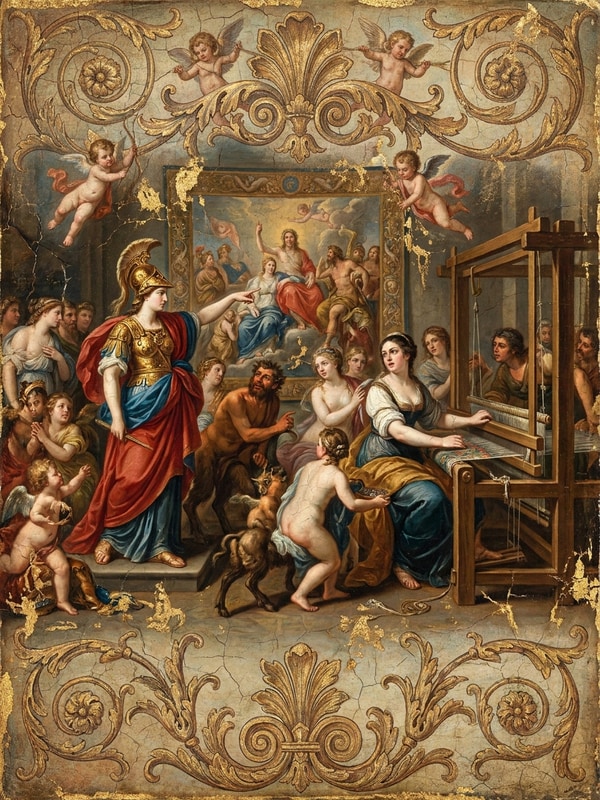
Arachne and Athena — Greek Mythology
Arachne, a young woman of Lydia, was so gifted at weaving that she refused to admit her skill came from Athena and even challenged the goddess herself. Athena descended to compete with her, and in the end transformed Arachne into a spider, doomed to hang forever from a thread and weave her webs.
Article
Summary
Near Colophon in Lydia lived Arachne, the daughter of a wool-dyer rather than a noble house. Her skill at the loom became so famous that even the nymphs came to watch her spin and weave. When people said such art must have come from Athena, Arachne rejected the praise and declared that, if the goddess was truly superior, she should come and compete. Athena first appeared not in divine splendor, but as an old woman with white hair and a staff. She warned Arachne to ask forgiveness while there was still time, admitting her greatness among mortal women but urging her not to rival a goddess. Arachne answered with insults and refused to withdraw her challenge. Then the old woman cast off her disguise, and Athena stood revealed before the terrified onlookers. The contest began at two looms. Athena wove Olympus, the gods in their proper places, and her own victory over Poseidon in the contest for Athens, surrounding the scene with examples of mortals punished for offending heaven. Arachne wove with equal brilliance, but her cloth showed gods deceiving, pursuing, and harming mortals: Zeus as the bull carrying Europa, Zeus in other disguises, and the pursuits of Poseidon, Apollo, Dionysus, and others. Arachne's tapestry was flawless, and that made its insult sharper. Athena tore the cloth apart and struck Arachne with the shuttle. Shamed and furious, Arachne tried to hang herself, but Athena would not let her die. Instead she transformed the girl into a spider, leaving her and her descendants forever suspended from their own threads, still weaving, but now under the sign of divine punishment.
The Girl in the Dye-House
In the land of Lydia there lived a young woman named Arachne. Her family was not noble. Her father, Idmon, made his living by dyeing wool, often lowering fleeces into vats of purple to give them the rich color loved by the great. But Arachne won fame by her own two hands.
When she sat before the loom, those nearby often fell silent. First she loosened the soft wool, then drew it gently into thread between her fingers. The strand slipped out fine and even, like spider silk in spring. The shuttle passed back and forth through the warp; the wooden beam gave a soft sound; and slowly, across the cloth, flowers, figures, and rivers began to appear. Some who saw the dyed threads thought their colors were like dawn touching the clouds. Others, looking at the fabrics she made, said such work could hardly belong to mortal hands.
The nymphs of the hills and groves heard of her renown. Leaving their springs and shaded trees, they came to Arachne’s house to watch her turn tangled wool into thread, and thread into living pictures. They gazed in wonder and often murmured that such skill must surely have been taught by Athena herself.
Athena was the goddess of weaving, handiwork, and wisdom. When mortal women became famous at the loom, people often believed they had received her favor. But Arachne was not pleased to hear such praise.
She lifted her head and said, “Do not give my skill to the goddess. Athena never taught me. If she wishes to compete with me, I am not afraid.”
The words spread quickly. Some feared for her and urged her not to speak so boldly of a god. Others thought she was merely young and proud, not understanding the weight of what she had said. But the more they warned her, the less Arachne would bow her head. If Athena was truly better, she said, then let the goddess come and prove it.
The Old Woman’s Warning
Athena heard these words. She did not at once reveal her divine power, nor did she immediately send down punishment. Instead she changed herself into a white-haired old woman, took up a staff, and came before Arachne.
The woman’s face was wrinkled, her hair snowy white, but her voice was clear. She said to Arachne, “Child, when the old speak, it is not always out of envy for the young. No one denies that your skill is great. But you should ask the goddess for forgiveness. Among mortal women you may be called the first; do not try to rival Athena. It is not too late to admit your fault. Perhaps the goddess will pardon you.”
Arachne’s expression changed at once. She stopped her work, glared at the old woman, and said, “You are old, and you talk too much. Go home and advise your daughters and daughters-in-law. Do not lecture me. If Athena has any skill, let her come herself. I will not take back what I said.”
At that, the old woman dropped her staff, and all the weakness of age vanished from her body. The white hair was gone; the bent back stood straight. A cold, bright light seemed to flash through the room, and only then did everyone see that the one standing before Arachne was Athena.
The onlookers drew back in terror. The nymphs lowered their heads, not daring to look directly at the goddess. Only Arachne stood beside her loom. Her face first went pale, but then she bit her lip and refused to yield. She had spoken too far to retreat now; she could only stand beneath the goddess’s gaze.
Athena gave no further warning. Two looms were set in place, and colored threads were arranged beside them. Goddess and maiden sat down, tightened the warp, and began the contest.
Two Woven Tapestries
The looms began to sound.
Athena’s hands were swift and steady. She wove the heights of Olympus, where the gods sat each in their proper place: Zeus holding the thunderbolt, Poseidon raising his trident, Hera seated in majesty nearby. At the center of the cloth she showed the contest between herself and Poseidon for the guardianship of Athens. Poseidon struck the rock with his trident, and from the cleft came seawater—or, in another telling, the horse. Athena, by contrast, made the olive tree rise from the earth, its branches thick with leaves, its fruit hanging heavy. When the gods saw the gift she offered, they awarded the city to her.
In the four corners of the tapestry, Athena wove smaller scenes of mortals punished after offending the gods. One, irreverent toward heaven, was changed into a bird; another, too proud in speech, lost the shape they once had. Those little pictures seemed to warn Arachne: however clever a mortal may be, she should not forget where she stands.
Arachne did not falter. Her threads flew across the loom, colors spreading layer upon layer. The folds of garments, the white foam of waves, the play of light on a bull’s back—all were rendered with astonishing delicacy. Yet she did not weave a hymn of praise to the gods. She wove stories of the gods deceiving, pursuing, and harming mortals.
She showed Zeus in the form of a bull carrying Europa away from the shore. The girl sat upon the bull’s back, one hand gripping a horn, the other lifting her sea-wet dress, while she looked back toward the coastline growing farther and farther away. Arachne wove Zeus again as a swan, as a shower of gold, and in other shapes, approaching mortal women. She wove, too, the transformations and pursuits of Poseidon, Apollo, Dionysus, and other gods. Every scene was exquisitely made, and every scene made its meaning plain: Arachne was not unable to praise the gods. She had deliberately set their shameful deeds upon the cloth.
Not a single thread was out of place. Not one color had failed. Even Athena could not say the tapestry was clumsy. Arachne’s skill was truly marvelous. The figures seemed almost ready to speak; the sea seemed still to flow; the leaves looked as though a wind might stir them.
But the more perfect the cloth was, the more it felt like an open slap across the face.
The Broken Thread
Athena looked upon the tapestry, and anger rose within her. She was not enraged simply because Arachne was skilled. She was enraged because this mortal girl had used the finest craft to weave contempt for the gods into visible form.
The goddess seized Arachne’s work and tore it apart. The colored threads snapped; the pictures were wrenched into shreds. Then Athena took up the shuttle and struck Arachne on the forehead—once, then again. Everyone in the room stood frozen with fear. But to Arachne, the blows were less unbearable than the ruin of the tapestry.
Her pride had held her upright for a long time, but in that moment it collapsed. She looked at the torn cloth, then at the irresistible goddess before her, and shame and rage rushed over her together. Turning away, she found a rope, tied it to a beam, and tried to end her life.
Athena saw her hanging in the air and did not let her die. The goddess’s anger had not entirely faded, yet she was unwilling to let this gifted weaver vanish from the world completely. She held Arachne up and said, “You may live, but you shall hang. You and your descendants shall weave in this way forever.”
Then Athena sprinkled a dark potion over Arachne’s body. The girl’s hair fell away. Her nose and ears disappeared. Her body shrank little by little. Her fingers grew thin; her legs became many long, slender feet; her belly swelled round. The young woman who had stood beside the loom was, in an instant, a tiny spider.
She dropped down along a thread, then climbed back toward a corner of the wall. She no longer sat before a wooden loom, nor did she weave pictures from dyed wool. Yet still she drew out fine silk, fastening it in circles, crossing it layer by layer. When the wind blew, she hung from her own thread, light as a speck of dust.
From that time on, Arachne and her descendants have woven their webs in corners, among branches, and beneath the eaves of houses. When people see a spider endlessly spinning silk, they remember the Lydian girl whose skill was great but whose pride would not bend—and they remember how Athena turned a weaving contest into an everlasting punishment.