Greek Mythology
Artemis and Actaeon — Greek Mythology
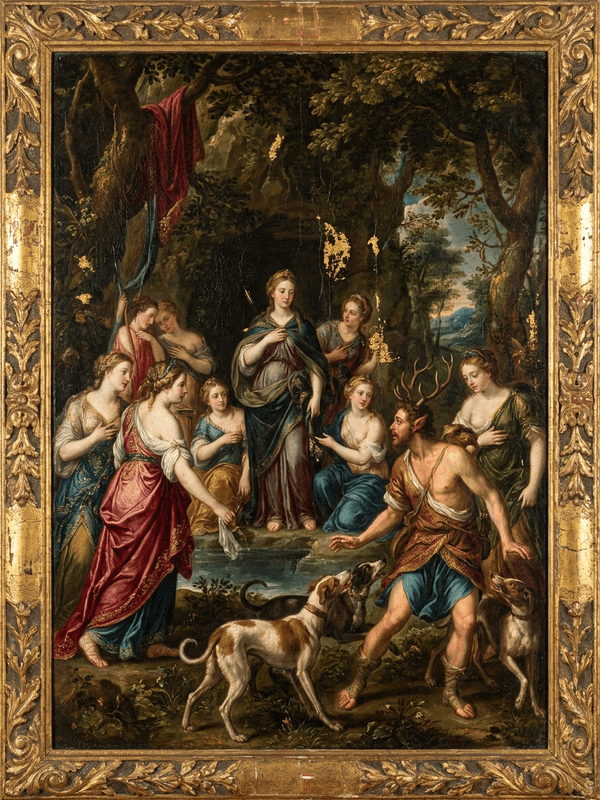
Actaeon, a hunter from Thebes, strays into a hidden glen in the mountains where Artemis is bathing and sees the goddess as no mortal should. She changes him into a stag; unable to cry out for help, he is torn apart by the very hounds he raised with his own hands.
Article
Summary
Actaeon is a young hunter from the country around Thebes, at home among the woods, springs, and game trails of Mount Cithaeron. Some said Chiron taught him the hunter's craft, and Actaeon himself raised a great pack of hounds who knew his whistle, his footsteps, and his hand signals. One noon, after a long hunt, Actaeon leaves his companions and walks alone into the deep wood in search of water. Following the sound of a spring, he enters a hidden glen and accidentally sees Artemis bathing among her nymphs. The nymphs cry out and hurry to shield the goddess, while Actaeon stands frozen, unable to explain that he has strayed there by chance. Artemis does not need her bow. She lifts a handful of spring water and throws it into his face, telling him to go and speak of what he has seen if he still can. At once Actaeon grows antlers and hooves and becomes a young stag. His mind remains human, but his mouth can only give the frightened cry of a deer. He flees into the woods, but his own hounds catch his scent. The pack does not know the stag is their master; barking wildly, they run him down and tear him apart. Afterward the hounds search everywhere for Actaeon, until Chiron makes an image of their master and finally quiets the dogs who have lost him.
The Young Hunter on Mount Cithaeron
Actaeon was born into a noble house in the country around Thebes. His grandfather was Cadmus, and his family’s story was bound up with a royal city, oracles, and many uneasy tales. Yet in his youth Actaeon knew the sound of the forest wind better than the talk of palace halls.
He learned to hunt early. Some said that Chiron the Centaur taught him how to read the tracks of beasts, how to draw a bow, how to tell from a torn patch of earth where a wild boar had just rooted in the mud, and how to make hounds understand a hunter’s command. To Actaeon, the slopes of Mount Cithaeron, its oak woods, stone clefts, and springs, were as familiar as the courtyard of his own house.
When he went out at dawn, Actaeon often wore his hunting cloak, carried a javelin in his hand, and led a great pack of hounds behind him. Some had sharp noses, some swift legs, and some would never loosen their jaws once they had seized their prey. At their master’s whistle they plunged into the brush; at the lift of his hand they circled to the far side of a slope and drove deer and hares downward.
His companions all knew how much Actaeon loved the chase. He never begrudged the hardship of the mountains. Leaves and dust clung to his clothes, the sun darkened his face, yet his spirits remained high. If the quarry escaped, he laughed and gave pursuit; if a hound was hurt, he pulled out the thorn himself, washed away the blood, and bound the wound. The dogs knew him too. At the sound of his footsteps their tails swept the grass.
A Halt at Noon
One day Actaeon led his men into the mountains as usual. The hunters spread their nets, loosed the dogs, and drove game for a long while through the valleys. Deer hooves snapped dry twigs, wild boars crashed into brambles, and the barking of the hounds rolled from one hillside to another. The sun climbed higher and higher. The wind died. Heat gathered under the leaves and would not lift.
By noon the hunters were drenched in sweat. Actaeon looked at his companions, then at the hounds panting with their tongues out. He drove the butt of his spear into the ground and said, “Enough for today. The sun is too fierce. Do not press the dogs any further, and do not chase the beasts any more. Gather the nets. We will return at daybreak tomorrow.”
His companions obeyed. They unfastened the thorny nets from the trees and rolled them over their shoulders. Some went to leash the dogs; others looked for shade where they could rest. Actaeon, however, did not go back at once. He wanted to find water to wash the sweat from his face, and for a little while he wished to walk alone. Leaving the others behind, he followed a little-used path into the deep wood.
The farther he went, the quieter the path became. Branches interlaced above his head. Sunlight broke into small bright flecks and fell over stones and moss. Actaeon heard the sound of water in the distance, pushed aside the trailing vines, and walked toward it. He did not know that the water was leading him to a place no mortal ought to enter.
The Hidden Spring
Deep in the valley stood a natural grotto of stone. Pines and cypresses hid its mouth. Outside it lay a clear spring, welling from a cleft in the rock, running over smooth stone, and gathering in a shallow pool of bright water. No hunter’s footprint marked the place, no hoofprint of cattle. Only a cool breath rose from the surface, easing the noon heat in the glen.
Artemis often came there to rest. She was the goddess of the bow, a lover of mountains and forests, of swift-running deer, and of silence untouched by human voices. That day she had just finished hunting. Her bow was still near her shoulder, and her quiver lay close by. The nymphs who attended her first took away her weapons, then loosened her girdle and gathered her long hair back over her shoulders. Some held water for her; some stood guard by the spring; some laid her garments on the stone.
The goddess stepped into the clear water. It rose over her ankles and then to her knees. The forest was utterly still except for the soft voice of the spring. None of them imagined that a mortal’s footsteps were drawing near behind the trees.
Actaeon followed the sound of water to the mouth of the glen. He parted the last screen of leaves—and stopped.
He had seen Artemis.
In that instant he had not meant to spy, nor did he have time to turn away. The sight before him struck him like a blaze of light: the clear spring, the white stones, the nymphs crying out in alarm, and the goddess standing in the water. The nymphs saw him first and immediately screamed. They hurried to Artemis and tried to shield her with their own bodies, but the goddess was taller than them all and still rose above their frightened confusion.
Actaeon went pale. He opened his mouth, wanting to say he had come there by accident, wanting to say he would leave at once. But his tongue seemed frozen. Not a word came out.
A Handful of Water
Artemis’ bow and arrows lay on the bank, a few steps beyond her reach. She had no time to take them up—and no need. Shame and anger flashed first across the goddess’s face; then her expression hardened. She bent, lifted a handful of spring water in both hands, and flung it into Actaeon’s face.
The drops struck his forehead, eyes, and lips, cold as ice from the heart of the mountain.
Artemis said, “Now go and tell others that you saw me bathing—if you can still tell it.”
The words had barely left her mouth when Actaeon felt a tearing pain at the top of his head, as though two hard branches were forcing their way out through the bone. He reached up to touch them, but his fingers were shortening. His nails blackened, hardened, and turned into small hooves. His shoulders and back bent downward, his neck stretched long, and brown hair sprang from his skin. His ears sharpened, and he heard the far-off chirring of insects and the faint scrape of wind over grass. His nose grew keen; the smells of earth, water, bark, and human bodies rushed upon him all at once.
He tried to cry, “I am Actaeon!”
But what burst from his throat was only the frightened call of a deer.
He lowered his head and saw his reflection in the water: a young stag with branching antlers, but with human terror still in its eyes. He understood that he was lost. If his companions saw him, they would take him for quarry. If his hounds caught his scent, they would not remember that this was the man who fed them each day and called them by name.
He turned and fled.
His Own Hounds
Branches whipped against his body as he ran through the wood, and stones bruised his newly formed hooves. Never before had he run like this. Once he had chased deer; now the fear of the deer leapt in his own chest. Every trembling leaf seemed a danger, every gust of air a pursuer. He wanted to run toward the place where his companions were resting, yet feared they would raise their spears. He wanted to hide in a deeper valley, yet behind him he heard the barking of dogs.
They were his own hounds.
At first the pack caught the scent of an unfamiliar deer. Then they glimpsed a form flashing between the trees and sprang into excitement. They did not know their master had become their prey. They knew only that a strong stag was ahead. The fastest dogs rushed to the front, the others close behind, and their cries piled one upon another like stones tumbling down a mountainside.
Actaeon knew their voices. He had named some of them. He had patted their necks. He had let them lie at his feet beside the fire. Now all those familiar sounds had become the noise of death driving him onward.
He wanted to stop. He wanted to turn back and make them know him. He even tried to call each dog by name. But he no longer had a human mouth, and no human words would come. The hounds drew closer and closer, their hot breath at his hind legs. He leapt over a rock and forced his way through low brush, but his antlers snagged in the vines. A hard pull checked him for a moment.
The first dog sprang and fastened its teeth in his flank. The second seized his hind leg. More dogs closed around him, their teeth sinking into flesh. Actaeon fell to the ground, his hooves thrashing, his eyes fixed on the distance. His companions heard the pack bring down its quarry and came running, but they saw only a stag surrounded by hounds.
They shouted praise to the dogs and urged them to hold fast. No one knew that the creature being torn apart was their companion. Actaeon struggled among dust and leaves, still understanding with a human mind, yet unable to utter a single human word. At last his strength ebbed away, and the barking in the valley seemed to fade into the distance.
The Dogs Without Their Master
When it was over, the hunters could not find Actaeon.
At first they thought he had wandered somewhere else, so they called his name through the woods. The valley answered them only with echoes and birdsong. The hounds had drunk their fill of blood, yet they too seemed suddenly to have lost something. They sniffed the ground, ran along the mountain paths, darted into thickets, and then returned whining softly to the hunters’ feet.
They could not find their master.
Later, people told the story in more than one way. Some said Actaeon had simply strayed into the place where the goddess bathed and was punished because he saw what he should never have seen. Other traditions said the anger of the gods had a deeper cause. But the best-known tale remained the one set in that noonday valley: the hidden spring, the clear water, and the handful of water flung at a mortal man.
The pack would not quiet for a long time. They ranged over Mount Cithaeron, sniffing every place their master had once passed, yet they could find neither Actaeon’s voice nor his gesture. At last Chiron heard of the disaster and made an image of Actaeon. The hounds gathered around the likeness of their master, and when they saw the familiar form, their howling slowly ceased.
From then on, the woods of Mount Cithaeron kept this dreadful story: a young hunter saw the goddess in a hidden hour and in an instant became a stag. He had once driven his hounds after the beasts of the mountain; in the end, his own hounds ran him down. The spring of Artemis still flowed between the rocks—clear, cold, and bright, as though nothing at all had happened.