Greek Mythology
Troy — Greek Mythology
Troy is the central city of the Trojan War in Greek myth, the royal city ruled by Priam and defended by Hector. Its importance comes from the ten-year siege, the great battles on the plain outside its walls, and its final fall through the stratagem of the Trojan Horse.
Overview
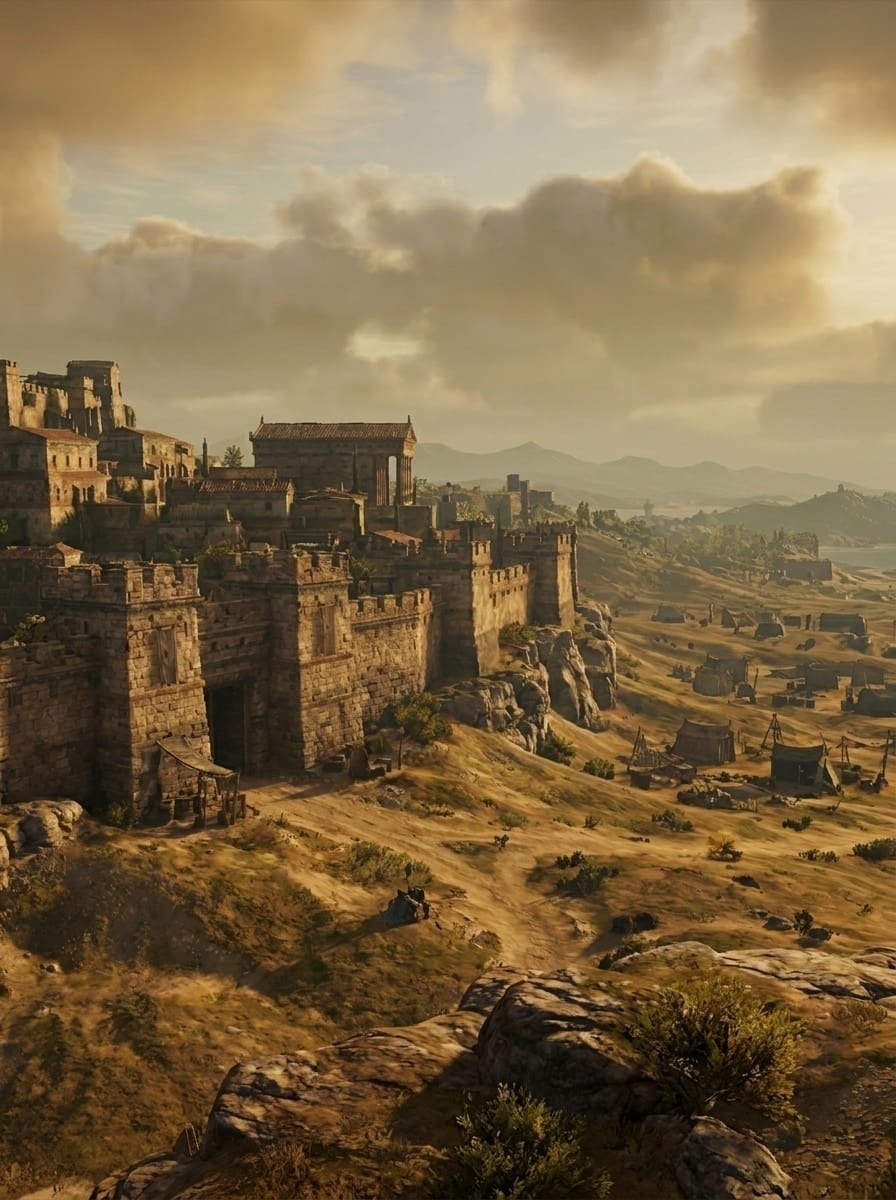
Troy lies near the coast reached by the Greek expedition after sailing east from Aulis. Its walls stand on high ground beside a plain. Outside the city are the plain leading toward the shore, the Greek ship-camp, and the battlefield around the Scamander River; within the city are the palace, streets, gates, and temples.
Article
Role in Greek Mythology
In Greek myth, Troy is first of all a besieged royal city. It is ruled by Priam, and figures such as Hector, Paris, Cassandra, Hecuba, and Andromache are all tied to its royal house and wartime life. The cause of the war is connected with Helen's arrival in Troy, while the Greek coalition, led by Agamemnon, Menelaus, Odysseus, Achilles, and others, remains encamped outside the city for years.
The city's mythic function is not merely to serve as a battlefield backdrop. Its walls, the Scaean Gate, the palace, the temple of Athena, and the plain outside together form the main spaces of the war narrative. Hector urges his mother inside the city to offer a robe to Athena, rebukes Paris, and then says farewell to Andromache and their young son beside the gate. Outside the walls are the places of heroic duels, the arrival of allies, and the danger that reaches the Greek ships. Near the end of the war, the Trojan Horse is dragged into the city; the walls and gates can no longer protect the royal city, and Troy changes from a place of resistance into a fallen city.
Geographic Background
Troy is a city near the coast, with walls and gates behind it and a plain stretching before it. After arriving by sea, the Greeks land on the Trojan shore, haul their ships onto the beach, and make camp by the sea. The Trojans sally out through the gates, and the two sides clash again and again on the plain and near the river.
The inner spaces of Troy are clearly those of a royal city. Priam's palace houses the queen, princes, and royal women; the temple of Athena is where Hecuba leads the women of the city in prayer for protection; and the walls and gates connect life within the city to the battlefield outside. The meeting beside the Scaean Gate shows that the gate is both a military boundary and a place where families part and watch the fighting.
The spaces outside the city are tied to the Greek camp and the progress of the war. The Greek ships, camp wall, ditch, and tents by the shore form the temporary base of the besieging army. Under Hector's leadership, the Trojans once break through the camp wall and press the fighting all the way to the sterns of the ships. The banks of the Scamander, the dust before the gates, and the beach are all recurring battle sites in the Trojan War.
Related Stories
"The Greeks Arrive at Troy" mentions this place: the Greek coalition sails from Aulis, reaches the Trojan coast, and the siege truly begins after Protesilaus is the first to step onto Trojan soil.
"Hector in Troy" mentions this place: Hector returns from the battlefield into the city, arranges for a robe to be offered to Athena, and briefly meets Andromache and his son beside the gate.
"The Trojans Drive to the Ships" mentions this place: Hector leads the Trojans forward from below the city, crosses the Greek ditch and camp wall, and pushes the fighting close to the ships by the sea.
"Penthesilea at Troy" mentions this place: Penthesilea, queen of the Amazons, comes to Troy to aid Priam and fights Achilles on the plain outside the city.
"Memnon at Troy" mentions this place: Memnon comes from the east with an army to support Troy, kills Antilochus outside the city, and then falls to Achilles.
"The Fall of Troy" mentions this place: the Greeks enter the city by means of the Trojan Horse; Priam is killed; the palace, temples, and streets are destroyed; and Troy finally falls.