Greek Mythology
Thebes — Greek Mythology
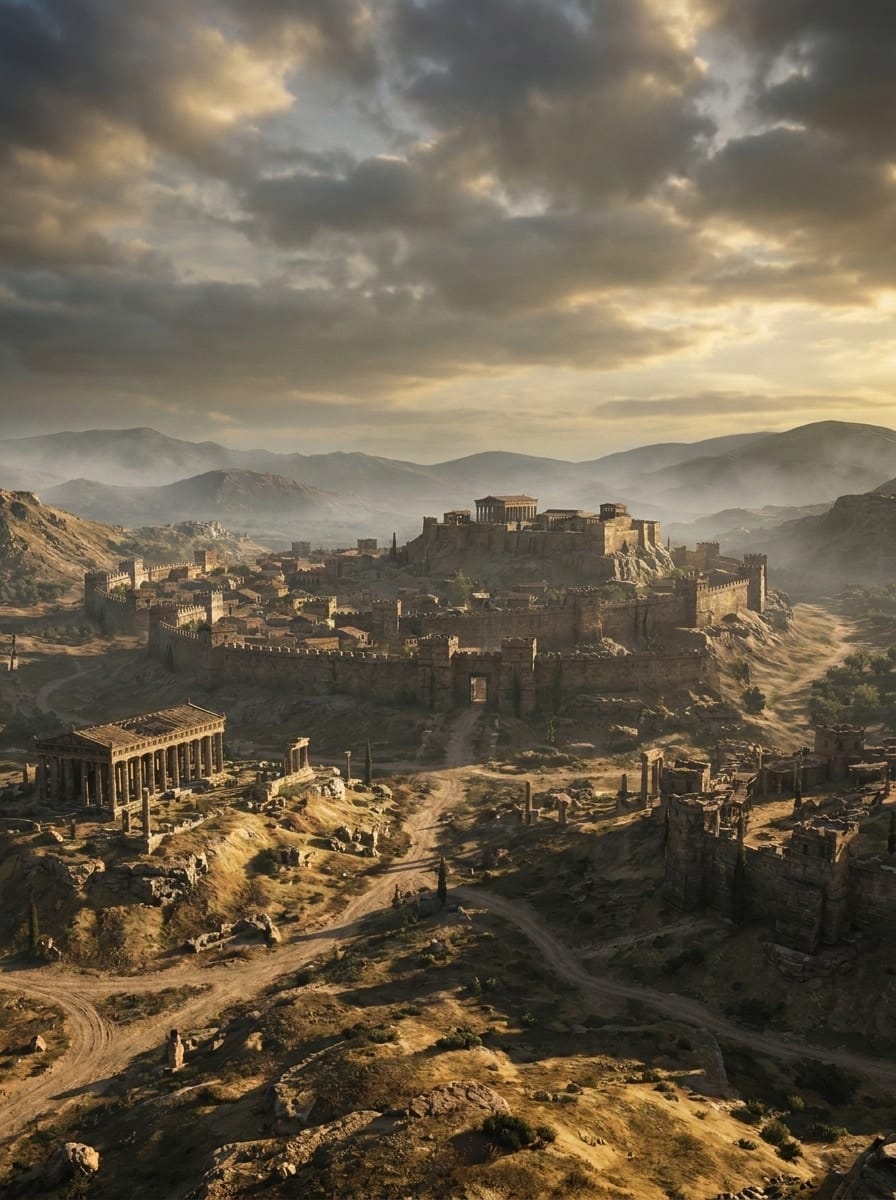
Thebes is a city-state in Greek mythology located in Boeotia, and the central city of the traditions of Cadmus, the house of Oedipus, Tiresias, and the Seven against Thebes. It is a recurring setting for royal succession, oracles, and family curses, and it is preserved in heroic legend as the city of the seven gates.
Overview
Thebes lies in Boeotia in central Greece, and mythic narratives often present it as a city set between open plain and defensible high ground. The story of Cadmus' foundation places its origin on the land where a cow lay down, and refers to a spring, an elevated citadel, and the later city walls. In real geography, modern Thebes, or Thiva, continues the area of ancient Thebes and remains an important town in Boeotia.
Article
Role in Greek mythology
In Greek mythology, Thebes is first of all the city founded by Cadmus. Following the oracle of Delphi, Cadmus trailed a cow into Boeotia, killed the dragon of Ares beside a spring, and sowed the dragon's teeth; from them came five Sparti, or "sown men," who became his first companions and the ancestors of the Theban nobility. The city's high citadel is associated with Cadmus, so its origin combines oracle, blood-debt to Ares, and royal genealogy.
In later tradition, Thebes becomes the chief stage for the disasters of the house of Oedipus. After Oedipus leaves the city, Eteocles and Polynices struggle over the kingship, drawing in the army of Argos and the seven attacking leaders. The seven gates of Thebes therefore become a key narrative space: the outside army assaults the gates, the royal house and the prophet deliberate within the city, and the two brothers die in single combat before the walls.
Thebes is also closely tied to the prophetic tradition of Tiresias. In the siege stories, he explains the old debt left by Cadmus' killing of the dragon and identifies Menoecus' sacrifice as bound up with the survival of the city. When the next generation of heroes attacks, he again advises the Thebans to abandon the city and withdraw. Thebes is therefore not only a place of war, but also a royal city repeatedly tested by divine will, kinship obligations, and civic responsibility.
Geography and natural setting
Mythic narrative places Thebes on the land of Boeotia, with plains, springs, and high ground suitable for fortification around it. In the foundation story of Cadmus, the spring lies amid trees and wet ground and is guarded by the dragon; the higher part of the city functions as a citadel and is later associated with Cadmus' name.
The "seven gates" are one of the most stable features of Thebes' mythic geography. The attack of the Seven, the sacrifice of Menoecus, the duel of the brothers, and the later attack by the Epigoni all unfold around the walls, gates, palace, temples, and the plain outside the city. In these stories, the gates are both military defenses and the boundary where royal conflict moves from the palace into battle.
In real geography, Thebes corresponds to the ancient city and modern town of Thebes, or Thiva, in the Boeotia region of central Greece. It is not a purely imaginary place, but a site with layers of ancient city-state history, Mycenaean remains, and modern urban continuity.
Name and literary tradition
In English, the city is conventionally called Thebes; modern Greek forms are often represented as Thiva or Theva. In mythic narrative, it appears as the city founded by Cadmus, the city of the royal house of Oedipus, and the "seven-gated" city.
Thebes has an unusually concentrated role in heroic-age narrative. The foundation by Cadmus, the house of Oedipus, the Seven against Thebes, the revenge of the Epigoni, and the prophecies of Tiresias all treat the same city as the meeting point of kingship and disaster. This makes Thebes one of the major narrative cities of Greek mythology, comparable in importance to Athens, Argos, and Troy.
Historical and religious landscape
Ancient Thebes was an important city-state of Boeotia and, in the historical period, became one of the region's main political centers. Archaeological evidence shows Bronze Age remains in the ancient city area, including Linear B tablets connected with Mycenaean administrative culture.
On the mythic level, palaces, altars, temples, walls, and gates repeatedly appear in and around Thebes. In the related stories, the city's inhabitants rush to the temples during the siege to pray to Athena, Ares, and the city's guardian powers; the foundation tradition of Cadmus brings together the dragon of Ares, Athena's instruction, and the marriage of Harmonia. The historical and mythic layers are not the same, but together they preserve the image of Thebes as a royal city, a sacred center, and a city of war.
Modern status and preservation
Modern Thebes, or Thiva, occupies the area of ancient Thebes and preserves archaeological remains and museum displays. The ancient city's remains, Bronze Age sites, and scattered traces of ancient buildings make Thebes not only a mythic place-name but also a city of central Greece with visible historical continuity.
Related stories
"Cadmus Founds Thebes" mentions this place: Cadmus reaches Boeotia under the guidance of the oracle of Delphi, kills the dragon, sows the dragon's teeth, and establishes Thebes.
"The Expedition of the Seven against Thebes" mentions this place: Thebes is the seven-gated city defended by Eteocles and attacked by Polynices with a foreign army.
"The Siege of Thebes and Menoecus" mentions this place: the survival of the city is tied to the prophecy of Tiresias, Menoecus' voluntary sacrifice, and the fighting before the seven gates.
"The Brothers' Duel at Thebes" mentions this place: Eteocles and Polynices fight before the gates of Thebes, and the struggle for the throne ends with the deaths of both brothers.
"The Epigoni Attack Thebes" mentions this place: the sons of the Seven attack Thebes again and take the city after Tiresias advises the Thebans to evacuate.