Greek Mythology
Corinth — Greek Mythology
Corinth is one of the important city-states of Greek myth, appearing in several royal, heroic, and exile traditions as a homeland, refuge, or political center. It is directly associated with Sisyphus, Bellerophon, Medea, the early identity of Oedipus, and the overland tradition of Theseus's journey toward Athens.
Overview
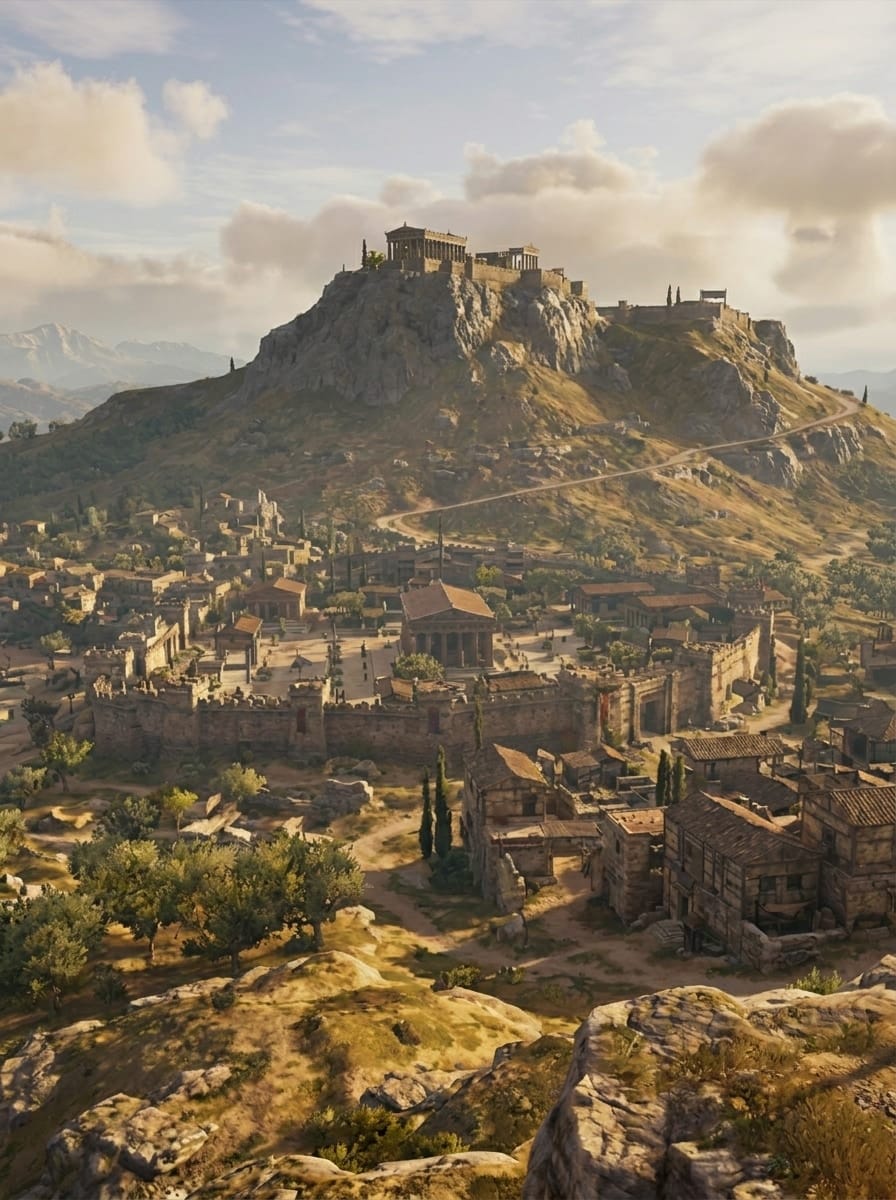
Corinth is often described as a city near sea routes and connected to inland roads, with heights, altars, and a royal palace within its urban setting. The area of the Isthmus of Corinth was also an important overland route from the Peloponnese toward Athens; mountain paths, pine woods, seaside cliffs, and roads haunted by robbers recur in the Theseus tradition.
Article
Role in Greek Mythology
In Greek myth, Corinth is first of all a royal city. When Sisyphus ruled there, the city was also called Ephyra; famed for cunning and trickery, he revealed to the river god Asopus the secret that Zeus had carried off Aegina, receiving a spring within the city in return. This tradition makes Corinth the starting point of the Sisyphid family stories and links the city with offense against the gods, royal craft, and Sisyphus's later punishment after death.
Corinth is also tied to the origins of Bellerophon. He is described in the stories as a young man of the Corinthian royal line who leaves his homeland after a killing and later enters the heroic traditions connected with Argos, Lycia, and Olympus. Pegasus also appears by a spring near Corinth, making the city an important background before Bellerophon gains the winged horse.
In the later story of Medea and Jason, Corinth is the place of exile and the setting of tragedy. Jason tries to regain political standing by marrying the daughter of Creon, king of Corinth, while Medea carries out there her devastating revenge against Jason, Creon's royal house, and her own family.
Geographic Background
In the stories, Corinth stands where sea routes and land routes meet. The Sisyphus tradition notes that the city can look toward the sea on one side and connect to inland roads on the other, so that both merchants and sailors can reach it. The Medea tradition likewise emphasizes Corinth's nearness to sea traffic, with merchants and sailors continually passing through.
The Isthmus of Corinth forms part of the dangerous overland route in the Theseus stories. When Theseus travels from Troezen to Athens, he chooses not to go by sea but passes through mountain roads and wooded country near the isthmus; robbers such as Sinis hold this area, turning the roads around Corinth into a stage on which the hero proves himself.
Name and Tradition
In its earlier tradition, Corinth was also called Ephyra. This older name appears in the background of Sisyphus's kingship and marks an early phase of the Corinthian royal tradition. Later stories more often call the city Corinth and use it as a city of kingship, exile, and heroic origins.
Historical and Religious Landscape
In mythic narrative, Corinth is not only an ordinary place of residence; it also contains political and religious spaces such as a palace, altars, and springs. The spring Sisyphus receives from Asopus is described as living water within the city. In the Medea story, Corinth includes Creon's palace, the setting of the wedding, and an altar environment. These materials chiefly present the cityscape of mythic narrative, rather than independently verifiable archaeological detail.
Related Stories
"Sisyphus and Bellerophon" mentions this place: Corinth is the city where Sisyphus reigns and the homeland of the royal line to which Bellerophon belongs.
"Bellerophon and the Chimera" mentions this place: Bellerophon is described as a noble youth from the Corinthian area, and Pegasus appears by a spring near Corinth.
"Jason and Medea's Later Tragedy" mentions this place: after leaving Iolcus, Jason and Medea come to Corinth, where the main events involving Creon's royal house and Medea's revenge take place.
"The Birth and Exile of Oedipus" mentions this place: Oedipus is brought into the city by a Corinthian shepherd, adopted by King Polybus and Queen Merope, and raised there.
"The Birth and Youth of Theseus" and "Theseus's Road to Athens" mention the area of the Isthmus of Corinth: when Theseus chooses the overland route to Athens, he passes through the dangerous roads nearby.