Greek Mythology
Athens — Greek Mythology
Athens is the central city-state of Attica in Greek myth, and the city whose patronage Athena won and whose name is bound to hers. In its associated stories, it is both the land contested by Athena and Poseidon and the main setting for the royal legends of Aegeus, Theseus, and the Athenian line.
Overview
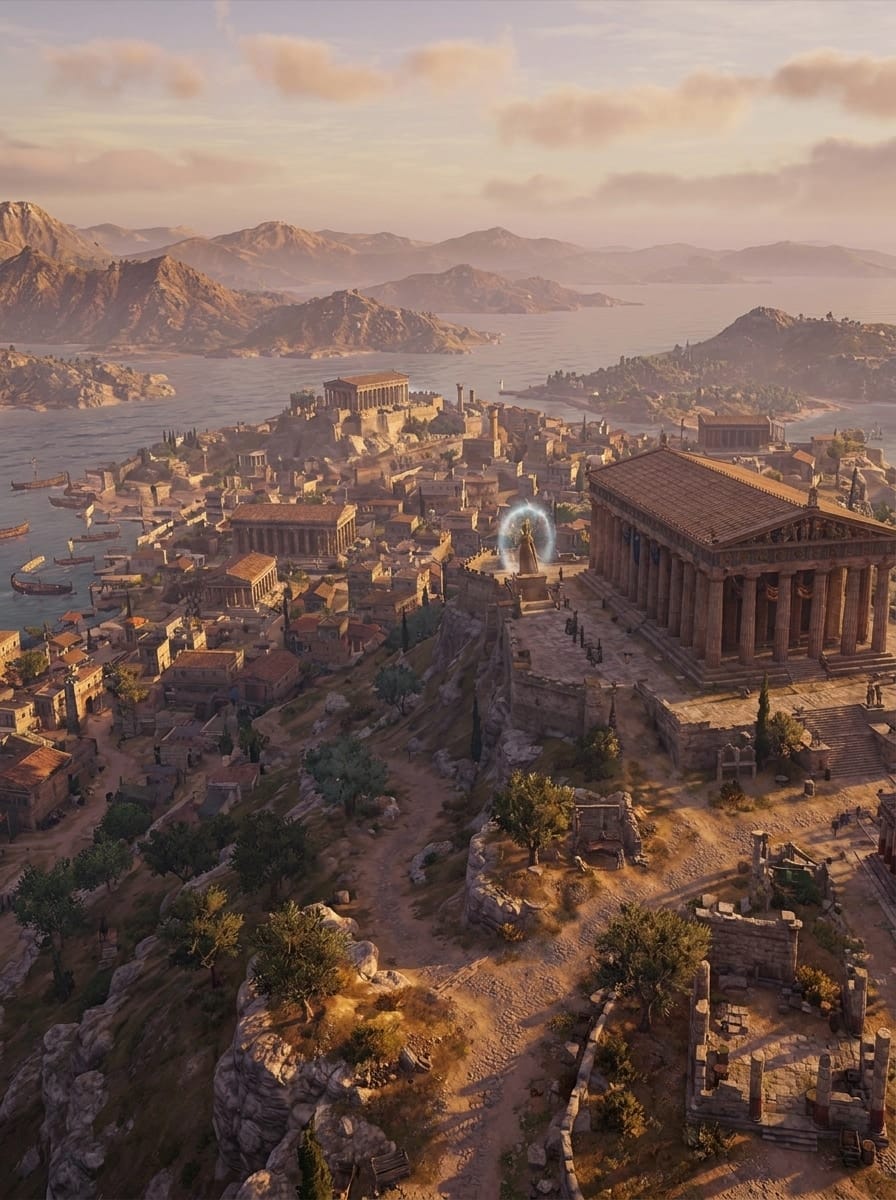
Athens lies in Attica, where the stories place it among hills, coastline, and open ground, with the Saronic Gulf visible in the distance. The city includes a raised rocky hill and a fortified height; later narratives often organize its space around the Acropolis, the royal palace, roads, and routes leading into the surrounding countryside.
Article
Role in Greek Mythology
In Greek myth, Athens is first of all a city-state under divine protection. Poseidon and Athena both claim the right to be patron of the land: Poseidon strikes the rock with his trident and leaves behind salty water, while Athena plants the olive tree. The gods judge Athena's gift to be better suited to civic life, and the city is therefore linked to her name and guardianship.
In heroic legend, Athens is also a place of royal succession and civic order. Aegeus is king of Athens, and Theseus, after retrieving the sword and sandals left by his father at Troezen, travels overland to Athens to be recognized. Once he enters the city, Aegeus identifies him in the palace; Theseus then defeats the succession plot of the sons of Pallas and further strengthens his standing among the Athenians by subduing the Marathon Bull.
Geography and Natural Setting
The Athens of these stories rests on Attica's rocky hills, thin soils, and position near the sea. Attica is described as not especially fertile, yet it has defensible hills, a coast open to ships, and patches of cultivable ground. The sea winds of the Saronic Gulf, pale stone slopes, poor hill country, and olive trees together form the natural background of Athens in mythic narrative.
Athens is also closely tied to the roads around it. When Theseus travels from Troezen to Athens, the sea route is considered faster and safer, but he chooses the overland road. Along the way he passes the Isthmus, mountain paths, pine woods, seaside cliffs, and the region near Eleusis before finally reaching Athens. This route presents Athens as the political center of Attica and the destination of a hero's journey.
Historical and Religious Landscape
The religious landscape of Athens is centered in the stories on the Acropolis and Athena's olive tree. The salty spring and the trident mark left by Poseidon, together with the olive tree planted by Athena, are preserved in the city's mythic memory. Although Athens belongs under Athena's protection, the stories also emphasize that the Athenians continue to revere Poseidon, because the city lies near the sea and cannot stand apart from the sea god's power.
The royal palace is the central setting for narratives of Athenian kingship. There Aegeus receives the still-unrecognized Theseus, and there Medea prepares the poisoned cup. Once Theseus is recognized by the sword and sandals, the crisis of succession to the Athenian throne becomes public, and civic politics and heroic identity meet within the palace.
Related Stories
"The Contest of Athena and Poseidon for Athens" mentions this place: Athens, as the central city-state of Attica, is the object of the two great gods' struggle for patronage, and the olive tree and salty spring become part of the city's mythic memory.
"Theseus' Journey to His Father" mentions this place: Athens is the destination of Theseus after he leaves Troezen, and the city where he goes to seek recognition from Aegeus with his father's tokens.
"Theseus in Athens" mentions this place: after Theseus enters the royal palace of Athens, Aegeus recognizes him, and within the city Theseus faces the crisis of kingship caused by Medea and the sons of Pallas.