Greek Mythology
Argos — Greek Mythology
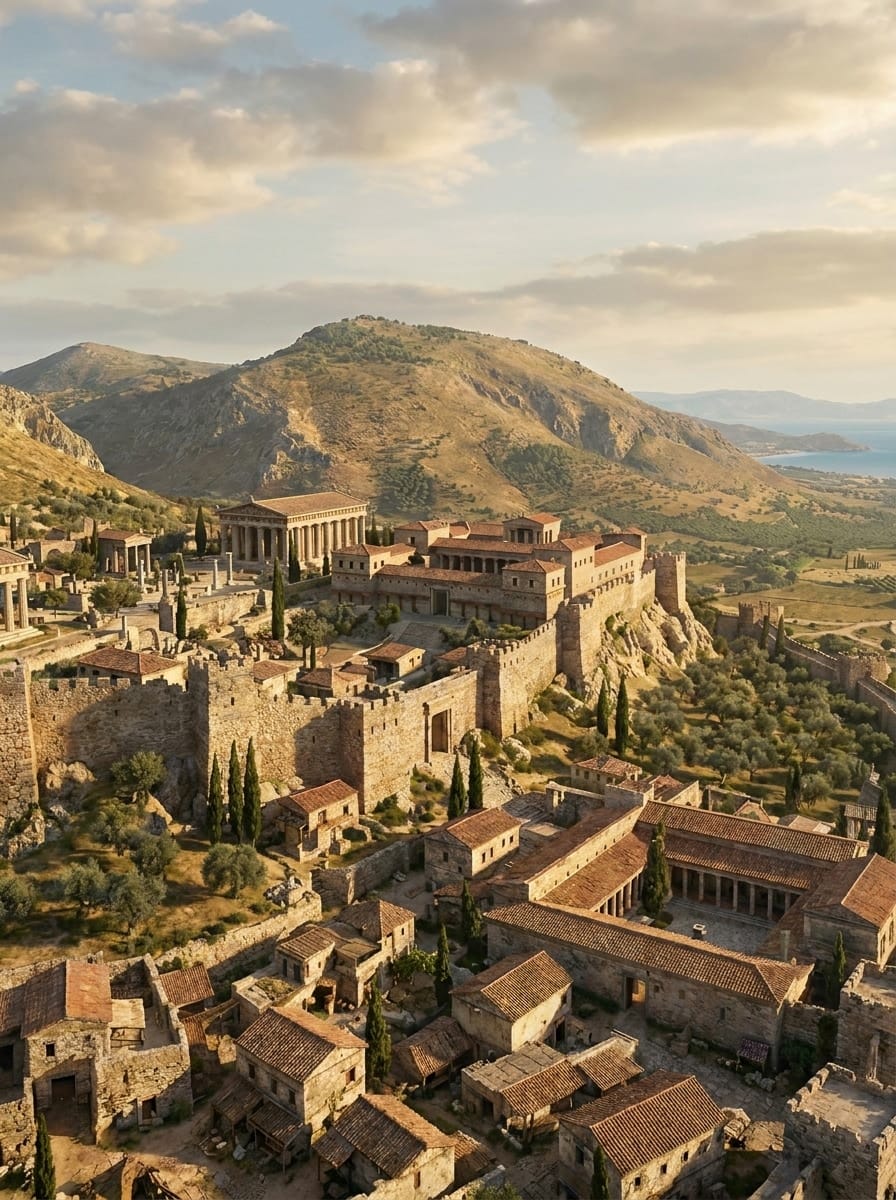
Argos is an important city and royal center in northeastern Peloponnese in Greek mythology, linked with the legends of Io, Danae, Perseus, Acrisius, and other figures. It often appears as the setting for royal households, homecoming, purification, exile, and the unfolding of oracles.
Overview
Argos lies in the Argolid region of the northeastern Peloponnese. Mythic narratives often connect it with nearby rivers, fields, palaces, Tiryns, and the area around Nemea; modern Argos is part of the municipality of Argos-Mycenae.
Article
Role in Greek Mythology
In Greek mythology, Argos is first of all a royal city. Acrisius rules there, and, fearing an oracle that his daughter Danae will bear a grandson who will kill him, he imprisons her. After Perseus is born, mother and child are cast out from the royal order of Argos and set adrift at sea. When Perseus later tries to return to his homeland, Acrisius flees in fear of the oracle, which is eventually fulfilled elsewhere.
Argos is also one of the starting points of Io's story. Io is described as the daughter of Inachus, and her early life is placed around the riverbanks, meadows, and sacred ground of Hera in the Argos region. After she is changed into a white heifer, she is guarded by Argus Panoptes and then driven away by a gadfly, leaving her homeland to begin a long wandering.
In heroic legend, Argos also functions as a place of purification and royal hospitality. Bellerophon leaves home because of blood-guilt and comes to Proetus, king of Argos, to be purified. He is received in the palace, but after the queen falsely accuses him, he is sent to Lycia, leading into the stories of the Chimera and Pegasus.
Geography and Natural Setting
In traditional narrative, Argos appears alongside rivers, plains, meadows, and the space of a royal city. Io's story emphasizes clear river water, reeds, and grass in the Argos region, while the banks of the Inachus are the setting for her recognition by her father. In the Perseus tradition, Argos is more strongly associated with the palace and the civic center: the bronze chamber, walls, throne, and problems of succession form its narrative setting.
In real geography, Argos is located in the Argolid of the northeastern Peloponnese, near ancient centers such as Mycenae and Tiryns. In modern administration, it belongs to the municipality of Argos-Mycenae and continues as an inhabited urban settlement.
Name and Literary Tradition
The name "Argos" refers here to the Greek place-name Argos. It should be distinguished from Argus Panoptes, the hundred-eyed guardian in the Io story: the former is a city and regional center, while the latter is the mythic figure sent by Hera to guard Io. Both appear in the Io tradition, but one is a place and the other a character.
Related Stories
"The Wanderings of Io" mentions this place: Io is placed among the riverbanks and fields around Argos, where she becomes entangled in the conflict involving Zeus, Hera, and Argus Panoptes before beginning her wandering.
"The Birth of Perseus and the Oracle" mentions this place: Argos is the royal city of Acrisius, and it is the setting for Danae's imprisonment, Perseus's birth, and the casting of mother and child into the sea.
"Perseus and Medusa" mentions this place by recalling the background in which Acrisius, because of Argive kingship and the oracle, exiles Danae and her son.
"The Return of Perseus" mentions this place: after completing his journey, Perseus wishes to return to Argos, but Acrisius leaves the city to avoid the oracle he fears.
"Sisyphus and Bellerophon" mentions this place: after leaving his homeland, Bellerophon comes to the Argos region, seeks refuge with Proetus, and receives purification.
"Bellerophon and the Chimera" mentions this place: Bellerophon comes to Argos for purification and is then sent to Lycia by Proetus after the queen's false accusation.