Cthulhu Mythos
The Picture in the House — Cthulhu Mythos
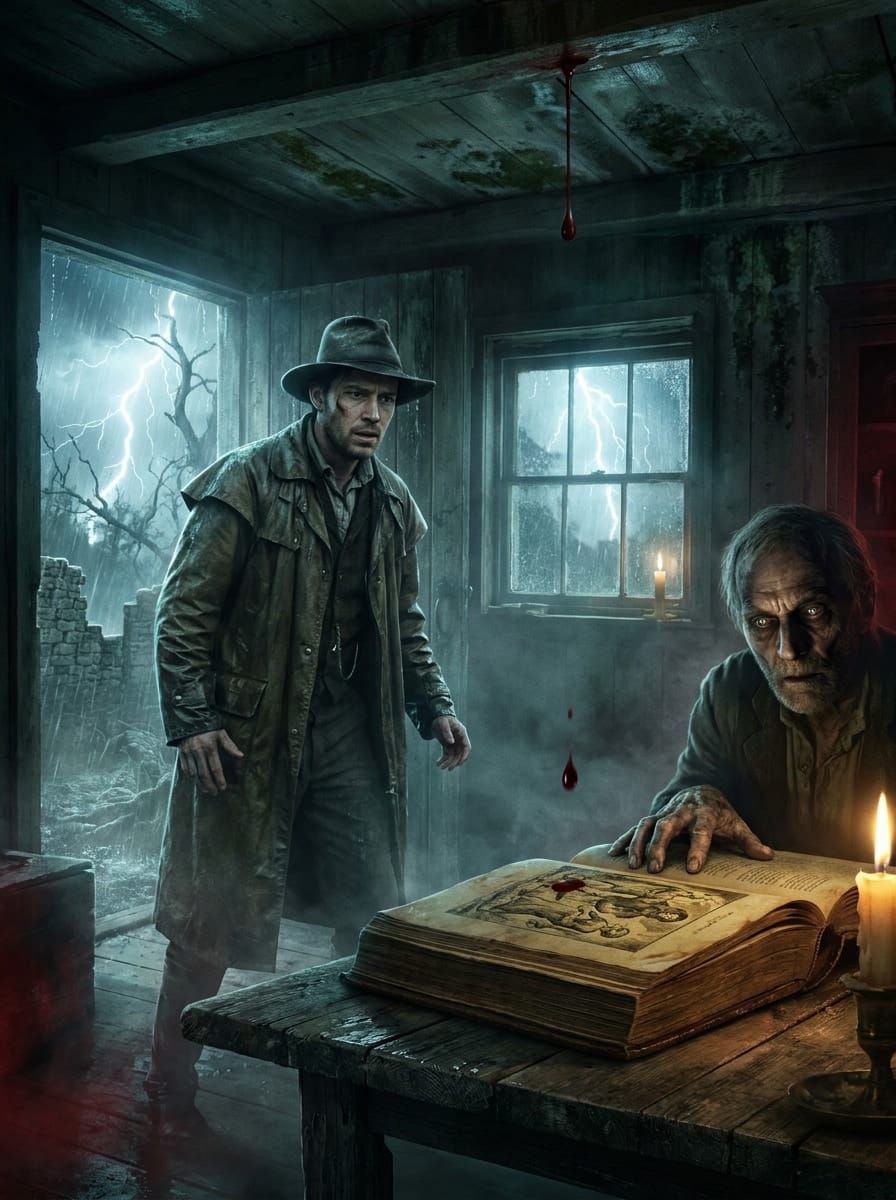
A traveler studying old New England lore takes shelter from a storm in a lonely house, where he meets an owner who seems ancient and confused, yet remains disturbingly fixated on a brutal illustration in an old book. Their conversation gradually reveals a dreadful truth, until blood begins to drip from the ceiling and a lightning strike brings everything to a sudden end.
Article
Summary
A traveler rides his bicycle along lonely New England back roads, searching for old houses and family legends that time has nearly erased. When a storm breaks without warning, he leaves the muddy lane and takes refuge in a decaying farmhouse hidden among the trees. The place looks long abandoned, yet inside he finds antique furniture and a heavy old book. The master of the house soon appears: a strangely withered old man, speaking in a rough country dialect, yet unexpectedly able to make out Latin. With an almost oppressive eagerness, he keeps the traveler inside and opens the book, a volume about distant voyages and foreign customs. Above all, he wants his guest to look at an image like a scene from a slaughterhouse. The old man says that he first saw the picture when he was young, and that ever since, he has never stopped thinking about the flesh it showed. As he speaks, he recalls the people in the image, killed and cut apart, not with fear but with something like longing. The traveler grows more uneasy with every word. Outside, the thunderstorm darkens the sky; inside, the stale air of the house seems to grow heavier. Just as the old man is about to say something still worse, a soft sound comes from the ceiling, and a drop of fresh red blood falls onto the page. The traveler looks up and sees more blood seeping through the boards. Then lightning strikes the house, and darkness, fire, and thunder swallow everything. What remains is the fearful rumor of that old house in the woods, and the knowledge that the deepest shadows are not always hidden in far ruins. Sometimes they wait in a silent house that has stood too long.
The Old Road in the Rain
That day, the traveler was riding alone by bicycle along a country road in New England. The district lay far from the main ways. Damp woods crowded the hillsides, stone walls had collapsed into the weeds, and now and then an old farmhouse leaned beside a barren field, as if the world had forgotten it.
He had not come merely to pass through. Those ancient houses, those old families, those traces of deserted villages were exactly what he wished to find. He believed that terror did not need distant ruins, tombs, or islands to take root. In the silent houses of New England, loneliness, poverty, ignorance, and the slow pressure of years could brew shadows no one could easily name.
In the afternoon, the sky suddenly sank into darkness. Clouds pressed over the woods; wind stirred the leaves into disorder; then rain hammered the road. Mud splashed the wheels, and the bicycle became harder and harder to guide. Looking about for shelter, the traveler at last saw a low old house beyond a screen of trees.
It was unpainted, its boards blackened, its windows small and dim, its roof seeming bent beneath the rain. Tall weeds choked the doorway, the stone steps were cracked, and there was no livestock, no fresh mark on any fence, no human sound at all. It looked as though it had stood empty for many years.
The traveler pushed his bicycle closer and knocked. No one answered. The rain came down harder. He tried the door, and it slowly opened.
The Old Book Inside
The house smelled of damp timber and long-settled dust. The traveler waited at the threshold and listened, but nothing stirred within. He dragged his bicycle into the entry and stepped into the dark front room.
Everything inside was astonishingly old. Heavy chairs stood against the walls, the hearth gaped cold and black, and dust lay across the table. Old tools and implements hung from the walls, some rusted fast. It did not seem like an ordinary abandoned house, for many things had been left in careful order. Yet it did not feel inhabited either. There was no smell of food, no sound of footsteps, only rain beating on the roof.
He approached a table and saw a large old book lying there. It was thick as a brick, with a worn cover, yellowed pages, and a moldy odor when opened. Its pages held many illustrations: ships, forests, strange clothing worn by unfamiliar peoples, and several scenes that gave no comfort to the eye.
The traveler could tell this was no book a common farmer would be likely to read. It seemed to be an old account of distant exploration, printed with passages in Latin. He was bending over one illustration when a faint noise came from above.
He straightened and heard floorboards creak. Then an old man slowly emerged from the rear of the house.
The Old Man's Welcome
The old man was terribly thin. The skin of his face was wrinkled and yellow, his beard sparse, his clothes so worn their original color could hardly be guessed. Yet his eyes were still bright, and their brightness was frightening. Seeing a stranger in the house, he showed no anger. Instead, he greeted him in a harsh, eager voice.
The traveler quickly explained that he had only come in to escape the rain, and that if he had intruded he would leave at once. The old man waved this aside. As though he had not seen a visitor in years, he urged him to sit, asked where he had come from, and where he was going.
His speech carried a thick rustic accent, and some of his words sounded as if they had survived from another age. At first the traveler took him for nothing more than an old farmer hidden away in the hills, but soon he sensed there was more to him. When the old man noticed the book on the table, he suddenly grinned, set one bony hand upon the page, and said he had loved that book since he was young.
The traveler was surprised, and cautiously asked whether he could read the words in it. The old man first claimed he knew little, but then pointed to several lines of Latin and stammered out their meaning. It was not the reading of a trained scholar, but neither was it the wild guessing of someone wholly ignorant.
This gave the traveler a deep unease. Here was an old man in a ruined house among the woods, with no new books, no lamplight, no neighbors, yet he had kept this strange volume with him for who knew how many years.
Thunder rolled outside, and rain ran down through the window seams. The old man dragged his chair nearer the table and insisted on showing his guest one picture in particular.
The Picture
When the pages reached a certain place, the old man stopped. His finger rested beside an illustration, its nail yellow and sharp. The traveler looked down and saw a place like a slaughterhouse. Several figures in unfamiliar dress stood around a body that had been cut open, and the engraver had rendered each motion with a cold exactness, as if recording the butchering of cattle or sheep.
The traveler frowned and tried to look away. But the old man stared at the picture, and his expression changed. He said he had first seen it when he was young, and afterward he had often thought of it. It was not like other pictures, he said. Once seen, it could not be forgotten.
He explained that the book described the customs of certain far countries, where people were said to eat human flesh. He did not lower his voice when he said this, nor did he show the disgust ordinary people feel when speaking of horrors. Instead, he spoke as though discussing something that had stirred his curiosity for years. The more he talked, the closer he leaned, until his body nearly pressed over the table.
The traveler forced himself to answer, but his heart tightened. He heard the old man speak of the taste of meat, of how it might be cut and boiled, of the pieces in the picture as if they were not shadows on paper but real things set before his eyes. As the old man talked, the corners of his mouth twitched, and a muffled laugh rose in his throat.
The house suddenly seemed lower and darker. There was no fire in the hearth, and beyond the window the day had blackened into night. Rain struck the boards; thunder came nearer and nearer. The traveler wanted to rise and excuse himself, but the old man still held one hand on the book, the other lightly on the edge of the table, as though he had not yet spoken the thing that mattered most.
He began to tell how, back then, he had wondered what it would be like if he could truly taste it.
Blood on the Ceiling
A chill crawled up the traveler's back. He did not want to listen any longer, yet he did not dare interrupt too sharply. The old man's eagerness had grown terrible, as though all the silent years in that abandoned house were pouring from his mouth at once.
Then something struck the table.
At first the traveler thought rain had leaked through the roof. But the drop that fell onto the page of the old book was not clear. It was dark red. It spread slowly, soaking into the paper beside the dreadful image.
The old man saw it too. Both men looked up.
From the cracks between the ceiling boards, a second and then a third drop of red liquid were seeping through. They gathered into small beads along the dim wood, then fell with soft taps. It was not rain from the roof. It was blood.
In that instant the traveler understood that something was above them, or that someone had once been there. The expression on the old man's face was impossible to name. He looked like a man whose secret had been discovered, and also like one whose old desire had suddenly been awakened. Thunder burst outside. White light split through the window, throwing the old man, the book, and the drop of blood into ghastly brilliance.
The next moment, true lightning struck the house.
The crash drowned everything. Beams split, and fire and smoke leapt upward together. The traveler knew only a blaze of white before his eyes and the sound of countless boards breaking, while the whole house groaned heavily in the rain.
When wind and water covered the noise again, the old book, the old man, and the secret above the ceiling had all been swallowed by lightning and flame. The house in the woods was no longer merely a derelict dwelling. It had become a dreadful tale sealed by storm. And when people spoke of it afterward, they could only say that in such lonely old houses, the worst horror is not always some monster from outside, but a desire one person has hidden there for years, and the mark of it that at last comes dripping down.