Greek Mythology
The Birth and Return of Zeus — Greek Mythology
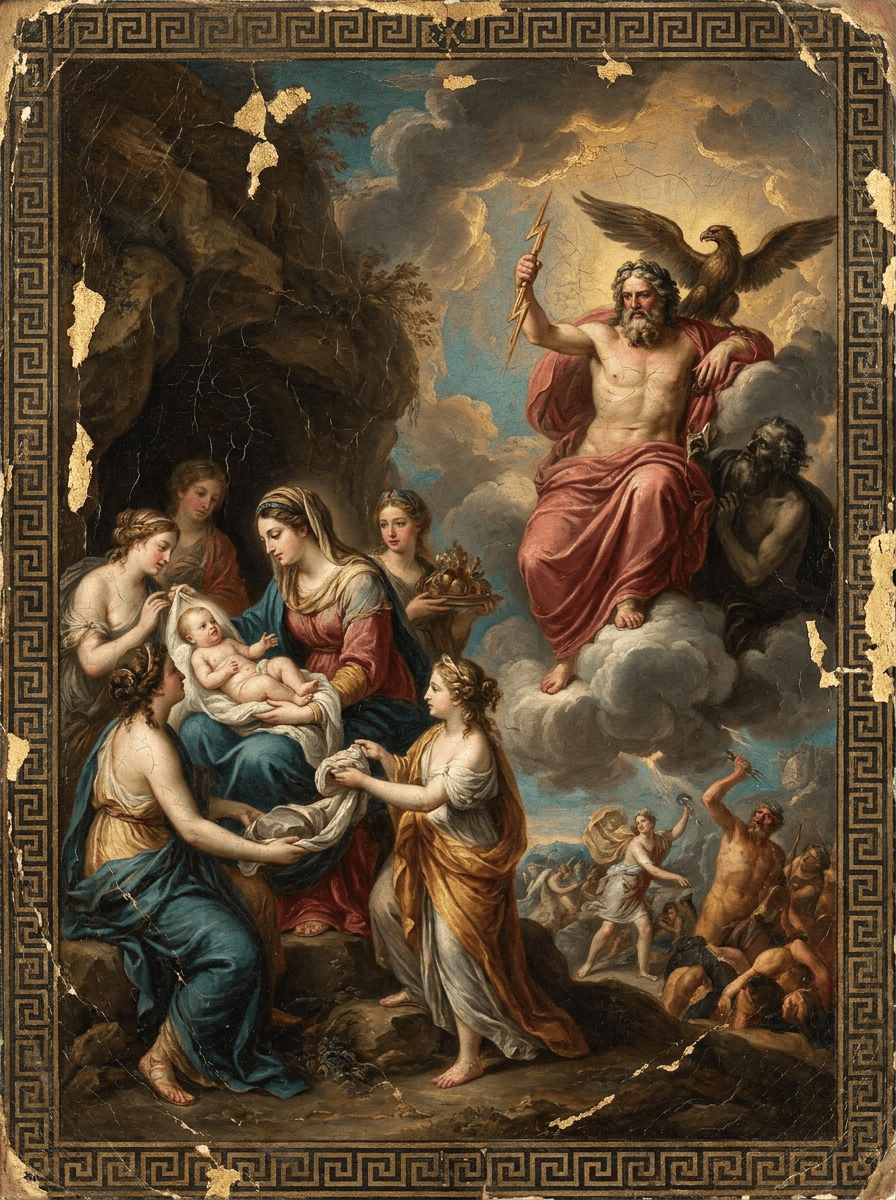
Cronus feared that one of his own children would overthrow him, so each time Rhea gave birth, he swallowed the child whole. Rhea hid her youngest son, Zeus, and tricked her husband with a stone wrapped in swaddling cloth. When Zeus grew up, he returned, rescued his brothers and sisters, and brought Cronus’s reign toward its end.
Article
Summary
After overthrowing Uranus, Cronus took the throne as king of the gods, but the old prophecy never left him: he too would be overthrown by one of his children. So whenever Rhea gave birth, Cronus seized the newborn and swallowed the child whole. Hestia, Demeter, Hera, Hades, and Poseidon vanished one by one into their father’s body, while Rhea was left with empty arms. When Rhea became pregnant again, she sought help from Gaia and Uranus. Following their counsel, she slipped away from Cronus and went to a cave on Crete, where she gave birth to her youngest son, Zeus. The true child was hidden there, cared for by divine nurses and the she-goat Amalthea, while the Curetes struck shields and spears outside the cave to drown out the baby’s cries. Rhea then wrapped a stone in swaddling cloth and carried it back to Cronus. Blinded by fear, Cronus did not look closely and swallowed the bundle as if it were the newborn child. He believed he had defeated fate again, unaware that the real Zeus was growing far away and gradually learning who he was and what had happened to his brothers and sisters. Later, Zeus found a way to make Cronus drink a potion. Cronus could not withstand it: first he vomited up the stone, and then Hestia, Demeter, Hera, Hades, and Poseidon came forth one by one. The siblings saw the light again and stood beside Zeus. Zeus also freed the imprisoned Cyclopes and received thunder, lightning, and the thunderbolt. From then on, he possessed the power to challenge the old king.
The King Who Swallowed His Children
After Uranus was overthrown, Cronus took the throne as king of the gods.
He had once lifted the sickle and helped his mother Gaia rise against the father who pressed down from above upon the earth. In those days he was young and fierce, and he believed he had finally escaped his father’s shadow. But when he himself became king, the old prophecy lodged in his heart like a thorn.
It said that Cronus, too, would be overthrown by his own child.
The more Cronus thought on it, the more uneasy he became. When he looked at his wife Rhea, there was no longer only the closeness of husband and wife in his heart; suspicion had entered there as well. When Rhea first gave birth, the child was still tiny, warm with new life, his cry thin and delicate. Rhea held him in her arms, wanting to name him, wanting to let him sleep against her breast.
But Cronus came toward her.
He did not smile. He did not bend down to play with the infant. He reached out, snatched the child from Rhea’s arms, opened his mouth, and swallowed him whole.
Rhea cried out, but it was already too late. The child vanished down Cronus’s throat, and even his last cry was cut short.
From then on, every time a child was born, Rhea’s heart would brighten for an instant and then sink again. Hestia was born, and Cronus swallowed her. Demeter was born, and she too was swallowed. Hera, Hades, and Poseidon followed one after another, and none escaped their father’s hand.
The children did not die, but darkness closed around them. They were trapped inside their father’s body, unable to see the sun, unable to reach out and touch the earth. Cronus believed that by doing this he could keep his throne. He sat high above all others, outwardly secure, yet in his heart he still feared the prophecy.
Rhea grew quieter with each passing day. She was their mother. She remembered the weight of every child at birth, and she remembered the terrible emptiness when her arms were suddenly left bare. She did not dare struggle openly with Cronus, for she knew that would only make the next child be torn from her sooner.
But she could not endure it forever.
Rhea’s Plea
In time, Rhea became pregnant again.
This time, she did not tell Cronus of the fear in her heart. She kept her head bowed and remained in the palace as before, but at night she often woke alone, listening to the wind pass through the cracks of the doors, her hand resting on her belly. The child within her moved softly, as if reminding her from the darkness: he was alive, and he had not yet fallen into his father’s hands.
At last Rhea went to Gaia and Uranus for help.
Gaia was the earth, the ancient mother. She knew what it meant to be oppressed, and she knew how the heart ached when children were taken away. Uranus had once been overthrown by Cronus, yet he too knew that the prophecy would not fall empty. Together they gave Rhea counsel: when the time of birth drew near, she must leave Cronus and go to distant Crete. There were hidden caves there, thick woods, and valleys deep enough to cover a child’s cries.
Rhea did as they advised.
She slipped away from Cronus’s sight, left the dwelling place of the gods, and came to Crete, the island ringed by the sea. Its mountains were high and rugged; trees grew among the rocks, and shadows lay across the mouths of caves. There, inside a cavern, Rhea gave birth to her youngest son.
When the child came into the world, there was no golden hall and no great celebration. There were only damp stone walls, the sound of wind in the dark, and the quickened breath of his mother.
Rhea lifted the child into her arms. She saw his tiny hands clench and open. Just as his cry was about to rise, she pressed him close against her breast. She knew that if this cry reached Cronus’s ears, all would be lost.
She named the child Zeus.
The Stone in the Swaddling Cloth
Rhea could not remain in Crete forever. Cronus would soon discover that she had given birth. She had to return with a “child” in her arms.
So she found a stone. It was neither too large nor too small, just the right size to be wrapped in cloth. She wound swaddling bands around it, layer after layer, until it looked like a newborn infant. Once the corners of the cloth were drawn tight, no one looking from the outside could tell whether they held cold hard stone or warm soft flesh.
Rhea left the real Zeus in the cave and entrusted him to local divine nurses. Some traditions say that Adrasteia and Ida cared for him; others say that the she-goat Amalthea fed him with her milk. Outside the cave stood the Curetes. Whenever the baby cried, they broke into a war dance at the entrance, striking their spears against their shields until loud waves of bronze rang through the air. The echoes rolled through the valley, and the infant’s cries were covered over.
Rhea looked at her child one last time, held back her tears, and carried the swaddled stone back before Cronus.
Cronus did not look closely.
His heart was already packed full of fear. When he saw Rhea holding something in her arms, he believed it was the newborn child. He feared the prophecy coming true. He feared the child growing up. He feared that one day he too would be cast down from his height, just as Uranus had been. So he reached out, seized the bundle, and swallowed cloth and stone together in a single gulp.
The cold hard stone sank into his belly.
Cronus thought he had defeated fate once again. He did not hear the true child breathing in a far-off cave, and he did not see the faint, restrained gladness on Rhea’s face when she turned away.
The Child in the Cave
Zeus grew up in the cave on Crete.
He was not a prince raised in a palace. His first companions were the drops of water falling from the cave roof, the moss on the rocks, and the sound of wind moving through leaves outside. The divine nurses fed him and watched over his sleep. The she-goat Amalthea lay nearby, giving the hidden child the nourishment he needed to live.
Day by day Zeus grew taller. Strength entered his arms, and his eyes became brighter.
From those who cared for him, he learned who he was. His father was Cronus, the present king of the gods. His mother Rhea had saved him by deceiving her husband with a stone. His brothers and sisters had all been swallowed into Cronus’s belly and were still imprisoned in darkness.
These words did not at once become a roar inside Zeus. They were more like embers deep in a cave, slowly catching fire.
He thought of how he himself should have been swallowed. He thought of his mother risking everything to leave the palace. He thought of the siblings he had never seen. Hestia, Demeter, Hera, Hades, Poseidon: they were not merely names. They were living beings stolen by their father.
Zeus began to wait for his chance.
When he was young, he could only hide. But once he had grown, he could not remain forever in the cave of Crete. If the prophecy had fallen upon him, then he had to walk back into Cronus’s presence.
Making Cronus Give Back the Children
When Zeus returned to Cronus, he did not rush to raise a weapon.
Cronus was still powerful, still seated in his high place. His strength came from the ancient race of Titans and from long years of rule. If Zeus simply attacked him, he might not be able to save the siblings who had been swallowed. So first he sought a way to make his father bring them up again.
Some stories say that Rhea helped arrange for Zeus to come near Cronus; others say that Metis gave Zeus a drug. However it happened, Zeus at last brought that drug to Cronus’s mouth.
After Cronus drank it, his belly churned violently. He tried to hold it down, but the force inside him grew stronger and stronger, as though something were battering its way up from the depths of his body. Suddenly he opened his mouth. The first thing he vomited up was not a child, but the stone he had swallowed long before.
The stone rolled onto the ground, still wrapped in the old deception and bearing the consequence that fate had planted years ago.
Then the swallowed children returned, one by one, into the light.
Hestia came forth. She left the darkness and breathed the outer air again. Demeter came forth. Hera came forth. Hades and Poseidon came forth as well. They had not aged inside him as mortals would have done, but still possessed the life of gods. Yet the long darkness had taught them what their father was willing to do for the sake of his throne.
They looked upon Zeus and knew that this youngest brother had saved them.
From that moment, Zeus was no longer only the child hidden in a cave. He stood among his brothers and sisters, and now he had companions with whom to resist Cronus.
Thunder Falls into the Hands of Zeus
To overthrow Cronus, brothers and sisters alone were not enough.
In a deeper place, other ancient powers were imprisoned. The Cyclopes had been confined there; they possessed mighty craft and terrible strength. The Hundred-Handers too were bound in darkness, their many arms unable to stretch, their rage with nowhere to go.
Zeus released them.
The freed Cyclopes did not forget this kindness. They forged thunder, lightning, and the thunderbolt for Zeus, placing in his hands weapons that could shake the sky. They also brought powers to Poseidon and Hades: Poseidon received a weapon that could stir the earth and the sea, while Hades received a treasure that made him unseen.
Across mountains and valleys, the old silence broke apart. Cronus had swallowed his children in order to prevent the prophecy; yet because of his cruelty, Rhea had hidden Zeus, Zeus had grown up and returned, and the brothers and sisters had at last stood together.
The struggle that followed was long and fierce. The Titans held to the old king, while Zeus and his companions advanced from the other side. Thunder burst across the heavens, lightning lit the ridges, and the Hundred-Handers lifted boulders and hurled them one after another against the enemy. The earth shook, the sea heaved, and the sky flashed as if it had been torn open.
At last Cronus lost everything he had fought so desperately to keep.
The stone he had swallowed had not shielded him from fate. The children he had swallowed had not remained forever in darkness. Zeus came out from the cave of Crete, rescued his brothers and sisters, took the thunderbolt into his hands, and became the leader of a new generation of gods.
Later, people said that the stone Cronus had vomited up was set in the region of Delphi as a memorial of what had happened. It reminded those who came after that Cronus once believed he had swallowed the future, but the future had already grown up in a distant cave, waiting to return into the light.