Greek Mythology
The Battle with Typhon — Greek Mythology
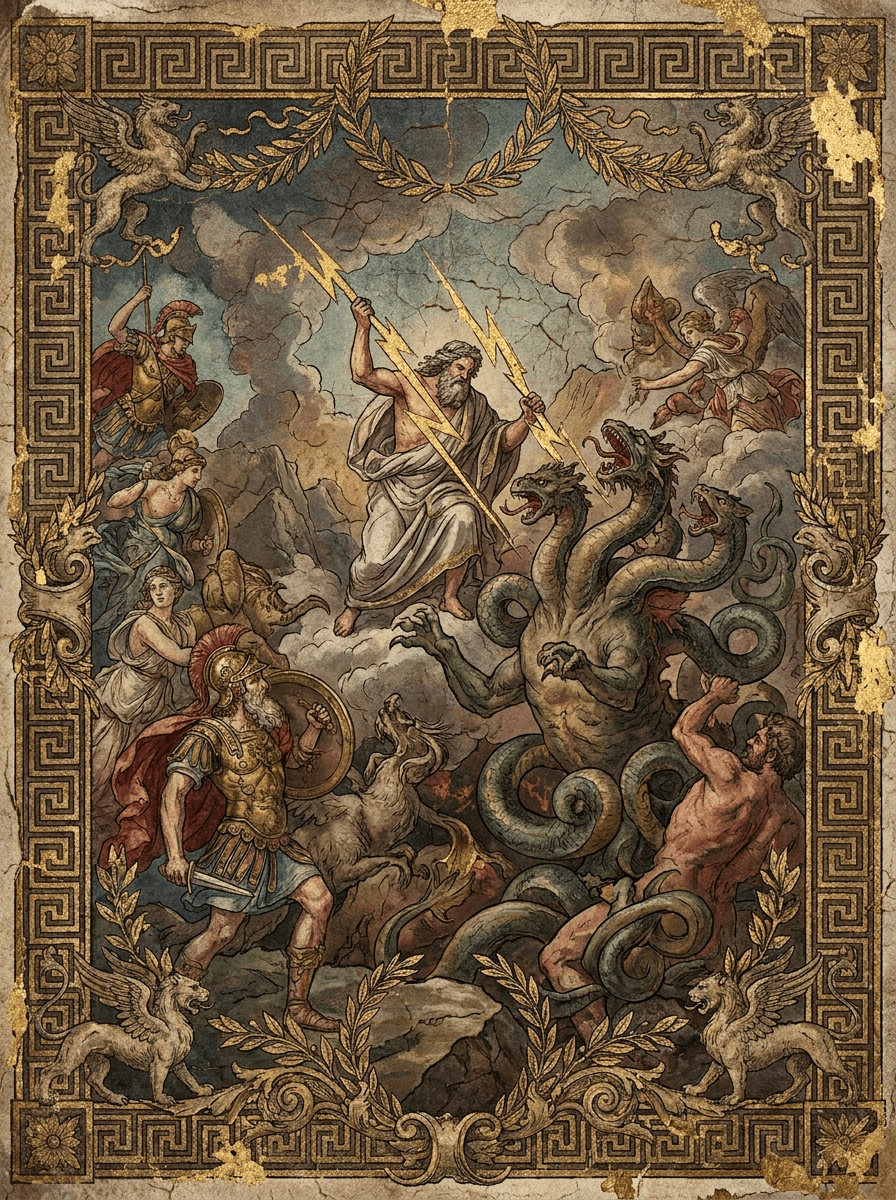
After the Titans were defeated, Gaia, goddess of the earth, brought forth the terrible Typhon and sent him storming into the sky to challenge Zeus. Zeus was wounded and trapped for a time, but he recovered his strength, pursued Typhon with thunderbolts, and at last buried him beneath Mount Etna.
Article
Summary
The Olympian gods had only just won their victory in the Titan War, and Zeus had taken his throne in the sky. Yet deep within the earth, anger had not grown still. Gaia could not bear to see her children imprisoned and crushed below, so she joined with Tartaros and gave birth to Typhon, a monster more dreadful than any giant.
Anger in the Deep Earth
After the Titans were defeated, the heavens were quiet for a long while.
Zeus sat upon Olympus with the thunderbolt in his hand. Poseidon had received the sea, Hades kept watch over the shadowed realm below, and Hera, Athena, Apollo, Artemis, and the other gods had each taken their appointed places. Clouds about the mountain were often lit with gold, and cups passed from hand to hand in the halls of the gods, as though no power would ever again dare to shake the rule of this new divine generation.
But in the depths of the earth, there was no peace.
Gaia saw some of her children locked away in Tartaros and others pinned beneath the dark. Anger remained in her heart. She did not wail like a mortal woman, nor did she rush up the mountain to plead her case. She sank into the earth and listened to its hidden tremors, to the distant rumble of volcanoes like thunder muffled underground. In time, she joined herself to Tartaros, the abyss, and conceived a dreadful child.
His name was Typhon.
The Hundred-Headed Monster Rises
Typhon was no ordinary giant.
When he rose from the earth, his head seemed almost to strike the stars. When he spread his arms, it was as though he could reach from sunrise to sunset. From his shoulders sprang many serpent heads, their tongues flickering in the dark. His legs were not human legs, but coiling snakes, and when he dragged them through the valleys, stones and tree roots were swept away in his wake. It was said that he had many voices: now the bellowing of a bull, now the roar of a lion, now the baying of hunting dogs, and then again the speech of a man. From a hundred mouths the sounds burst forth together, and the very cliffs shuddered.
When he passed along the shore, the waves rolled backward. When he crossed a ridge, pine woods flattened like grass before him. Fire streamed from his eyes and mouths, and black smoke wound about his heads. Earth had given him his body, the abyss his savagery, and from the moment of his birth he would not remain below. He lifted his gaze toward Olympus.
The gods upon Olympus soon heard the disturbance.
First the far clouds turned red. Then the ground shook, and the bronze doors of the divine halls clanged by themselves. The gods rose from their feast and saw dust surging at the foot of the mountain like a storm. Typhon was drawing near. He had not come to bargain or offer sacrifice. His serpent heads opened wide, and his roar came again and again, demanding that Zeus be dragged down from the throne of heaven.
Some of the gods were afraid. One tradition says that in that terror many fled toward Egypt and changed their forms in order to hide from Typhon. But Zeus did not leave. He stood upon the clouds, thunder kindling in his hand, lightning flashing across his face.
He knew that if he lost this battle, sky, sea, and earth would fall back into confusion.
The Thunderbolt Falls
Typhon struck first at the sky.
His serpent-feet coiled over the slopes, his body reared high, and his many heads opened together, breathing flame toward Olympus. The clouds around the holy mountain burned black. A hot wind swept through the halls of the gods, and the wine in golden cups trembled. Zeus raised his right hand, and the first thunderbolt fell, striking Typhon squarely across the shoulders and back.
The valley exploded with fire.
Typhon did not fall. He writhed, seized great rocks, and hurled them into the heavens. The stones tore through the clouds like black stars falling upward toward the dwelling of the gods. Zeus cast bolt after bolt, shattering the mountains as they flew. Broken rock plunged into the sea and threw up white walls of water. Other fragments crashed onto land, crushing woods and damming rivers.
Zeus rushed down from the clouds, holding a sharp sickle in his hand. He pursued Typhon until the battle came to the region of Mount Kasios in Syria. Thunder rolled among the heights, Typhon’s howls answered it, and neither would give way.
But Typhon was not only enormous. He was cunning and ferocious. When the fighting neared caves and walls of stone, he suddenly turned and wrapped his serpentine body around Zeus. The coils tightened and tightened, binding the god-king hand and foot. Zeus swung the sickle to cut himself free, but Typhon seized his chance and tore the sharp blade from him.
Then he did something cruel beyond measure.
He cut the sinews from Zeus’s hands and feet, robbing the lord of the sky of his strength. Zeus could no longer stand. He could no longer cast the thunderbolt. The master of heaven lay on the ground, and the lightning went out in his hand. Typhon hid the sinews in a bearskin, carried them to the Korykian cave, and set a serpent-woman to guard them there.
For a time, it seemed the battle had been decided.
Typhon dragged the wounded Zeus into the cave as one might hide a captive in the dark. His many serpent heads coiled at the entrance, hissing. Outside, the sky was without thunder, and Olympus itself fell silent. Wind moved through the valleys, carrying the smell of burning, and the gods did not dare draw near.
The Bearskin in the Cave
But Zeus was not dead.
Word quietly reached Hermes. Hermes was always light of foot; he knew how to slip past a guard, and how to act at the most dangerous moment. He did not lead a host of gods against the cave mouth, for that would only have roused Typhon. Instead, he and Aigipan crept toward the Korykian cave, avoiding the shadows of the coiling serpents and the watch of the serpent-woman, searching for the bearskin in which the sinews had been hidden.
The cave was damp and dark. Water dripped down its walls. From deep within came the sound of Typhon breathing, like a bellows rising and falling. Hermes held his breath, felt his way to the bearskin, loosened the wrapping, and took out Zeus’s sinews.
They brought them back to Zeus.
When the sinews were restored to his hands and feet, strength returned to his body little by little. First he clenched his fingers. Then he braced himself on his arms. At last he stood. Outside the cave, the clouds gathered again as though answering a summons, and far away a low thunder began to sound.
When Zeus came out of the cave, he was no longer the solitary captive he had been. He mounted his chariot, and the thunderbolt burned once more in his hand. The horses’ hooves beat through mist and cloud, the wheels rolled over the mountain crests, and the sky grew bright again.
When Typhon saw his wounded enemy rise once more, he roared in fury. He tore loose stone from mountain after mountain and hurled it at Zeus. Zeus did not retreat. He split the rocks with thunderbolts as they came, and fire burst in midair while shattered fragments fell like rain. Some stones were driven back by the lightning and struck Typhon’s own body, splashing blood across the slopes. One mountain, the story says, took its name from that bloodshed, as though it remembered the battle.
The fighting moved from the mountains to the shore, and from the shore westward. Typhon’s flames reddened the sky; Zeus’s thunderbolts tore open the night. Wherever they passed, rivers churned, forests broke, beasts fled into caves, and birds did not dare leave their nests.
Etna Holds Down the Roar
At last Typhon began to retreat.
He fled across the sea to Sicily, still trying to rise again by the sheer mass of his body. Zeus followed close behind, and the thunderbolts did not cease. In the end, Zeus lifted a whole enormous mountain and cast it down upon Typhon. That mountain was Etna.
When the great mountain fell, the earth gave a heavy groan. Typhon’s serpent-feet were pinned beneath it, and his many heads were buried in darkness. Fire still burst upward from below, but it could escape only through cracks in the stone. When Typhon struggled under the mountain, the rocks shook. When he breathed out rage, the crater smoked and flamed. When he tried to heave off the weight pressing him down, the earth trembled as though in fear.
Zeus stood high above and watched the column of smoke rise. The thunderbolt was still in his hand, but he did not cast it again. Typhon could no longer storm the sky. He could no longer stretch out his hands toward Olympus. The monster born of earth and abyss lay imprisoned beneath the volcano, becoming the distant roar that human beings heard from afar.
Only then did the thrones of Olympus truly stand secure. Zeus had not merely defeated the Titans; he had also held back the earth’s last terrible uprising. Yet Typhon did not vanish entirely. Whenever Mount Etna pours out flame and black smoke covers the sky, people remember that the hundred-headed monster is still breathing beneath the mountain, still turning in the dark, though never again able to drag the god of thunder from his throne.