Greek Mythology
Zeus and Europa — Greek Mythology
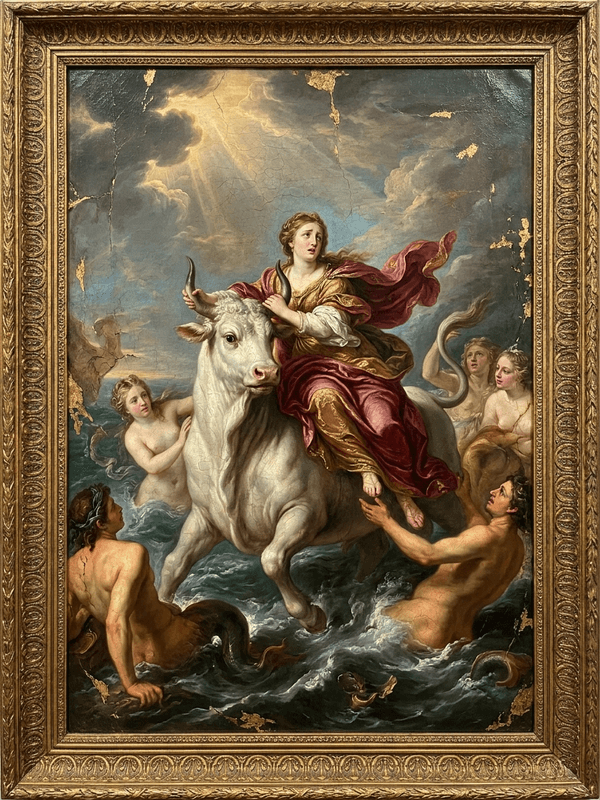
Europa, a Phoenician princess, was gathering flowers by the sea when Zeus, disguised as a white bull, carried her over the waves to Gortyn in Crete. There she became the mother of three famous sons, while the family she had left behind scattered across the world in search of her.
Article
Summary
Agenor, king of Phoenicia, lost his daughter and ordered his sons to go out and find her, forbidding them to return without her. But Europa never came home. She remained in Crete, where King Asterion later took her and her children under his care. The people of Gortyn remembered that Zeus had once brought the foreign princess to their land.
The Princess Gathering Flowers by the Sea
In Phoenicia there was a king named Agenor. His daughter Europa was young and beautiful, and she often went with her companions to play beside the sea. There the meadows ran down close to the waves; wind blew in from the water with the taste of salt, and flowers of many colors grew among the grass. The girls carried baskets, bent to gather blossoms, and their laughter drifted again and again along the shore.
On that day Europa was among them. She walked at the front, choosing the brightest flowers, tucking stems into the folds of her dress, and weaving garlands with her friends. She did not know that Zeus had already seen her from above.
Zeus watched Europa moving through the meadow by the sea, and desire took hold of him. Yet he did not wish to descend suddenly in the majesty of the lord of thunder and terrify the girl, nor did he wish Hera to notice him at once. So he put aside his divine splendor and changed himself into a bull, mingling with the herd near the shore.
It was no rough, frightening beast. Its whole body was white, its hide shining like sea foam freshly washed by the waves. Its forehead was broad, its eyes gentle, and its two horns curved evenly, as though they had been carefully polished by hand. It came forward slowly, neither pawing the earth with its hooves nor bellowing in alarm, but lowering its head beside the girls as if inviting their trust.
The White Bull Bows Its Head
At first the girls stepped back. But the white bull only stood quietly, its breath stirring the flowers and grass. It drew near to Europa and lowered its head beside her hand, as though asking to be stroked.
Seeing how tame it seemed, Europa grew bolder. She reached out and touched its forehead, then ran her hand along the smooth curve of its horn. The white bull showed not the slightest resistance; it only gazed at her with gentle eyes. Her companions gathered around as well, laughing as they laid flowers across its back.
Europa herself wove a garland and hung it between the bull’s horns. The petals glowed vividly against the white hair. Then the bull knelt down, presenting its broad back before her. The girls found this delightful and urged Europa to climb on, just for a moment.
Europa still hesitated, but the bull bent lower. So with one hand she held its horn, and with the other she lifted her skirt and lightly seated herself upon its back. The girls on the shore clapped and laughed, thinking it no more than a game.
But the game lasted only an instant.
The white bull suddenly rose. At first it walked forward slowly; then it quickened its pace and ran toward the sea. Europa cried out and tried to leap down, but already the bull had stepped into the shallows. Spray splashed against her feet, and the cold seawater soaked the hem of her dress.
Her companions ran along the shore, calling her name. Europa looked back and saw their figures growing smaller and smaller. The white bull did not stop. Its four hooves struck the crests of the waves as if treading solid ground, and it carried her out into the open sea.
Across the Waves
The sea opened beneath her. Europa’s face went pale with terror, and she could only cling tightly to the bull’s horns. In one hand she still gripped the garland; with the other she held down her wind-tossed dress, afraid she might slip from the animal’s back. Waves rose beside them and parted beneath the white bull’s feet.
She called toward the shore for her father and for her friends, but only the wind and the cries of seabirds answered her. She did not dare look down into the deep water. She crouched low against the bull’s back. Yet the white bull moved steadily onward and did not let her fall into the sea.
The realm of the sea gods shimmered around them. Fish passed below, and the waves seemed to yield them a path. Little by little Europa understood that this bull was no ordinary creature. Still she did not know who had carried her away, nor where she was being taken.
After a long while, land appeared in the distance. It was Crete. Its mountains emerged through the sea mist, and along the shore lay stony beaches and the shadows of trees. The white bull stepped onto the land and brought Europa onto the island. When her feet touched solid ground again, she was still trembling.
The Shade at Gortyn
The white bull had carried her to the region of Gortyn in Crete. There were clear springs there, and trees, and sunlight falling through leaves onto the earth. Europa stood in that strange land, looking toward the mountains and the sea, frightened and bewildered.
Then the white bull no longer kept its animal form. Zeus revealed himself as a god and stood before her. Only then did Europa know that the one who had borne her across the sea was none other than Zeus, lord of the thunderbolt.
In the shade of the trees at Gortyn, Zeus came together with Europa. In later times the people of that place remembered the event and said that the trees there had gained an extraordinary renown because of this divine visitation. Thus a girl carried away from the Phoenician shore remained in Crete.
Europa never returned to the meadow where she had gathered flowers. In Crete she bore three sons: Minos, Rhadamanthus, and Sarpedon. Minos would later become one of the most famous kings of Crete; Rhadamanthus was remembered for his justice; and the name of Sarpedon lived on in many tales of heroes.
Later, Asterion, king of Crete, received Europa and cared for her children. So the boys grew up in Crete, bearing both the blood of a princess from a distant land and the divine nature of Zeus.
Those Who Searched for Europa
After Europa was taken, panic filled the Phoenician palace. The girls from the shore returned in tears and told the king how the white bull had come near, how it had carried Europa away, and how it had gone striding over the waves. When Agenor heard their story, grief and anger overcame him. He could not accept that his daughter had simply vanished into the sea.
He summoned his sons and commanded them to go out and search for their sister. Unless they found Europa, they were not to return home.
So Cadmus and his brothers left Phoenicia and searched along coasts, islands, and foreign lands. But the sea was wide, and the path of a god was not something mortals could overtake. They did not bring Europa back to her father. Instead, each of them went on toward different lands, leaving behind other stories and the legends of other cities.
Europa remained in Crete. The princess who had once gathered flowers beside the sea became the source of many tales on that island. The people of Gortyn remembered the place where Zeus had brought her ashore; the Cretans remembered her sons; and her name, carried across the sea by a god’s desire, endured for ages in ancient legend.