Greek Mythology
The Wrath of Achilles — Greek Mythology
In the tenth year of the Trojan War, a priest’s daughter brings plague upon the Greek camp, and Agamemnon and Achilles come to open blows in the assembly. Achilles withdraws from battle in fury and asks his mother, Thetis, to plead with Zeus so the Greeks will suffer for losing him.
Article
Summary
In the tenth year of the Trojan War, the Greeks are still camped by the sea and Troy has not fallen. After one raid, Agamemnon receives Chryseis, daughter of the priest Chryses, while Achilles receives Briseis. Chryses comes to the ships with ransom and the staff of Apollo, begging to buy back his daughter, but Agamemnon insults him before the army and drives him away. Chryses walks beside the sea and prays to Apollo, and the god hears him. A plague falls on the camp like a flight of arrows: first mules and dogs die, then the soldiers themselves. On the tenth day, Achilles calls an assembly and asks the seer Calchas to tell the truth. Calchas declares that Apollo is angry because his priest has been dishonored, and that Chryseis must be returned with a sacrifice of a hundred animals. Agamemnon refuses to lose his prize without compensation and threatens to take another man's share. Achilles denounces him as greedy, saying that he fights for the sons of Atreus while always facing the greatest danger himself. Agamemnon then announces publicly that if Chryseis must be returned, he will take Briseis from Achilles' tent. Achilles is so furious that he nearly draws his sword, but Athena stops him, and he turns his rage into an oath: one day the Greeks will long for him. Chryseis is carried home by Odysseus, Apollo accepts the sacrifice, and the plague slowly ends. But Agamemnon also sends heralds to Achilles' hut. Achilles does not harm the innocent messengers; he has Patroclus bring out Briseis and give her up. Watching her led away, he feels his honor publicly stripped from him by the commander. He withdraws from battle, sits alone by the sea, and calls to his mother Thetis. Thetis rises from the water, hears her son's humiliation, and promises to plead with Zeus. She asks the king of the gods to help the Trojans for a time, driving the Greeks back toward their ships until they understand the cost of dishonoring Achilles. Zeus gives his nod. Achilles remains beside the ships and refuses to fight, while the Myrmidons lay aside their weapons. His anger has not yet burned through the camp, but it has already changed the course of the war.
The Old Man from the Shore
Outside Troy, the Greek camp stretched along the sea in a line of tents. Their ships had been dragged up onto the sand, their sterns turned toward the waves; spears stood by the doorways, and shields darkened in the sun. The war had already dragged on for years, yet the city still had not fallen. Again and again the Greeks had marched out to raid the towns around Troy, bringing back grain, bronze, cattle, and captives to divide among the chiefs.
In one of those raids they had taken the stronghold of Chryses, priest of Apollo. His daughter Chryseis was carried off to the camp and given to Agamemnon, commander of the host. Another woman, Briseis, had been allotted to Achilles.
Not long afterward, an old man came to the Greek ships. He wore the priest’s fillet and carried Apollo’s golden staff, with attendants behind him and a rich ransom in his hands. The sea wind stirred his white hair. He did not go first to the place where his daughter was kept. Instead he approached the leaders and begged them to accept the gifts and send Chryseis home.
Many of the Greeks thought the priest should be honored and the ransom received. But Agamemnon would not hear of it. Before everyone, he drove the old man away and ordered him never to return to the ships. Chryseis, he said, was now his; and if the priest pressed the matter again, even that holy staff would not save him.
Chryses dared say no more. With his head bowed, he walked slowly down the shore. The sound of the waves rolled at his feet, and the noise of the camp faded behind him. Only when he had gone out of sight did he raise his hands and pray to Apollo, asking the far-shooter to punish the insult done to him.
Apollo’s Arrows
Apollo heard the priest.
Before night had fully fallen, the god came down from Olympus. A silver bow hung at his shoulder, and his quiver clattered against his back. He took a seat at a distance from the Greek camp and drew the string. His first arrows struck the mules and the dogs; the camp echoed with the sound of animals dropping dead. Then he turned his shafts against the men.
The plague spread through the army like a fire no one could see. Soldiers suddenly burned with fever and collapsed in their tents. Funeral pyres rose one after another, and black smoke climbed from the shore into the sky. By day men carried out the dead; by night there was only weeping. The Greeks did not know how long the god’s anger would last. They only knew that each day more of their companions were dying.
On the tenth day, Achilles could bear it no longer.
He gathered the chiefs and soldiers in assembly. Men came from beside the ships, from before the tents, from around the fire-hearths, and sat together in the meeting ground. Achilles rose and said that if they were to die like this, taking Troy no longer mattered; they might as well sail home. He urged them to summon some man who understood the gods and discover whether the fault lay in a failed sacrifice, an unkept vow, or some offense against heaven.
Calchas, the seer, sat among them. He knew the answer, yet feared to speak. Achilles saw his hesitation and promised to protect him, whatever man he might anger.
Only then did Calchas stand and tell the truth. Apollo, he said, was not angry because of a shortage of offerings or because the victims were poor. He was angry because his priest had been shamed and his daughter not restored. If the plague was to cease, Chryseis must be sent back to her father without ransom, and a hundred beasts must be sacrificed to appease the god.
When he had finished, silence fell over the assembly. Every eye turned to Agamemnon.
The Quarrel in Assembly
Agamemnon’s face darkened. He would not admit he had done wrong, and even less would he surrender the woman in his keeping. He insulted Calchas for always bringing bad news, then declared that if Chryseis had to go, he would not be left empty-handed. If the Greeks meant to strip him of his prize, then they must give him another of equal worth.
Achilles was enraged. The spoils, he said, had already been divided. Was Agamemnon now to take back what belonged to another man? If the king could wait, then when Troy fell there would be more enough for all.
But Agamemnon would not yield. His voice grew harder. If no compensation was offered, he would take someone else’s prize by force. He could seize one from Ajax the Greater, or from Odysseus, or from Achilles himself.
That was the stroke that pierced Achilles.
Before the whole assembly, his anger blazed up at once. He said that he had not crossed the sea to fight some private quarrel of his own with the Trojans. The Trojans had not stolen his cattle or burned his fields. He had come because of Agamemnon and Menelaus. Whenever the fighting was most dangerous, he and his men had been first in the attack, yet when the spoils were divided, the largest share always went to Agamemnon. And now the king meant to steal even what had already been allotted to him.
Agamemnon would not back down either. He said that no matter how brave Achilles might be, he was only one chief among many. Since Chryseis was to be returned, he would send men to Achilles’ tent and take Briseis away, so all would know who commanded the army.
Achilles reached for his sword in fury. His hand closed on the hilt, and the bronze blade gave a faint sound in its sheath. Everyone in the assembly stared at him, and no one spoke. If he drew steel, the Greek host might begin killing one another before Troy’s walls.
Then Athena came down and stood behind him. Only Achilles could see her. She caught him by his golden hair and told him to hold back, not to kill Agamemnon. In time, she said, he would receive three times the compensation. For now, he must content himself with words and not let his sword taste the blood of his own comrades.
Achilles recognized the goddess and forced himself to release the hilt. He shoved the sword back into its sheath, but his rage did not leave him. In front of everyone he swore that one day the Greeks would miss him; when Hector was cutting them down beside their ships, Agamemnon would regret this insult.
Old Nestor also rose to try to calm them. He said Achilles was the greatest of fighters and Agamemnon the commander, and both ought to give way. But neither would listen. The assembly broke apart, and the wound remained in the camp.
Briseis Taken Away
Soon afterward Agamemnon acted on Calchas’ words. He put Chryseis on a ship and sent Odysseus with men to escort her home, along with the beasts for sacrifice to Apollo. The vessel slipped away from the camp and over the dark water toward Chryses’ land.
At last Chryses saw his daughter returned. Beside the altar he prayed for the Greeks and offered sacrifice. Apollo accepted the gifts, and the plague slowly eased. The pyres in the camp grew fewer, and the soldiers were able to breathe again.
But another disaster had already been loosed.
Agamemnon sent two heralds to Achilles’ tent to take Briseis. The men were afraid. They knew Achilles’ temper, and they knew this business was dishonorable. When they reached the tent, they stopped short and did not dare speak.
Achilles saw their faces and understood at once. He did not blame the heralds. He said they were not guilty; Agamemnon had sent them. Then he told Patroclus to bring Briseis out.
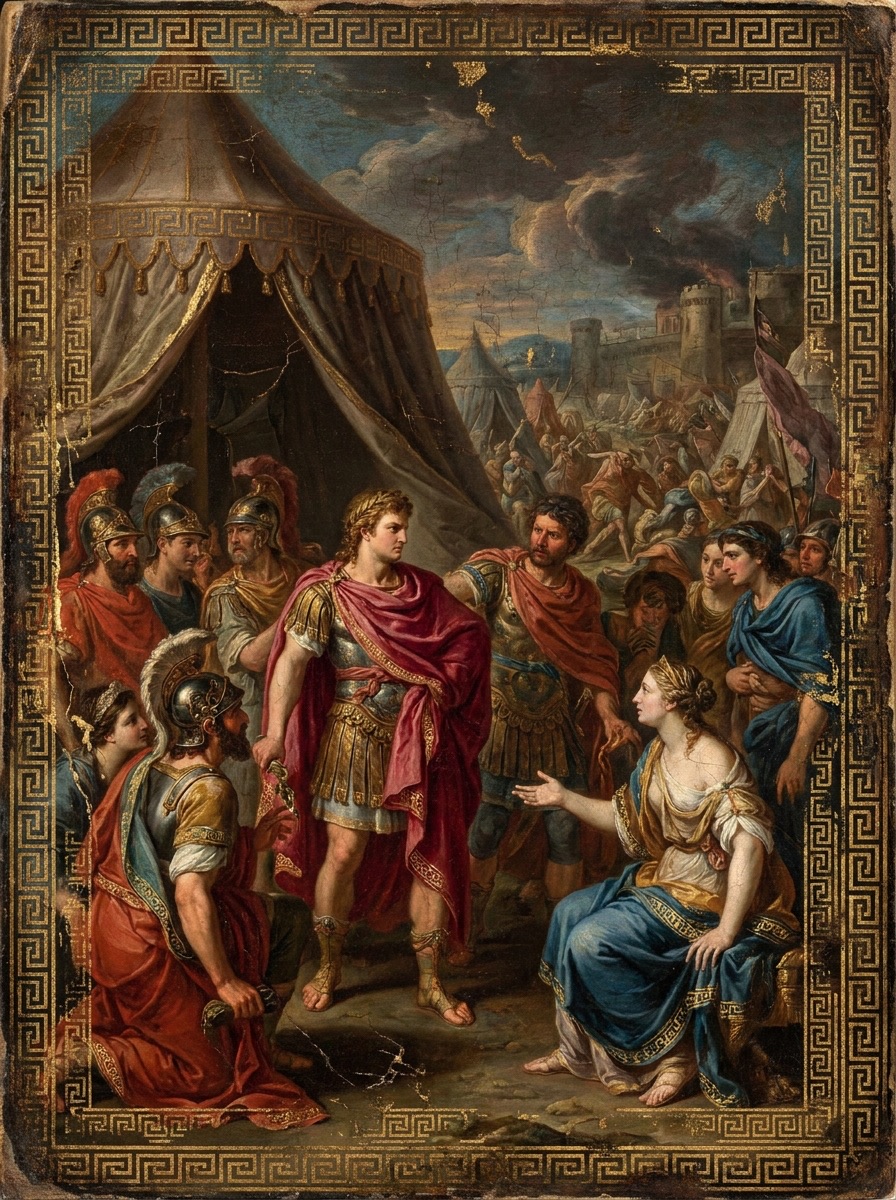
Briseis came from the tent and went away with the heralds. As she walked, she looked back. Achilles watched her being led toward Agamemnon’s quarters, and his anger turned into something deeper: humiliation. He did not run after her, and he did not call his men together to seize her back. He left his comrades and went alone to the seashore.
The waves broke again and again on the sand. Achilles sat by the water, staring out over the gray sea, and called to his mother, Thetis.
The Mother Rising from the Sea
Thetis was a sea goddess. Hearing her son, she rose from the depths and came to sit beside him. She laid a hand on his face and asked why he was weeping.
Achilles told her everything: how Chryses had been insulted, how Apollo had sent the plague, how Calchas had spoken the truth, how Agamemnon had returned Chryseis only to seize Briseis. He said that his life was brief enough already; if even the honor due to him could be taken away, what comfort was there in living?
Thetis grieved when she heard him. She knew her son’s fate, and she knew how closely his glory always stood beside his death. Achilles asked her to go to Zeus and plead for him: let the Trojans prevail for a time, and let the Greeks be driven back to their ships. Only then would Agamemnon and all the Greeks understand how lightly they had treated the greatest of their warriors.
Thetis agreed. She told Achilles to stay by the ships and keep out of the fighting until the gods returned from their feast among the Ethiopians. Then she would go to Olympus and make her request.
So Achilles withdrew to his tent. He took no more part in battle and no longer joined the chiefs in council. His Myrmidons remained by the ships, their spears stacked in place, their chariots gathered in dust. The Greek camp had lost its sharpest blade.
Zeus Nods
Many days passed before the gods returned to Olympus. At dawn Thetis rose from the sea into the upper air and came before Zeus. She knelt at the knees of the king of heaven, one hand beneath his chin and the other around his knee, and asked him to remember the help she had once given him. She begged him to grant Achilles’ wish: let the Trojans gain the upper hand for a while and drive the Greeks to their ships until they learned to honor Achilles as they should.
Zeus was silent for a long time. He knew the request would anger Hera, who had always hated Troy and longed for Greek victory. Yet Thetis still knelt beside him and would not go away.
At last Zeus nodded. Olympus shook at the assent. He granted Thetis her plea and promised that the Greeks would suffer for Achilles’ withdrawal.
Hera soon sensed what had happened. She demanded to know whether Zeus had once again made some secret promise. He would not explain, only told her not to press him. A quarrel rose between king and queen on Olympus, and Hephaestus hurried to soothe his mother, pouring wine for the gods until the hall grew calm again.
But by the sea, the Greek camp found no peace.
Achilles still sat by his ships and did not go out to fight. Agamemnon kept the outward dignity of command, but he had lost the most terrible warrior in the army. Beneath Troy’s walls, Hector and the Trojans did not yet know how soon fortune would turn in their favor; and the Greeks did not yet know in what blood and fire they would remember Achilles’ oath.
So Achilles’ wrath remained by the shore like a banked fire. It did not blaze at once, but it had already changed the course of the whole war.