Greek Mythology
The Wedding of Peleus and Thetis — Greek Mythology
The sea nymph Thetis had once been courted by Zeus and Poseidon, but a prophecy warned that the son she bore would surpass his father. So the gods gave her to the mortal hero Peleus instead. At their wedding, all the gods gathered together, and Eris, uninvited, cast in a golden apple, planting the first seed of the Trojan War at a feast that seemed full of joy.
Article
Summary
Thetis, daughter of the sea god Nereus, was beautiful and powerful, and both Zeus and Poseidon had once wished to marry her. Then came the prophecy: the son born to Thetis would become greater than his father. Remembering how he himself had overthrown Cronus, Zeus refused to risk a child who might threaten Olympus, and the gods decided that Thetis should marry the mortal hero Peleus. Thetis did not accept the marriage easily. Guided by advice, Peleus waited for her on the shore and seized her when she came near the land. In his arms she changed into fire, water, a wild beast, and a serpent, trying to escape the mortal who held her. Peleus endured every transformation and did not let go until she ceased struggling and accepted the marriage arranged by the gods. The wedding was celebrated on Mount Pelion, where the mountain home of Chiron became a feast for gods and heroes together. Zeus, Hera, Athena, Apollo, Artemis, Hermes, and the powers of the sea came to witness the union. The Muses sang, cups were filled again and again, and the gods gave Peleus armor, weapons, and wondrous horses fit for a hero. Yet Eris, goddess of strife, had not been invited. Standing outside the celebration, she brought a golden apple and cast it among the guests. On it were written the words “for the fairest.” Hera, Athena, and Aphrodite each believed that the honor belonged to her, and the joyful banquet was suddenly split open by comparison, pride, and rivalry. The marriage of Peleus and Thetis was completed, and in time Thetis bore Achilles, whose fame would indeed far surpass his father's. But the golden apple kept rolling toward a greater disaster: the quarrel of the three goddesses would draw Paris of Troy into judgment and lead many heroes toward the Trojan War. What began as a splendid wedding on the mountain had already hidden the spark of a vast conflict.
The Goddess by the Shore
On the northern coast of Greece, wave after wave rolled up over the sand and slipped back again into the deep. In the sea lived many ancient gods, and among them was Thetis. She was the daughter of Nereus, and she moved with the sea-nymphs among surf, caves, and rocks.
Thetis was not only beautiful. She had the elusive power of the sea itself, and the long life that belongs to a goddess. Zeus had seen her. Poseidon had seen her too. One ruled the sky, the other the waters, and both had once thought of taking her as a bride.
But the gods soon heard a prophecy: the son born to Thetis would become stronger than his father.
That was no small matter for Zeus. He had won his own throne by overthrowing his father, Cronus, and he knew better than anyone that the children of the gods could rise against those who came before them. Poseidon had no wish to invite such a danger either. So Thetis was no longer fit to be the wife of any great god.
At last the eyes of Olympus turned to a mortal. His name was Peleus, son of Aeacus, noble by birth and famous for his courage. A mortal would grow old and die, and even if Thetis bore him a mighty son, that child would not threaten Zeus himself. So the gods decided that Thetis should be given to Peleus.
The Bridegroom Who Held Fast
Thetis did not wish to marry a mortal so easily.
She was a goddess of the sea, used to salt spray, dark water, and hidden caves beneath the cliffs. Peleus, by contrast, was a hero of the land, with dust on his feet and a spear in his hand. It would not be enough to command her with words and expect her to follow.
After receiving counsel, Peleus went to the shore where Thetis often came. He did not stand at a distance calling out to her, nor did he try to win her with fine speeches. Instead he hid among the rocks and waited until the sea had withdrawn and Thetis, separated from her sisters, came near the land alone.
The wind lifted her garments. Foam dampened her ankles. Then Peleus sprang out and seized her from behind.
Thetis struggled at once.
She was no ordinary woman. In his arms she changed shape again and again: now burning like fire, now slipping away like water; now turning fierce as a wild beast, now coiling like a serpent. Peleus’s arms ached with the strain, his skin was scratched and torn, and fear rose in his heart. But he knew that if he loosened his grip for a single moment, she would vanish back into the sea and be lost to him forever.
So he clenched his teeth and held on without a word, tightening his embrace all the more.
At last, after a long struggle, Thetis ceased to change. The wind still blew. The waves still broke behind them. But she saw that this mortal would not let her go, and she saw too that the marriage had been willed by the gods. So she stopped resisting and agreed to become the wife of Peleus.
The Feast on Mount Pelion
The wedding was not held in any mortal house. It took place on Mount Pelion.
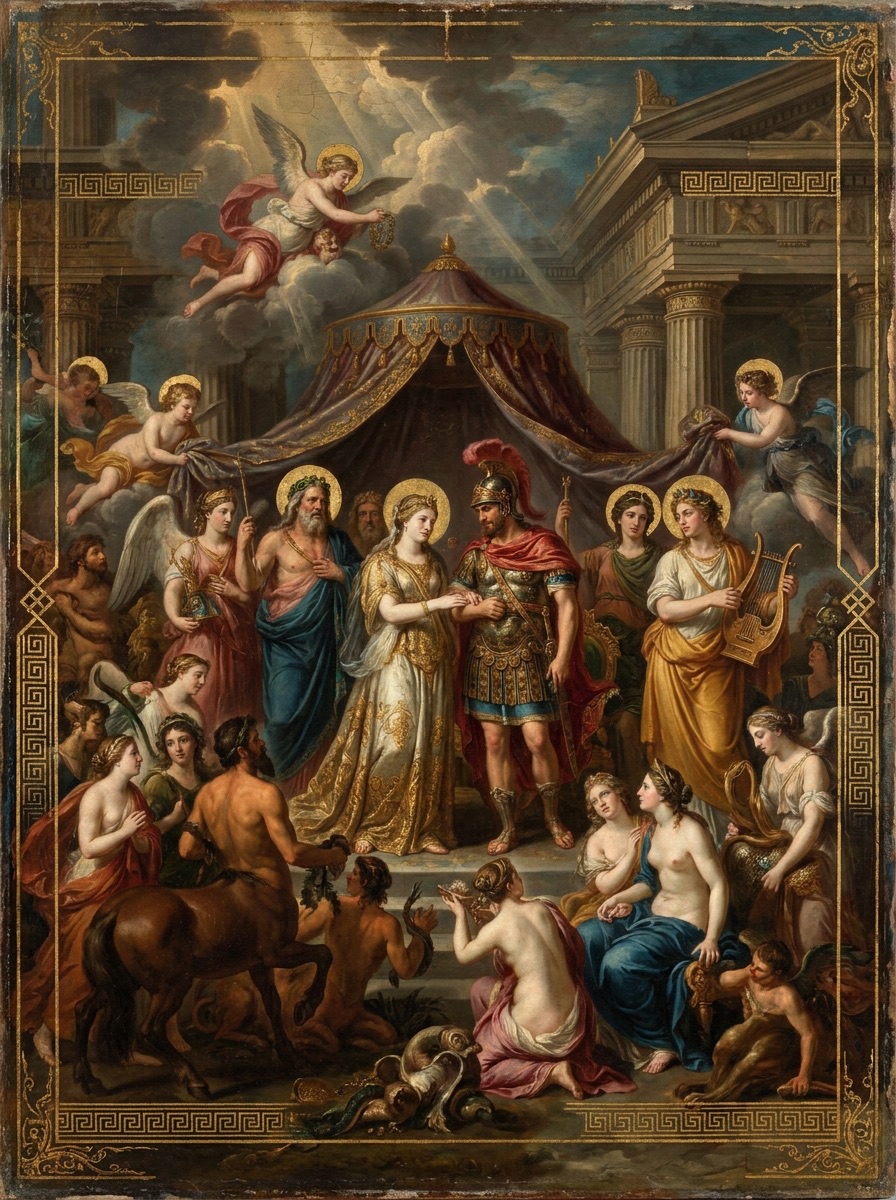
That was the home of Chiron, the wise centaur. The mountain had pine trees, clear springs, and broad stretches of grass. On the wedding day, mortal heroes and immortal gods came together. To Peleus, the scene was like something seen in a dream: Zeus, lord of the sky, was there; so were Hera, Athena, Apollo, Artemis, and Hermes. Sea gods rose from the waves with the smell of salt upon them. The Muses sang, and their voices echoed through the valleys.
Wine and meat were set out on the tables, and firelight shone on bronze vessels. The gods sat at the feast, drinking, talking, and laughing. Peleus stood there in his wedding garments among the undying guests, honored and overwhelmed at once. He was mortal, yet on that day he dined beside the gods.
The gods also brought gifts.
Some gave Peleus armor and weapons. Some brought him swift horses, horses unlike any ordinary beast, horses that would one day draw his chariot across the battlefield with the speed of the wind. For a hero, there could be no more precious gifts than sharp weapons and divine horses.
Thetis sat beside him. She had left the shore and become the wife of Peleus. The songs rose higher and higher, and the wine cups were filled again and again. Looking only at that moment, one might have thought the story complete: a sea goddess married to a hero, with the blessing of the gods and the mountain bright with light.
But beyond the feast, there was one goddess who had not been invited.
Eris, Uninvited
Her name was Eris, the goddess of strife.
Everyone knew what followed her. Where she appeared, calm words soon turned into argument, and laughter at table gave way to anger. A wedding was a day of joy, and the gods did not want her seated among them. So no invitation was sent. No cup was set aside for her, and no song was sung in her honor.
Eris did not leave in silence.
She came near Mount Pelion and heard the music and laughter pouring out from within. Firelight flickered among the trees, and the voices of the gods drifted from the hall. She stood outside with a golden apple in her hand.
It was no ordinary fruit. Golden light shimmered over its skin like the last glow of the sun on metal. Eris did not burst into the feast shouting, nor did she overturn the tables. She merely threw the apple into the midst of the guests and let it roll before the gods.
Upon it was written a single line: for the fairest.
At first the voices in the hall seemed to fall beneath some invisible weight. The gods looked at the apple, and all of them knew that this was no small gift, but a spark dropped into dry grass.
Hera saw it. She was the wife of Zeus, and no slight against her dignity could be ignored. Athena saw it too. She was a goddess of wisdom and battle, calm-eyed and never willing to yield in matters of honor. Aphrodite could not look away either, for beauty itself was her brightest power.
Each of the three believed the apple should be hers.
The joy of the feast was broken at once. The place that had only moments before rang with song was suddenly tight with tension. No goddess wished to admit before the others that she was less beautiful. Eris said nothing more. What she wanted had already been done.
The Shadow Left by the Wedding
The wedding of Peleus and Thetis was still completed.
A mortal hero married a sea goddess, and the gods themselves witnessed the union. Later, Thetis would bear Peleus a son named Achilles. That child would indeed be mightier than his father, and his fame would outshine Peleus by far.
But the golden apple thrown into the feast was not forgotten.
The quarrel among Hera, Athena, and Aphrodite grew so bitter that it had to be judged by another hand. In time, a young prince of Troy named Paris would be drawn into the dispute. Each goddess promised him a gift in exchange for her favor. The little apple rolled away from the wedding meadow and, in the end, rolled all the way to the walls of Troy.
So the wedding of Peleus and Thetis was at once a brilliant celebration and the beginning of a great calamity. The songs on the mountain would fade. The cups would be emptied. But the strife cast in by Eris remained behind, like a hidden fire waiting for the day it would burn through heroes and cities alike.