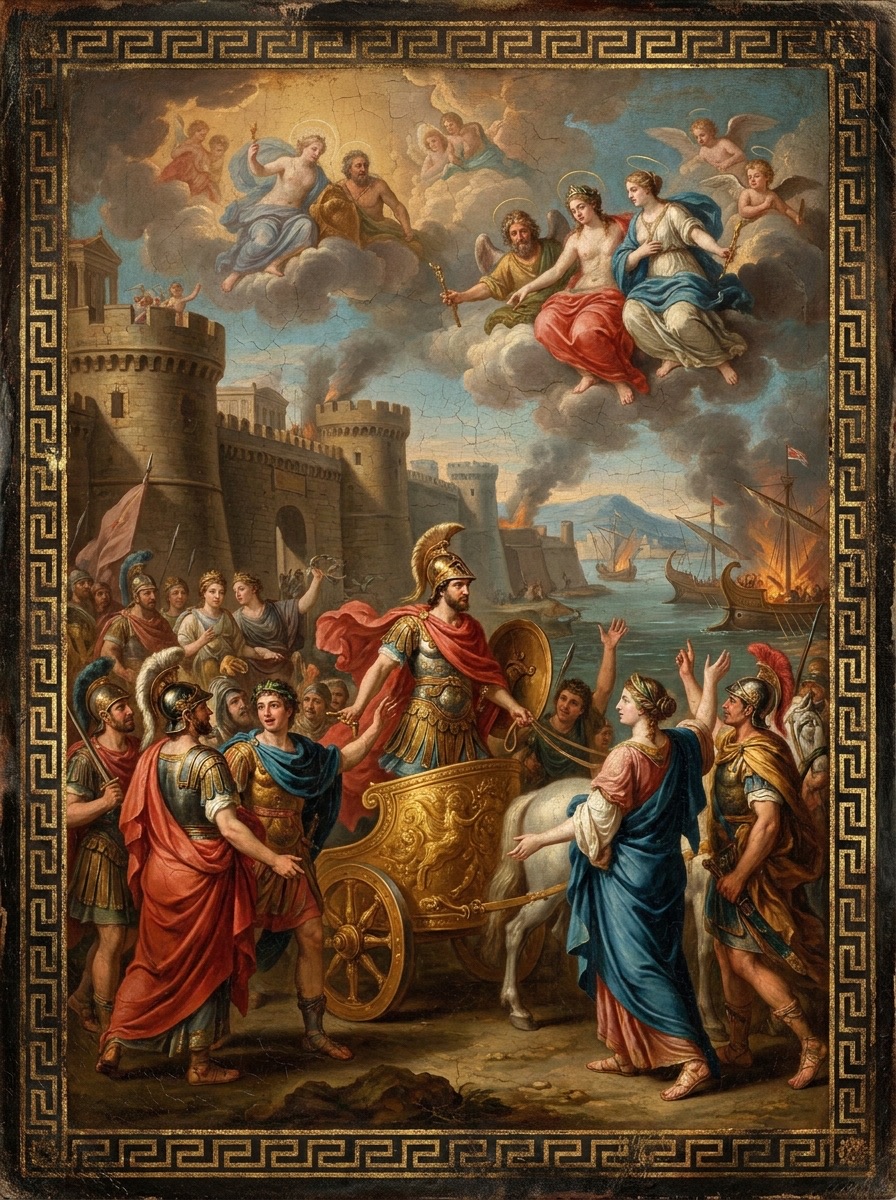
Greek Mythology
The Trojans’ Victory — Greek Mythology
Achilles still refuses to fight. One after another, the strongest Achaean leaders are wounded, and the Trojans seize their chance: they cross the ditch, break through the camp wall, and drive all the way to the ships. With Zeus aiding him, Hector presses close to the sterns, and the Greeks are left with only one last line of defense.
Article
Summary
After Achilles withdraws from the battle, the Greeks keep struggling on, but their old force is gone. Agamemnon, Diomedes, and Odysseus take turns entering the fight, trying to drive the Trojans back beneath their city walls. Yet the battle surges like a rising sea, now sweeping one way, now crashing back the other. Agamemnon is the first to be wounded and leave the field. Diomedes and Odysseus are hurt soon after. Seeing how badly matters are turning, Nestor urges Patroclus to plead with Achilles: if Achilles still will not fight, then at least he should let Patroclus put on his armor and lead the Myrmidons out, frightening the enemy with the sight of it. Hector seizes the moment and leads the Trojans to the wall of the Greek camp. The ditch stops the chariots, and an ominous sign appears in the sky—an eagle dropping a snake—but Hector refuses to fall back. He lifts a great stone, smashes open the gate, and the Trojans pour after him into the Greek camp. The Greeks retreat to the ships, where Ajax the Greater and others fight desperately to hold the line. When Zeus awakens, he sends Apollo to strengthen Hector, and the Trojan assault grows fiercer still. Hector reaches the stern of a ship and calls for fire to burn the fleet. The Greeks’ hope of survival is driven to its final edge.
Morning Outside the Wall
Achilles had not entered the battle for a long time.
His black ship lay beside the sea, its prow turned toward the gray waves. He sat near his shelter, able to hear the shouting far off and see dust rising from the plain, but he put on no armor and took up no spear. Patroclus stood beside him, glancing more than once toward the Greek camp, yet not daring to say too much. The Myrmidons too sat idle, like hunting dogs held fast on a leash: they could smell blood, but they were not allowed to spring.
On the plain of Troy, the war did not stop because Achilles was silent.
At dawn the Greeks mustered beside the ships. Agamemnon put on his armor, and the bronze plates across his chest shone in the sun. Though his heart was heavy, he stood before the ranks and called loudly to the warriors of the different cities. He knew that if they could not hold the Trojans beneath Troy’s walls, the fire of war would sooner or later reach the ships. Once the ships were burned, even the road home would be gone.
Before the camp lay a ditch, and beyond the ditch a barrier of stakes and earthwork. The Greeks had raised this defense out of fear. Once they had often challenged the enemy beneath Troy’s walls; now they had to guard their own ships, as if defending a temporary city.
The Trojans also formed their ranks. Hector stood at the front, the horsehair crest of his helmet tossing in the wind. He was no longer merely the prince who defended the city; he was like a fire advancing toward the shore. He called to the Trojans and their allies behind him, telling them to remember their wives and children in the city, the old men and the altars behind the high walls. If they broke through the Greek camp wall that day, he said, the enemy’s ships would become a heap of ashes.
Soon the two sides crashed together. Spearheads struck shields, bronze swords rang against bronze helmets, and the fallen pressed the dust beneath their feet. At first Agamemnon fought fiercely, driving back the Trojans who came against him. Seeing their commander at the front, the Greeks pushed forward with him. The Trojans were forced back; chariots wheeled around, and their wheels rolled over stones and bodies.
But the advantage did not last long.
In the crush of battle Agamemnon was wounded. Blood ran from his arm and through his armor, and pain bit down into the bone. He still wanted to remain in the front line, but the wound kept bleeding, and his attendants had to help him into his chariot and drive him back toward the ships. When the Greek army saw its commander leave, the ranks began at once to waver.
The Leaders Leave One by One
When Diomedes saw Agamemnon withdraw, he urged his chariot forward. There had been days when the Trojans trembled merely at the sound of his name, and even now he was full of courage. Odysseus also stayed in the field. Gripping his long spear, he watched for openings in the press of men and did all he could to steady the Greek line.
Hector saw Agamemnon wounded as if he had heard a battle drum. He called the chariots onward and pointed his spear toward the Greek ranks. The Trojans surged forward again. Dust covered men’s faces, and the neighing of horses drowned the shouts of captains.
Then Diomedes was struck by an arrow and could scarcely bear the pain. He clenched his teeth and pulled the shaft out, and blood welled up at once. Odysseus found himself trapped among the enemy, his comrades falling one by one around him. He would not abandon his place. He raised his shield against incoming spears and struck down those who came near. But more and more enemies closed around him, like hunters surrounding a wild boar.
Only when Ajax the Greater and Menelaus arrived was Odysseus drawn out of the press. Yet Odysseus too was wounded and had to retreat toward the ships. Diomedes, Agamemnon, Odysseus—men who usually held up the whole field of battle—left the front one after another. The courage of the Greeks loosened like a fence from which the stakes have been pulled.
In the camp by the sea, Nestor saw all this and felt a chill in his heart. He was old and could no longer charge as he had in youth, but his eyes still read the battle clearly. He had driven out to see the wounded Machaon, and he feared the line would collapse. From Achilles’ camp Patroclus saw Nestor’s chariot pass and noticed that it seemed to carry a wounded man; at Achilles’ command, he went to ask who it was.
When Nestor saw Patroclus, it was as though he had caught hold of the last rope left to him. He did not merely answer the question about the wounded man. He poured out the whole danger facing the Greeks: their leaders wounded, their line driven back, the Trojans coming closer and closer. He urged Patroclus to return and plead with Achilles. If Achilles still refused to fight himself, then let Patroclus at least put on his armor and lead out the Myrmidons. If the Trojans saw that armor from afar, they might think Achilles had returned, and fear might break their courage before the fight even began.
Patroclus listened with a troubled heart. When he left Nestor’s shelter, the shouting in the distance had come nearer.
The Omen at the Ditch
Hector gave the Greeks no time to breathe. He led the Trojans straight to the ditch before the Greek camp. The ditch was deep and wide, its bottom set with sharpened stakes; horses and chariots could not cross it easily. The Greeks stood behind the wall, hurling stones and spears downward, trying to keep the enemy out.
For a moment the Trojans halted at the edge. The horses would not leap down, and the wheels could not pass the stakes. Polydamas advised Hector not to force the chariots across the ditch. They should dismount and fight on foot, he said, sending the soldiers in ordered companies against the wall. Hector, for all his impatience, knew the counsel was sound. He ordered the men to leave their chariots, give the horses to the drivers, and advance on foot.
Just as they were preparing to charge, an eagle flew overhead. In its talons it held a snake, still alive, writhing in the air. Suddenly the snake twisted back and bit the eagle in the breast. In pain, the eagle opened its claws, and the snake dropped among the Trojan ranks. Many who saw it stopped where they stood.
Again Polydamas warned Hector that the sign was unlucky. The eagle had seized its prey but had not brought it home to its nest; instead, wounded by the snake, it had been forced to let it fall. If the Trojans reached the ships that day, he said, they might not return safely.
Hector’s face darkened as he listened. He would not draw back when victory seemed so near. He rebuked Polydamas for watching the flight of birds instead of trusting the spears in warriors’ hands. The best omen, he said, was to defend one’s own homeland. Then he raised his shield and strode forward, and the Trojans roared behind him.
The Greeks met them from the wall. Ajax the Greater stood there like a tower of bronze, holding his great shield and moving back and forth to hearten his comrades. Beside him Teucer bent his bow, and his arrows flew down from the wall, striking Trojan throats, chests, and shoulders. Each time a man fell, confusion broke out below; but men from the rear immediately stepped through the dust and filled the gap.
Hector searched beneath the wall for a place to break through. He saw a great stone, so heavy that two ordinary men could hardly have lifted it. Yet he bent down, clasped it in both hands, and rushed at the gate. The stone crashed against the doors. The bar splintered, and the timbers gave a terrible groan. Hector hurled his strength against it again, and the gate burst open, shards of wood flying wide.
He was the first through the wall, dust on his face and the horsehair crest of his helmet tossing high. The Trojans streamed in after him like river water breaking through a dike.
The Sea God’s Encouragement
The Greeks fell back to the ships.
The sea wind moved over the sails, and the hulls stood in rows along the shore. Those ships had carried them across the sea; now they were their last refuge. If the Trojans set fire to them, the planks, ropes, and canvas would all blaze, and the whole army would be trapped to die on a foreign coast.
Then Poseidon looked from the sea and saw the Greeks in danger, and pity stirred in him. He could not openly defy the will of Zeus, but he slipped quietly among the troops in the shape of a mortal man, encouraging warriors who were close to giving way. His voice was steady and strong, like waves striking rock. When the Greeks heard him, warmth returned to their chests, and they gripped their spears again.
Ajax the Greater and Oilean Ajax stood side by side before the ships, urging everyone to hold the ground. There was no time left to think about honor, and no time to argue over who had been at fault. Every man knew that the ships behind him were the shadow of home. If they were lost, the fathers, mothers, wives, and children far away would remain only in dreams.
Hector, however, grew fiercer and fiercer. After breaking through the wall, he drove the Trojans close to the line of ships. The Greeks formed a dense hedge of long spears, shaft against shaft, shield pressed against shield. Again and again the Trojans charged and were thrust back; before those who retreated could steady themselves, men behind them crowded forward and pushed them on.
There was no open space left on the battlefield—only men, shields, spears, blood, and dust. One man seized the rim of an enemy shield and had his fingers hewn off by a sword. Another fell beside a ship with his hand still clenched around a rope. Another called the name of a comrade and heard no answer. The waves kept rising and falling on the shore, as if they knew nothing of the slaughter.
After Zeus Awoke
Hera had contrived to send Zeus into sleep, hoping to win the Greeks a little breathing space. But when Zeus woke and saw the state of the battlefield, he knew at once that the gods had been at work behind his back. In anger he ordered the gods not to interfere as they pleased, and he sent Apollo to aid Hector.
Hector had earlier been struck down by a stone in the fighting and had lain stunned, filling the Trojans with fear. Apollo came to his side and poured strength into him. Hector opened his eyes; breath filled his chest again, like a warhorse released from the reins. He rose, took up his weapons, and rushed once more toward the front.
When the Greeks saw him return, their hearts sank. A moment before they had thought this terrible enemy fallen; now he was more violent than ever. Apollo went before the Trojans, breaking down the Greek defenses and throwing their minds into disorder. The Trojans took advantage and drove on, while the Greeks retreated step by step toward the sterns of the ships.
Nestor lifted his hands to the sky and prayed, begging Zeus to remember the sacrifices the Greeks had offered in former days and not let them perish utterly beside the sea. But the sound from heaven was not thunder driving the enemy back. It was the Trojan war cry coming nearer.
Hector reached one of the ships and seized its stern with his hand. He shouted for his comrades to bring fire, so they could burn the Greek fleet. At his cry the Trojans’ spirits leapt. They crowded toward the ships: some carrying torches, some stabbing with spears at the men who defended the hulls, others clinging to the sides and trying to climb aboard.
Ajax the Greater stood on a ship with a long boarding spear, thrusting down one attacker after another as they came near. Blows rang constantly on his shield, like bronze hammered in a smithy. He knew he could not retreat. If he gave even a single step, fire would touch the planks. So he ran back and forth along the stern, shouting to the Greeks: “Hold the ships! Here there is no wall, no ditch, and no road of retreat!”
Hearing him, the Greeks set their teeth and stood fast. But their line had been pressed thin, and all along the ships lay the wounded and the dead. Behind Hector, more and more Trojans gathered, like flames driven by wind toward dry timber.
The Last Line Beside the Ships
Patroclus hurried back from the edge of the battlefield to Achilles’ shelter. Along the way he saw wounded Greeks retreating, healers busy pulling out arrows and binding wounds, and men sitting on the ground with their eyes fixed toward the rising dust, too exhausted even to speak.
When he reached Achilles, he could no longer hold back the urgency in his heart. In the distance, Hector’s shout seemed already to be sounding against the ships themselves. The Trojans had driven the Greeks to the shore, and torches flashed amid the crowd. If they delayed any longer, Achilles’ anger might not yet be spent, but the Greek ships might already be ash.
That day the Trojans won one of their greatest successes since the war began. They no longer merely defended their gates; they were no longer driven back to the banks of the Scamander. They crossed the ditch, smashed open the gates, broke into the enemy camp, and forced the Greeks all the way to the ships by the sea.
Yet victory had not fully settled. Hector’s hand had already gripped a stern, and firelight was already drawing close to the wood; but Ajax the Greater still stood on the ship, like the last beam holding up a roof. The fighting by the shore did not stop, and everyone understood that the next short span of time would decide whether the Greek ships would be saved—or burn amid the shouts of Troy.