Greek Mythology
Theseus’ Road to Athens — Greek Mythology
Theseus refuses the safe sea route to Athens and chooses the dangerous road instead. Along the way he defeats the robbers and monsters who had made the route a terror to travelers.
Article
Summary
Once Theseus has taken the sword and sandals from beneath the stone, he refuses the safer sea route and walks the land road toward Athens. This road is not only a journey to his father but a public test of heroism: Periphetes, Sinis, the Crommyonian sow, Sciron, Cercyon, and Procrustes each turn the path into a trial, and Theseus answers each danger in kind.
The Tokens and the Dangerous Choice
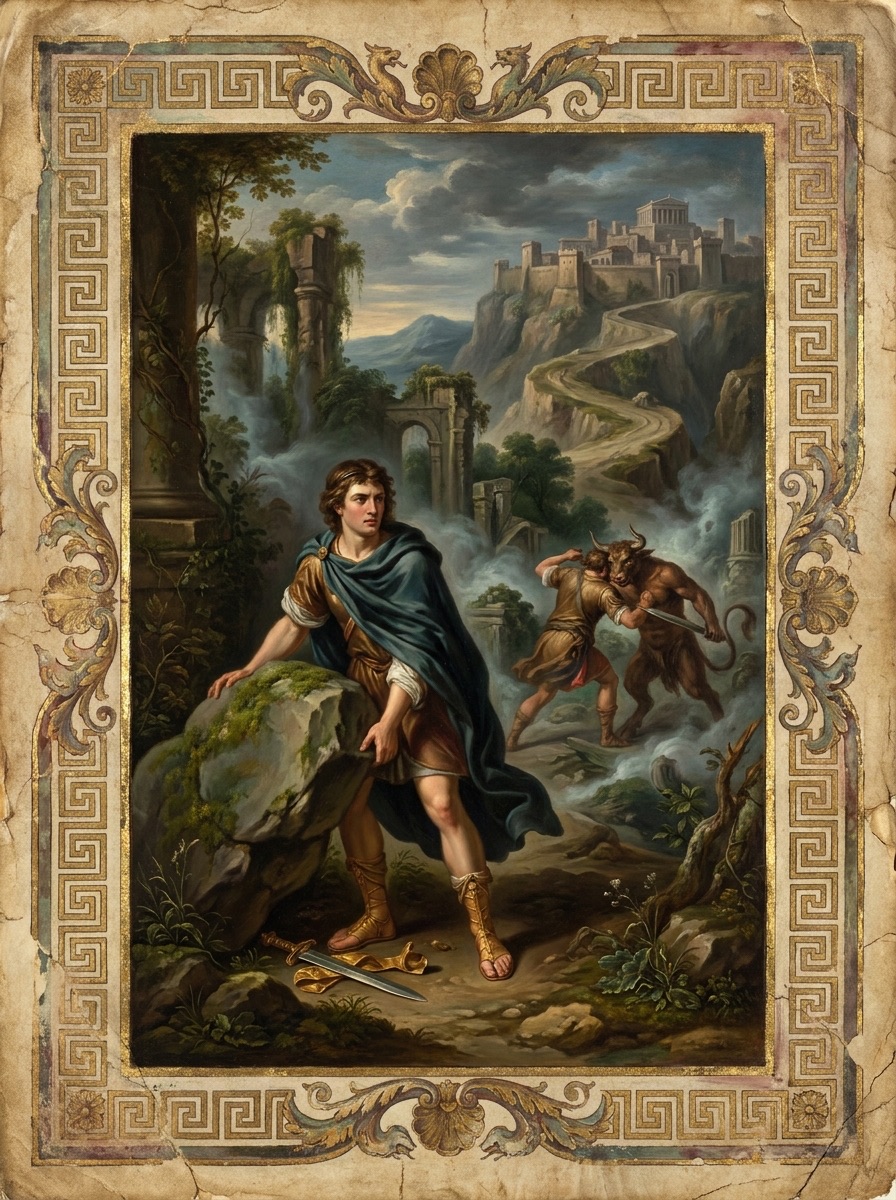
Theseus had already lifted the stone in Troezen and taken the sword and sandals left by Aegeus. His mother urged him to sail, but he chose the land road because it was full of men who preyed on travelers. If he meant to reach Athens as a hero and not merely as a hidden son, that road would prove him.
The Robber with the Bronze Club
On the first part of Theseus’ road, the sea was still in sight. Wind blew in from the water through the trees, and rocks and thickets lined the way. But the farther he went, the narrower the road became, and the fewer people he met. There were no city walls in those places to protect a traveler. Violent men hid in the woods, waiting for anyone who passed alone.
Before long he met the first of them. His name was Periphetes, though some called him the Club-Bearer. In his hands he carried a heavy bronze club, and with it he stopped travelers on the road. If they could not surrender enough money, he smashed their skulls; even if they gave him all they had, they were not always allowed to leave alive.
When Periphetes saw that Theseus was young and alone, he strode out to block the way. He struck the bronze club against the ground, and stones leapt beneath the blow.
“Leave what you carry,” he said, “and then I shall decide whether to let you go.”
Theseus did not step back. He looked at the bronze club and said, “That weapon suits you well. But if you use it only to frighten people, I fear it may have a new master today.”
Periphetes roared and swung the club at him. Theseus slipped aside, and the club crashed into the earth, splitting the ground. Before the robber could recover his balance, Theseus sprang forward and seized the shaft. They struggled in the road, dragging the club first one way and then the other. Periphetes was powerful but clumsy. Theseus was quicker. With a sudden turn he drove his shoulder into the robber, wrenched the club from him, and struck him down with his own weapon.
From that day on, Theseus carried the bronze club with him. It was the first spoil he had won on his journey, and it seemed to warn every enemy who came after: an instrument of cruelty could fall into the hands of one who punished the cruel.
The Man Torn by the Pines
Theseus went on and came near the Isthmus of Corinth. There the mountain road twisted among tall, dense pines. In that forest lived a robber named Sinis, whom people called the Pine-Bender. He did not merely steal from travelers; he murdered them in a manner of terrible cruelty.
Sinis had astonishing strength. He would seize the tops of two pine trees, bend them down to the ground, and bind a traveler’s hands and feet to them. Then he would let go. The trunks sprang upright, and the victim was torn apart in the air. Others said that he bent a single pine, tied a person to it, and let the tree fling him upward. Whatever the method, no one who fell into his hands came to a good end.
When Theseus entered the pine wood, he heard the branches hiss in the wind. Sinis stepped out from behind a tree and looked at him as though he were prey.
“Young man,” said Sinis, “you have come at the right time. I have a game that lacks only someone to try it.”
Theseus understood what he meant, but pretended not to. “What sort of game?”
Sinis smiled with pride. He reached up, took hold of a pine top, and slowly bent it down as if it were no more than a supple branch. He wanted Theseus to be afraid. But Theseus stepped closer, suddenly seized him around the waist, and the two crashed down beneath the tree. Dirt flew up, and pine needles scattered over the ground. Sinis was strong, but he was not as nimble in wrestling as Theseus. Finding his chance, Theseus pinned him, then used against him the very punishment he had used against others, binding him to the bent pine.
When the tree was released, Sinis died by his own torture.
From then on, one more shadow of terror was gone from the forest road. Theseus did not linger. He gathered his pack, passed through the pines, and continued northward.
The Sow of Crommyon
After leaving the isthmus, Theseus came to the region of Crommyon. The people there feared not only robbers, but a savage sow. The beast was huge and fierce. It rushed out from the woodland, ruined fields, killed livestock, and even bold hunters dared not come too near it. Some said the sow was connected with a wicked woman named Phaea; others simply called the monster Phaea itself.
When Theseus heard the villagers speak of it, he asked where it was usually seen. Someone urged him to take another road. “You have already passed through danger. Why risk your life for a wild beast?”
But Theseus thought that if he were traveling only for his own sake, he might indeed avoid it. Yet if the people here suffered from it day after day, he could not pretend he had not heard.
Taking the bronze club and his sword, he entered the scrub. The ground had been rooted up, and rough scrape marks scarred the bark of trees. After a while, from a low thicket came the sound of heavy breathing. When the sow burst out, mud still clung to its tusks, and the bristles along its back stood up like hard spikes.
Theseus sprang aside and let it charge past. The beast wheeled and rushed at him again with terrifying speed. He struck it hard across the head and neck with the bronze club, then, as it rolled and struggled, drew his sword and drove the blade home. The sow thrashed in the dust a few more times and at last lay still.
When the people of Crommyon heard that the monster was dead, they came out to see. Some lifted broken fences back into place; others pointed at the carcass and gave thanks that the danger was over. Theseus asked no reward from them. He washed the blood and dust from himself and went on toward Athens.
The Cliff by the Sea
Farther along, the road drew close to the sea. The cliffs were steep, and below them white waves broke upon the rocks. There lived a robber named Sciron, who often sat on a stone beside the path. He stopped travelers and ordered them to wash his feet. If they refused, he pushed them over the cliff at once. If they crouched down to obey, he kicked them into the sea while their heads were bowed.
Below the cliff, it was said, a monstrous sea turtle waited to devour those who fell. In time, anyone who heard the name of Sciron would rather take a long detour through the mountains than pass that way.
When Theseus came to the stone, Sciron was sitting there with his feet stretched into the middle of the road, looking idle and careless.
“Come here,” he said. “Wash my feet.”
Theseus glanced down at the waves below, then looked back at him. “Do you often make others do this?”
Sciron laughed. “They have all done it. Only after they finished, few of them were able to keep walking.”
Theseus understood. He came closer as though he meant to kneel, but suddenly seized Sciron by the ankle. Sciron started in alarm and tried to kick Theseus over first, but Theseus had already heaved him up from the stone. For a brief moment they struggled at the cliff’s edge, and loose pebbles rattled down into the sea. Then Theseus flung the robber over the same drop where he had sent so many others.
The waves soon swallowed Sciron’s cries. The road by the sea grew quiet again, with only the tide striking the rocks below.
The King in the Wrestling Ground
Theseus was now drawing nearer to Athens, and he came to the region around Eleusis. There lived a man named Cercyon, enormous in strength and cruel in heart. He forced travelers to wrestle with him. If anyone lost, Cercyon killed him on the spot. Many had no wish to compete at all, but were dragged into the wrestling ground and left dead in the dust.
When Cercyon saw Theseus, he gave the same command as always.
“Young man, wrestle with me. If you win, go on your way. If you lose, your life stays here.”
Theseus set down his pack and stepped into the ground. The onlookers stood at a distance, too afraid to speak. Cercyon was thick-bodied, with arms like heavy branches. At once he reached for Theseus’ shoulders, meaning to throw him by brute force. But Theseus did not meet strength with strength. He first stepped back half a pace, then closed in at the right instant, hooked a foot, twisted an arm, and threw Cercyon off balance.
The first time, Cercyon merely stumbled. The second, he grew angry. The third, Theseus caught him by the belt and wrist and hurled him hard to the ground. The earth gave a dull thud beneath him. Cercyon tried to rise, but Theseus gave him no chance and ended his life.
Only then did those who had been forced to watch dare to come closer. They saw the brutal man who had sent so many unwilling travelers to their deaths lying powerless on the ground, no longer able to give orders. Theseus lifted his pack again and went on, carrying the dust of the road with him.
Procrustes’ Iron Bed
On the last stretch of road to Athens lived one more robber, more sinister than the rest. His name was Procrustes, though some called him Damastes. He did not rush out with a club at first sight, as other robbers did. Instead he put on a show of hospitality and invited travelers into his house for the night.
Inside stood a bed. If a guest was longer than the bed, Procrustes cut off whatever hung over the edge. If a guest was shorter, he stretched the body by force until it matched the bed’s length. What seemed to be a place of rest was in truth an instrument of murder.
When Theseus reached that place, evening had fallen. Procrustes stood at his doorway and greeted him with a smile. “Young man, the road is long and tiring. Come in and rest for the night. I have a bed here, perfectly suited to travelers.”
Theseus saw that the house was kept too neatly, while old bloodstains marked a corner of the wall. He did not expose the man at once, but followed him inside and asked, “Can your bed truly fit every guest?”
“Of course,” said Procrustes. “If it does not fit, I make it fit.”
Theseus nodded. Then he turned suddenly, seized Procrustes, and forced him down upon the bed. Procrustes struggled and shouted, reaching for a knife hidden nearby. Theseus took the knife from him, and in the same manner Procrustes had used upon travelers, he made him meet the end prepared by his own bed.
That night, the last villain on the road fell. Theseus washed his hands outside the house. In the distance he could already see the roads leading into Athens, and the lights of the city shone like scattered stars in the dark.
Athens Ahead
When Theseus had left Troezen, he carried only the sword taken from beneath the stone, the sandals his father had left, and a heart eager to find its parent. By the time he came near Athens, the bronze club rested on his shoulder, and behind him lay a chain of roads made safe: Periphetes no longer committed murder, the pines of Sinis no longer hoisted travelers into the air, the beast of Crommyon lay dead, Sciron’s cliff was free of screams, Cercyon’s wrestling ground was silent, and the iron bed of Procrustes could kill no more.
He did not come to Athens unnoticed. News had already traveled ahead of him: a young man had walked all the way from the Peloponnese, refusing the ship, refusing the detour, choosing the very places where robbers ruled. One by one, those whose names had once terrified travelers had died by the cruel methods they themselves had used.
When Theseus entered Athens, he did not yet know that a new danger was waiting beside his father. But on this journey to seek Aegeus, he had already made many people remember his name. The sword hidden beneath the stone was no longer only a token of recognition. Together with the dust of the road, the mountain tracks, and the sea cliffs he had crossed, it proved that Theseus was worthy to stand before Aegeus, king of Athens.