Greek Mythology
Theseus in Athens — Greek Mythology
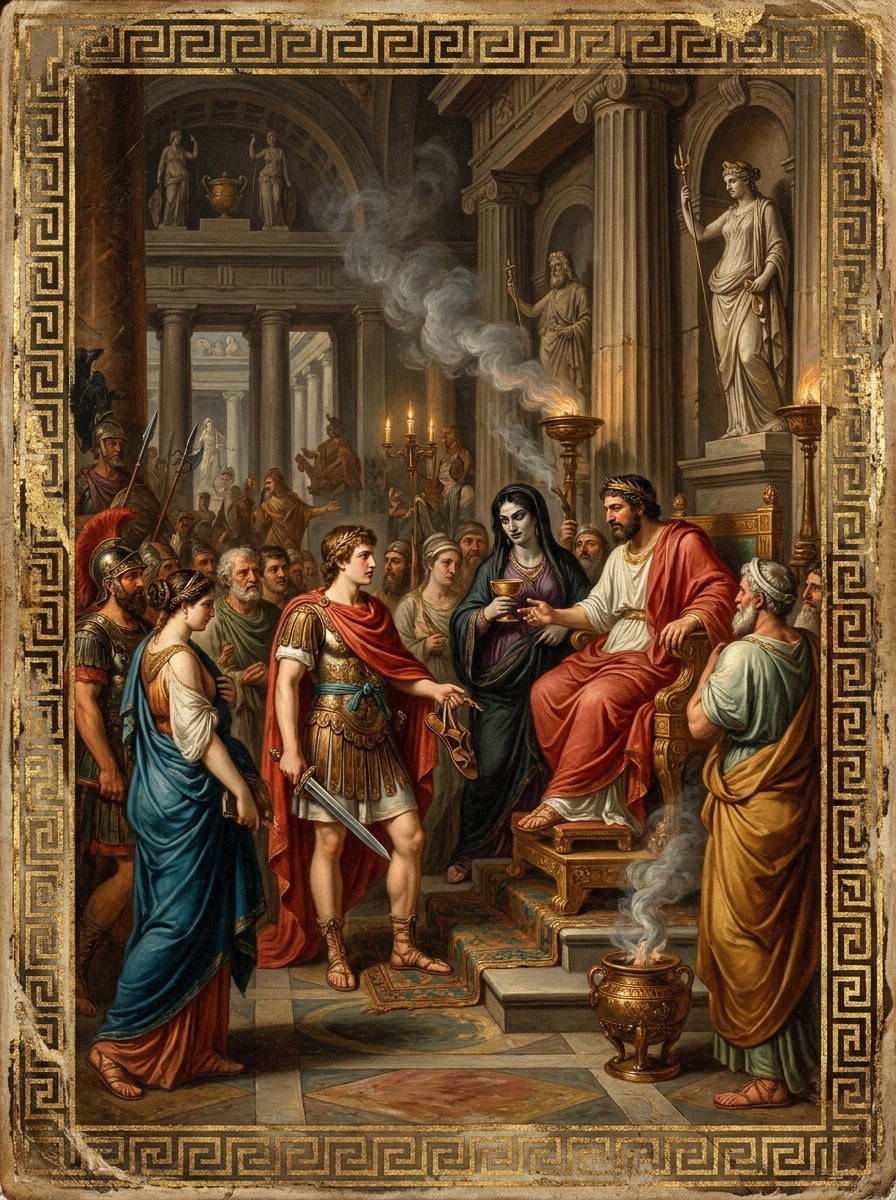
Theseus arrives in Athens as an unnamed stranger. Medea recognizes the danger he poses, prepares poison, and Aegeus only saves his son when he sees the tokens he once hid beneath the stone.
Article
Summary
Theseus reaches Athens after clearing the road, but he does not reveal his name at once. The palace is already tense: Aegeus is old, rival claimants watch the throne, and Medea quickly guesses that the stranger may be the hidden heir. Her poisoned cup nearly kills him before the sword and sandals reveal him to his father.
The Stranger at the Palace Door
By the time Theseus reached Athens, the road behind him had already made his name travel ahead of him. Yet inside the city he did not announce himself as Aegeus’s son. He entered the palace as a stranger carrying old tokens, while the old king sat among rivals, rumors, and the watchful eyes of Medea.
Medea’s Poisoned Cup
Medea heard of the visitor before long.
She was quicker than the others to suspect him. A young man from the direction of Troezen, of exactly the right age, already famed for what he had done on the road—if he was no ordinary traveler, why should he come to the palace at all? Medea did not need anyone to tell her the answer. She guessed that this stranger was likely Aegeus’s hidden son.
She did not expose him at once. Instead, she approached Aegeus with smooth urgency and said, “A stranger has come into the city, and no one knows where he comes from. Have you heard the rumors outside? He may not be a hero at all, but a man with some other design. Your nephews are already restless enough. If you let a powerful unknown youth into the palace, who can say what will happen?”
Aegeus had always been suspicious by nature. Once Medea spoke of plots, of the throne, and of a foreign young man, his thoughts went into confusion. She then proposed a solution: receive the guest at a banquet, honor him publicly, and slip poison into his wine. That way, no alarm would be raised in the city, and no open fight would be needed.
The old king fell silent. He did not know that the young man was his own son. Years before, when he had left Troezen, he had indeed hidden a sword and sandals beneath a stone, but so many years had passed that he had never seen what the child had become, or even whether he lived. Now, suddenly, a stranger of rising fame stood before him, and fear and doubt overcame him. In the end he nodded to Medea’s plan.
The banquet was soon prepared. There was meat, bread, and wine in shining cups. Servants moved to and fro through the palace, and the firelight touched the bronze vessels and Medea’s untroubled face.
Theseus was brought to the table. He saw the king at the head of the hall, older now, his brow lined with worry. There before him sat the man who was his father, yet he could not throw himself upon him at once. If the king did not believe him, and if the others grew suspicious, matters could only be made worse. So he sat like any honored guest, spoke carefully, and waited for the right moment.
Medea watched him all the while. She had already put the poison into the cup and now waited only for it to be handed to Theseus.
At last the cup was brought to him.
Theseus took it, but did not drink. He knew he must first show Aegeus the tokens. So, as though merely reaching for his knife to carve meat, he slowly drew the sword at his side. The blade slid from its sheath, and in the firelight the hilt shone.
Aegeus froze.
He knew that sword. It was no common weapon, but the one he himself had left beneath the stone in Troezen. Then he saw the sandals as well. Memory came rushing back at once: the shore, Troezen, Aethra, the great stone, and the words he had spoken before leaving.
The cup was already at Theseus’s lips.
Aegeus sprang up and struck it from his hand. Wine and poison spilled across the floor, and the cup rolled away while everyone at the feast stood stunned. The old king forgot all else, rushed to the young man, and cried out that this was no enemy, but his son.
Only then did Theseus kneel and tell him how he had lifted the stone, taken up the sword and sandals, and come from Troezen to Athens. Aegeus was half overwhelmed, half overjoyed, and clung to him as though he could not let him go. The fear of long years turned in an instant to happiness, though danger still lay close beside it: had he recognized the youth a heartbeat later, his own son would have died at the banquet he had himself ordered.
Medea knew the game was lost. She could no longer remain. In the confusion she fled with her own son. Some say she drove away in a chariot drawn by dragons; others say she simply escaped the palace and vanished into the distance. However it was done, her power in Athens was at an end.
After Father and Son Are Reunited
Aegeus now acknowledged Theseus publicly and brought him before the people of Athens. Only then did the city learn that the young man who had cleared the roads of evil-doers was the king’s own son.
Many rejoiced. Athens needed an heir who was strong, brave, and able to lift a weapon in the city’s defense. Theseus’s fame had already traveled ahead of him on the tongues of merchants and travelers, and now that fame stood beside the king himself. The people felt that Athens had gained a new support.
But the sons of Pallas were angered when they heard the news.
They had believed that Aegeus would never have a son to acknowledge, and that the throne would one day come to them. Now Theseus had appeared, bearing the tokens, the king’s recognition, and a reputation earned along the road. They were unwilling to yield. So they gathered their kinsmen and followers and began to plan an attack, hoping to strike before Theseus had firmly settled himself.
They were many, and they trusted in their numbers. Their plan was to move against Athens from two sides: one group would attack openly and draw the city’s attention, while the other would circle around and lie hidden, ready to spring out when the city was in confusion. They thought that with such a scheme they could kill Theseus and frighten the aging Aegeus into submission.
But the plot did not stay hidden.
A man named Leos revealed their plan to Theseus. Theseus did not wait indoors for the enemy to arrive. He put on his armor, took trusted men with him, and went out quietly to meet the hidden force first.
Whether by night or through the thin mist of morning, the road was still and dim. The sons of Pallas thought themselves well concealed. They waited for the signal, expecting their companions to throw the city into chaos. Instead, they heard not their allies’ cries, but the sudden rush of Theseus and his men. The ambush broke before it could form. Theseus led the charge himself, as decisively as he had once dealt with the robbers on the mountain roads.
With the hidden force shattered, the open attack lost all heart as well. The sons of Pallas saw their design collapse. Some were slain, others fled, and those who had hoped to seize the kingship while the old king was weak now dared no longer make light of the young prince.
The Bull of Marathon
Yet Theseus would not stand firmly in Athens by blood and victory alone.
In the region of Marathon there was a fierce bull that roamed the land, trampling fields, scattering flocks, and keeping the farmers from working in peace. Different tales were told of where it had come from. Some said it had once arrived from Crete; others linked it with one of Heracles’s labors. To the people of Athens, though, the important thing was not its origin, but the ruin it was causing in their own countryside.
When Theseus heard of it, he decided to subdue the beast himself.
He did not hand the matter to another man. At daybreak he left the city and went out toward the fields of Marathon. There he found flattened crops, broken fences, and frightened herdsmen who pointed him toward the bull’s path. The wind moved over the plain, and dust rolled low across the ground. Then, from between scrub and waste ground, came the heavy beat of hooves. The bull charged out with its head down, its horns aimed straight ahead.
Theseus did not run. He judged the beast’s charge, slipped aside, and closed in again when it turned. The bull was huge, snorting hot breath, tearing at the earth with its feet, trying to smash the young man to the ground. Time after time Theseus avoided its horns, and at last he seized the chance to cast a rope around it and bring all his strength to bear. Man and bull strained together in the dust while the onlookers watched from a distance, afraid to come near. In the end the bull was mastered and forced to lower its head.
Theseus led it back to Athens. The people poured out to the roadside when they saw him returning with the very beast that had terrorized their fields. Afterward he offered the bull to Apollo. The flames rose at the altar, the blood flowed, and the fear in the hearts of the people ebbed away with it.
From that time on, Theseus was no longer only “Aegeus’s son.” The Athenians had seen for themselves that he could pierce a palace plot, defeat relatives who sought the throne, and go out into the fields to rid the people of danger. He came to stand on Athenian soil with the sword that had traveled from Troezen, and with it his true place in the city was made plain.
Aegeus watched his son from the palace and felt both joy and a great weight lift from him at last. The stone that had once hidden the sword and sandals had waited for the boy to grow; now the boy had come to his father and to the people of Athens. For the moment the city was at peace, and the name of Theseus began to bind itself to Athens forever.