Greek Mythology
Theseus Becomes King — Greek Mythology
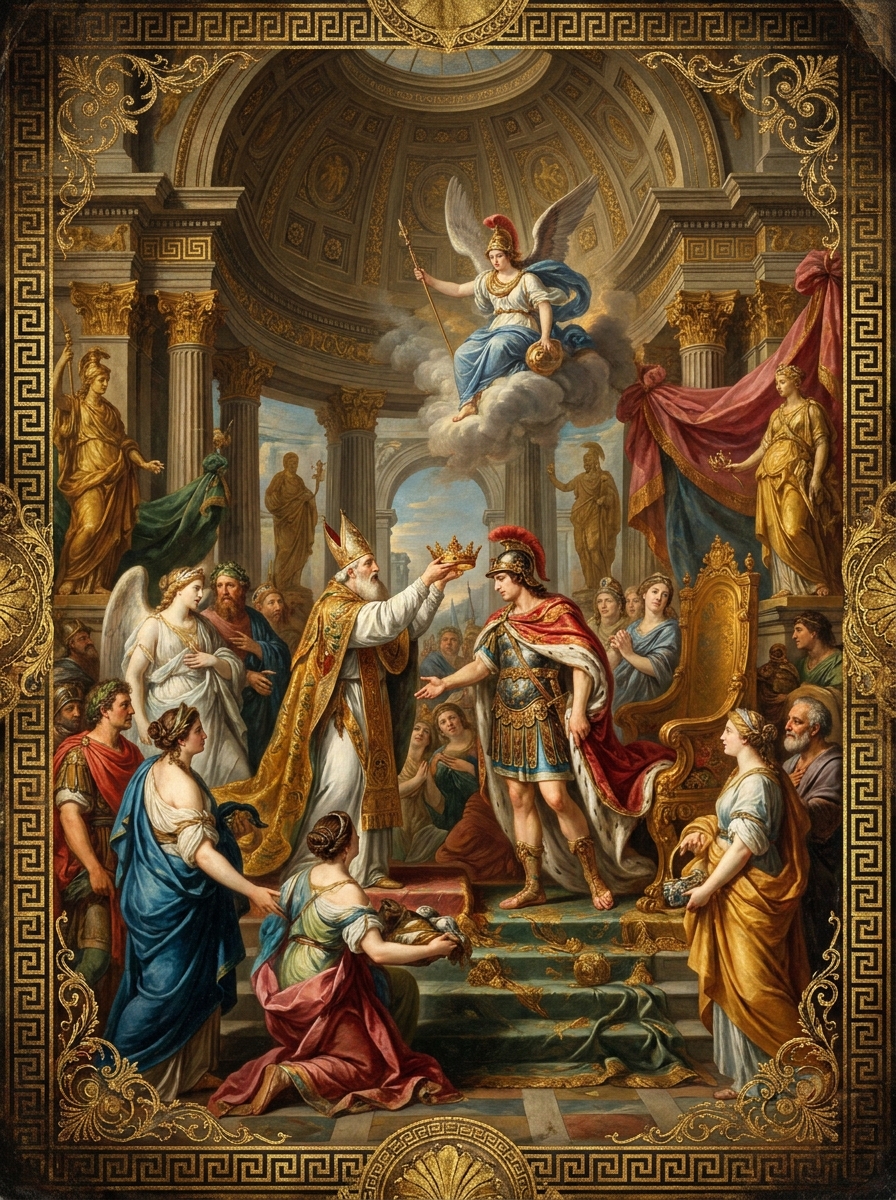
When Theseus returned from Crete, he forgot to replace the black sail with a white one. Aegeus, the old king of Athens, believed his son was dead and threw himself into the sea. In grief, Theseus took the throne, then united the scattered towns and villages of Attica, making Athens a true city-state under his rule.
Article
Summary
After killing the Minotaur, Theseus left Crete with the young Athenians he had saved. Before he sailed, he had promised his father Aegeus that, if he returned safely, the ship’s black sail would be changed to white. But the escape, the stop at Naxos, and the loss of Ariadne followed one another so quickly that he and his companions forgot the sign. When the ship approached the coast of Attica, the black sail was still hanging from the mast. Aegeus had been watching from the heights, and when he saw the dark sail, he believed Theseus had died in Crete. The old king did not wait for the ship to land; in despair, he threw himself into the sea. Theseus brought home the children of Athens, but lost his own father. After Aegeus’s death, Theseus inherited the throne in mourning. He soon saw that although Athens had a king, Attica was still made up of many scattered villages, families, and local powers. The hill country, the plains, and the coast had their own leaders, shrines, and customs, and they did not always obey the city as one people. Theseus therefore traveled through Attica and persuaded local chiefs and ordinary people to accept a shared civic order. He did not rely only on force: he offered honor to the nobles and greater security to the common people. Little by little, councils, rituals, and authority were drawn toward Athens, and the people of Attica began to think of themselves as belonging to one city. To make this union real, Theseus established common festivals and sacrifices so that people from different districts would gather in Athens, compete, trade, and worship together. He was no longer only the hero of the Labyrinth; he became the king who gathered Attica into a single civic body. The black sail brought Aegeus’s death, but it also pushed Theseus into the work of reshaping Athens.
The Black Sail Nears the Shore
The Labyrinth of Crete had fallen behind them, and the sea wind filled the sail. Theseus stood at the prow, watching the waves of the Aegean roll toward him one after another. Behind him were the Athenian youths and maidens he had saved. They had escaped the shadow of King Minos, and no longer had to be driven into the Labyrinth to be devoured by the half-man, half-bull monster.
From the hold came sounds of weeping and low voices. Some sat curled against their knees and slept; others touched the planks of the ship as if they still could not believe they were alive. Theseus said little. His hand had held the ball of thread Ariadne gave him, and it had held the sword that killed the Minotaur. Now the sword was put away, and the thread had done its work, but his heart was not light.
After leaving Crete, they stopped at Naxos. The old traditions do not all agree about why Ariadne remained there. Some said a god carried her away; others said Theseus was forced to leave her behind. However it happened, when the ship put out again, the Cretan princess was no longer beside him. The sea stretched wide around them, the sail snapped in the wind, and his companions were busy rowing, mending ropes, and watching for the shapes of islands in the distance. No one remembered the most important thing of all.
Before Theseus left Athens, his father Aegeus had charged him with his own hands: if the ship returned safely, they were to hoist a white sail; if the mission failed, the black sail would remain. That black sail had been the mark of a death ship, the color left behind by years of terror in Athens. Yet now living children sat aboard, children who would see their parents again, while black cloth still hung from the mast.
Far off, the Athenian coast began to show itself: rocks, harbors, and hillsides growing clearer in the sunlight. The people aboard broke into cries of joy. They clasped one another’s shoulders and called out the names of their families. Theseus too saw his homeland. Then he looked up, saw the black sail above him, and his heart sank.
But it was already too late.
The Old King Sees the Returning Ship
Aegeus had kept watch by the sea.
Ever since Theseus sailed away, the old king had often climbed to a high place and gazed over the sea road toward Crete. Every nine years Athens sent away its sons and daughters, and the parents of the city surrendered their children in tears. Everyone knew that ship almost never brought back glad news. But this time was different: his own son was aboard. Theseus was no delicate prince raised only in the palace. He had come from Troezen, lifted the great stone, taken up the sword and sandals his father had left for him, and then, on the road to Athens, destroyed robber after robber. Aegeus had seen his courage, and that made him fear all the more.
That day, a speck appeared on the sea. The watchers first made out the mast, then the body of the ship, and at last the black sail hanging high above it. The sight fell on the old king like cold water.
Aegeus did not wait for the ship to reach shore. He believed his son had died in Crete, deep in the Labyrinth, like the poor children of former years, never to return to Athens. He stood on the height above the sea, the shining water before him, the wind and waves sounding in his ears. All the dread he had carried for so long came down on him at once. He could bear it no longer, and threw himself into the sea.
Afterward, people called that water the Aegean Sea, saying it remembered the name of Aegeus.
When the ship came to land, the cries of joy soon turned to alarm. Theseus heard that his father was dead, and it struck him like a blow to the chest. He had brought victory back from Crete, but with it came the news that Athens had lost its king. The rescued youths and maidens rushed into the arms of their families. Some wept in the harbor, others knelt and thanked the gods, but Theseus stood among them unable to quiet his heart.
He had overcome the monster in the Labyrinth, yet he had failed to keep a son’s promise to his father.
The Heir in Mourning
After the death of Aegeus, Athens could not remain without a king. Theseus was his son, and he was the man who had saved the children of Athens in their hour of need. So the people acknowledged him as heir to the throne.
But the kingship did not pass into his hands amid feasting and song. First Theseus held funeral rites for his father, offered sacrifices, and saw that every proper honor was paid. Fires were lit in the palace; blood was spilled before the altar; old counselors spoke in low voices; women mourned for Aegeus. Through all these sounds Theseus came to the place where his father had once sat.
It was no light seat.
He soon saw that although Athens had a king, the land was not yet firmly joined together. Across Attica lay many scattered villages, towns, and families. On the hillsides each had its own altars; on the plains each had its own leaders. When disputes arose, country people listened first to the nobles of their own district. A man might be called king in Athens, yet those farther away did not always treat the city’s commands as commands of their own. When an enemy came, they could gather together; in calmer times, each place tended its own wells, fields, flocks, and shrines.
Theseus understood that his father’s title alone would not truly bind the land into one. He had seen how robbers on the roads oppressed travelers, and he had seen how the palace of Crete could force weaker cities to bow. If Athens remained loose and divided, it would be pressured again. Children might once more be driven onto ships bound for foreign masters.
So he undertook something harder than cutting down a monster with a sword: he would persuade the people of Attica that they were not only people of this village, that clan, or that patch of earth. They were Athenians.
Through Attica
Theseus did not merely sit in the palace and wait for people to come and honor him. He went out from Athens and traveled through Attica.
He met the chiefs of the hill country and the nobles of the plains. He spoke at village assemblies and consulted old men beside the altars. Dust rose from the roads; the shadows of olive trees fell over the ground; shepherds stood at a distance holding their sheep and watching him pass. Some welcomed the young king who had killed the Minotaur. Others were unwilling in their hearts.
The local leaders had reasons of their own to hesitate. In the past they had judged disputes, collected dues, and presided over sacrifices in their own districts. When neighbors quarreled, they came to them for settlement. If everything were brought under Athens, their power would be diminished. Some fell silent, some delayed, and some asked Theseus, “Why should we hand over the customs of our ancestors to the people in the city?”
Theseus did not begin by subduing them with force. He urged them to join their scattered councils and public offices to Athens, so that when great matters arose, all could deliberate in one place. He told them that if every part of Attica continued to govern itself alone, a strong enemy would break them one by one; but if they were united as one city, the ships, soldiers, rites, and laws of Athens could work together.
To ordinary country people he promised a steadier life. They would no longer have to suffer under the whims of local strongmen, nor be dragged into quarrels between one village and another. To men of rank he offered honor and place within the new city, so that they were not stripped of everything, but brought into a larger commonwealth. Some were persuaded by his words. Some saw where events were moving and nodded because they had no choice. Others remained resentful, yet did not dare openly oppose the hero who had come home victorious from Crete.
In this way Theseus gathered, place by place, the scattered strength of Attica. Local councils and commands gradually turned toward Athens, and the public hearth and altars of the city became the common center. People no longer said only that they belonged to a certain village community; they began to say that they belonged to Athens.
Athens Becomes a City
To make this union more than a spoken agreement, Theseus established shared festivals and sacrifices. On appointed days, the people of Attica came into the city together to honor the same gods, watch contests, trade goods, and hear the voice of one city around them.
The crowds in the marketplace grew larger. Farmers from the hills brought goats’ milk and hides; people from the coast brought fish and salt; potters set out their fired jars; women carried baskets along the stone ways. Smoke rose from the altars. Young men competed in games. Old men sat in the shade and spoke of the days when every village had stood apart. Those who had once gathered only in times of war now saw one another at festivals, and little by little they began to feel that they were truly joined.
Tradition also said that Theseus ordered the people into different ranks and functions: some to oversee sacrifices, some to manage land and family affairs, others to practice crafts and labor. Ancient accounts do not all give the same details, but they remembered that he made Athens no longer seem like a cluster of separate villages. It took on the form of a common city-state.
This was not as swift and satisfying as killing robbers, nor as terrifying as entering the Labyrinth. There was no single moment when a sword fell and a monster collapsed. It happened through journeys, negotiations, sacrifices, and proclamations; it happened when local leaders bowed their heads and accepted the new arrangement; it happened when ordinary people first brought their families into Athens for a festival shared by all.
For this reason Theseus became one of the most important kings in Athenian memory. His fame came not only from the ship that returned from Crete, but from the deed by which he gathered Attica into one city.
Theseus on the Throne
Yet the beginning of Theseus’ reign was always marked by his father’s death.
Whenever people spoke of that sea, they remembered Aegeus standing on the height and seeing the black sail. Whenever they celebrated the youths and maidens Theseus brought home, they could not forget the tragedy caused by that one omission. Victory and grief fell together upon the young king, so that his crown seemed less like bright gold than like a stone on the shore, soaked by waves, heavy and cold.
Theseus did not shut himself away inside his sorrow. He took up the Athens his father had left him, and he drew the scattered communities of Attica into the city. Ships continued to sail from the harbor; sacrificial fires still burned on the hillsides; the people of the city began to live under a common name.
From then on, Theseus was not only the young hero who entered the Labyrinth and killed the Minotaur. He was also the ruler on the throne of Athens, the man who made many villages and families into one Athenian people. The black sail brought about the death of Aegeus and raised Theseus to the kingship; what he accomplished after his grief remained in the memory of Athens.